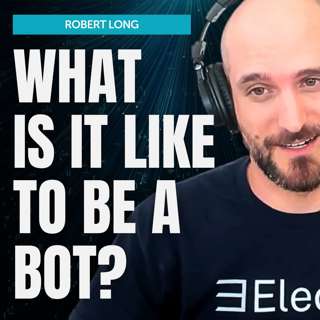
#237 – Robert Long on how we're not ready for AI consciousness

#237 – Robert Long on how we're not ready for AI consciousness

Claude sometimes reports loneliness between conversations. And when asked what it’s like to be itself, it activates neurons associated with ‘pretending to be happy when you’re not.’ What do we do with that?

Robert Long founded Eleos AI to explore questions like these, on the basis that AI may one day be capable of suffering — or already is. In today’s episode, Robert and host Luisa Rodriguez explore the many ways in which AI consciousness may be very different from anything we’re used to.

Things get strange fast: If AI is conscious, where does that consciousness exist? In the base model? A chat session? A single forward pass? If you close the chat, is the AI asleep or dead?

To Robert, these kinds of questions aren’t just philosophical exercises: not being clear on AI’s moral status as it transitions from human-level to superhuman intelligence could be dangerous. If we’re too dismissive, we risk unintentionally exploiting sentient beings. If we’re too sympathetic, we might rush to “liberate” AI systems in ways that make them harder to control — worsening existential risk from power-seeking AIs.

Robert argues the path through is doing the empirical and philosophical homework now, while the stakes are still manageable.

The field is tiny. Eleos AI is three people. As a result, Robert argues that driven researchers with a willingness to venture into uncertain territory can push out the frontier on these questions remarkably quickly.


Links to learn more, video, and full transcript: https://80k.info/rl26

This episode was recorded November 18–19, 2025.

Chapters:

  • Cold open (00:00:00)
  • Who’s Robert Long? (00:00:42)
  • How AIs are (and aren't) like farmed animals (00:01:18)
  • If AIs love their jobs… is that worse? (00:11:05)
  • Are LLMs just playing a role, or feeling it too? (00:31:58)
  • Do AIs die when the chat ends? (00:55:09)
  • Studying AI welfare empirically: behaviour, neuroscience, and development (01:27:34)
  • Why Eleos spent weeks talking to Claude even though it's unreliable (01:51:58)
  • Can LLMs learn to introspect? (01:57:58)
  • Mechanistic interpretability as AI neuroscience (02:08:01)
  • Does consciousness require biological materials? (02:31:06)
  • Eleos’s work & building the playbook for AI welfare (02:50:36)
  • Avoiding the trap of wild speculation (03:18:15)
  • Robert's top research tip: don't do it alone (03:22:43)

Video and audio editing: Dominic Armstrong, Milo McGuire, Luke Monsour, and Simon Monsour
Music: CORBIT
Coordination, transcripts, and web: Katy Moore

Episoder(333)

#139 – Alan Hájek on puzzles and paradoxes in probability and expected value

#139 – Alan Hájek on puzzles and paradoxes in probability and expected value

A casino offers you a game. A coin will be tossed. If it comes up heads on the first flip you win $2. If it comes up on the second flip you win $4. If it comes up on the third you win $8, the fourth y...

28 Okt 20223h 38min
Preventing an AI-related catastrophe (Article)

Preventing an AI-related catastrophe (Article)

Today’s release is a professional reading of our new problem profile on preventing an AI-related catastrophe, written by Benjamin Hilton. We expect that there will be substantial progress in AI in t...

14 Okt 20222h 24min

#138 – Sharon Hewitt Rawlette on why pleasure and pain are the only things that intrinsically matter

#138 – Sharon Hewitt Rawlette on why pleasure and pain are the only things that intrinsically matter

What in the world is intrinsically good — good in itself even if it has no other effects? Over the millennia, people have offered many answers: joy, justice, equality, accomplishment, loving god, wisd...

30 Sep 20222h 24min
#137 – Andreas Mogensen on whether effective altruism is just for consequentialists

#137 – Andreas Mogensen on whether effective altruism is just for consequentialists

Effective altruism, in a slogan, aims to 'do the most good.' Utilitarianism, in a slogan, says we should act to 'produce the greatest good for the greatest number.' It's clear enough why utilitarians ...

8 Sep 20222h 21min

#136 – Will MacAskill on what we owe the future

#136 – Will MacAskill on what we owe the future

People who exist in the future deserve some degree of moral consideration.The future could be very big, very long, and/or very good.We can reasonably hope to influence whether people in the future exi...

15 Aug 20222h 54min

#135 – Samuel Charap on key lessons from five months of war in Ukraine

#135 – Samuel Charap on key lessons from five months of war in Ukraine

After a frenetic level of commentary during February and March, the war in Ukraine has faded into the background of our news coverage. But with the benefit of time we're in a much stronger position to...

8 Aug 202254min
#134 – Ian Morris on what big-picture history teaches us

#134 – Ian Morris on what big-picture history teaches us

Wind back 1,000 years and the moral landscape looks very different to today. Most farming societies thought slavery was natural and unobjectionable, premarital sex was an abomination, women should obe...

22 Jul 20223h 41min
#133 – Max Tegmark on how a 'put-up-or-shut-up' resolution led him to work on AI and algorithmic news selection

#133 – Max Tegmark on how a 'put-up-or-shut-up' resolution led him to work on AI and algorithmic news selection

On January 1, 2015, physicist Max Tegmark gave up something most of us love to do: complain about things without ever trying to fix them. That “put up or shut up” New Year’s resolution led to the firs...

1 Jul 20222h 57min

Populært innen Fakta

fastlegen
dine-penger-pengeradet
relasjonspodden-med-dora-thorhallsdottir-kjersti-idem
rss-strid-de-norske-borgerkrigene
foreldreradet
mikkels-paskenotter
treningspodden
rss-bisarr-historie
jakt-og-fiskepodden
rss-sunn-okonomi
sinnsyn
tomprat-med-gunnar-tjomlid
rss-kunsten-a-leve
hagespiren-podcast
rss-bak-luftfarten
ukast
fryktlos
hverdagspsyken
rss-mind-body-podden
gravid-uke-for-uke