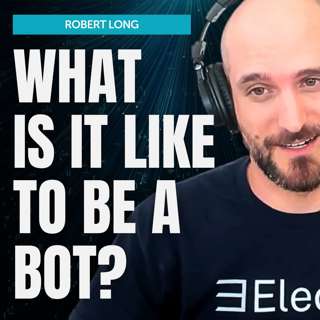

#237 – Robert Long on how we're not ready for AI consciousness

#237 – Robert Long on how we're not ready for AI consciousness

Claude sometimes reports loneliness between conversations. And when asked what it’s like to be itself, it activates neurons associated with ‘pretending to be happy when you’re not.’ What do we do with that?

Robert Long founded Eleos AI to explore questions like these, on the basis that AI may one day be capable of suffering — or already is. In today’s episode, Robert and host Luisa Rodriguez explore the many ways in which AI consciousness may be very different from anything we’re used to.

Things get strange fast: If AI is conscious, where does that consciousness exist? In the base model? A chat session? A single forward pass? If you close the chat, is the AI asleep or dead?

To Robert, these kinds of questions aren’t just philosophical exercises: not being clear on AI’s moral status as it transitions from human-level to superhuman intelligence could be dangerous. If we’re too dismissive, we risk unintentionally exploiting sentient beings. If we’re too sympathetic, we might rush to “liberate” AI systems in ways that make them harder to control — worsening existential risk from power-seeking AIs.

Robert argues the path through is doing the empirical and philosophical homework now, while the stakes are still manageable.

The field is tiny. Eleos AI is three people. As a result, Robert argues that driven researchers with a willingness to venture into uncertain territory can push out the frontier on these questions remarkably quickly.


Links to learn more, video, and full transcript: https://80k.info/rl26

This episode was recorded November 18–19, 2025.

Chapters:

  • Cold open (00:00:00)
  • Who’s Robert Long? (00:00:42)
  • How AIs are (and aren't) like farmed animals (00:01:18)
  • If AIs love their jobs… is that worse? (00:11:05)
  • Are LLMs just playing a role, or feeling it too? (00:31:58)
  • Do AIs die when the chat ends? (00:55:09)
  • Studying AI welfare empirically: behaviour, neuroscience, and development (01:27:34)
  • Why Eleos spent weeks talking to Claude even though it's unreliable (01:51:58)
  • Can LLMs learn to introspect? (01:57:58)
  • Mechanistic interpretability as AI neuroscience (02:08:01)
  • Does consciousness require biological materials? (02:31:06)
  • Eleos’s work & building the playbook for AI welfare (02:50:36)
  • Avoiding the trap of wild speculation (03:18:15)
  • Robert's top research tip: don't do it alone (03:22:43)

Video and audio editing: Dominic Armstrong, Milo McGuire, Luke Monsour, and Simon Monsour
Music: CORBIT
Coordination, transcripts, and web: Katy Moore

Episoder(333)

#79 – A.J. Jacobs on radical honesty, following the whole Bible, and reframing global problems as puzzles

#79 – A.J. Jacobs on radical honesty, following the whole Bible, and reframing global problems as puzzles

Today’s guest, New York Times bestselling author A.J. Jacobs, always hated Judge Judy. But after he found out that she was his seventh cousin, he thought, "You know what? She's not so bad." Hijacking ...

1 Jun 20202h 38min

#78 – Danny Hernandez on forecasting and the drivers of AI progress

#78 – Danny Hernandez on forecasting and the drivers of AI progress

Companies use about 300,000 times more computation training the best AI systems today than they did in 2012 and algorithmic innovations have also made them 25 times more efficient at the same tasks.Th...

22 Mai 20202h 11min
#77 – Marc Lipsitch on whether we're winning or losing against COVID-19

#77 – Marc Lipsitch on whether we're winning or losing against COVID-19

In March Professor Marc Lipsitch — Director of Harvard's Center for Communicable Disease Dynamics — abruptly found himself a global celebrity, his social media following growing 40-fold and journalist...

18 Mai 20201h 37min

Article: Ways people trying to do good accidentally make things worse, and how to avoid them

Article: Ways people trying to do good accidentally make things worse, and how to avoid them

Today’s release is the second experiment in making audio versions of our articles. The first was a narration of Greg Lewis’ terrific problem profile on ‘Reducing global catastrophic biological risks...

12 Mai 202026min
#76 – Tara Kirk Sell on misinformation, who's done well and badly, & what to reopen first

#76 – Tara Kirk Sell on misinformation, who's done well and badly, & what to reopen first

Amid a rising COVID-19 death toll, and looming economic disaster, we’ve been looking for good news — and one thing we're especially thankful for is the Johns Hopkins Center for Health Security (CHS). ...

8 Mai 20201h 53min

#75 – Michelle Hutchinson on what people most often ask 80,000 Hours

#75 – Michelle Hutchinson on what people most often ask 80,000 Hours

Since it was founded, 80,000 Hours has done one-on-one calls to supplement our online content and offer more personalised advice. We try to help people get clear on their most plausible paths, the key...

28 Apr 20202h 13min

#74 – Dr Greg Lewis on COVID-19 & catastrophic biological risks

#74 – Dr Greg Lewis on COVID-19 & catastrophic biological risks

Our lives currently revolve around the global emergency of COVID-19; you’re probably reading this while confined to your house, as the death toll from the worst pandemic since 1918 continues to rise. ...

17 Apr 20202h 37min

Article: Reducing global catastrophic biological risks

Article: Reducing global catastrophic biological risks

In a few days we'll be putting out a conversation with Dr Greg Lewis, who studies how to prevent global catastrophic biological risks at Oxford's Future of Humanity Institute. Greg also wrote a new ...

15 Apr 20201h 4min

Populært innen Fakta

fastlegen
dine-penger-pengeradet
relasjonspodden-med-dora-thorhallsdottir-kjersti-idem
foreldreradet
treningspodden
rss-strid-de-norske-borgerkrigene
mikkels-paskenotter
rss-bisarr-historie
jakt-og-fiskepodden
sinnsyn
rss-kunsten-a-leve
rss-sunn-okonomi
hverdagspsyken
tomprat-med-gunnar-tjomlid
rss-bak-luftfarten
ukast
fryktlos
gravid-uke-for-uke
lederskap-nhhs-podkast-om-ledelse
rss-kull