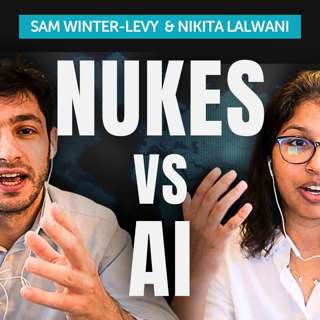
#238 – Sam Winter-Levy and Nikita Lalwani on how AGI won't end mutually assured destruction (probably)

#238 – Sam Winter-Levy and Nikita Lalwani on how AGI won't end mutually assured destruction (probably)

How AI interacts with nuclear deterrence may be the single most important question in geopolitics — one that may define the stakes of today’s AI race. Nuclear deterrence rests on a state’s capacity to respond to a nuclear attack with a devastating nuclear strike of its own. But some theorists think that sophisticated AI could eliminate this capability — for example, by locating and destroying all of an adversary’s nuclear weapons simultaneously, by disabling command-and-control networks, or by enhancing missile defence systems. If they are right, whichever country got those capabilities first could wield unprecedented coercive power.

Today’s guests — Nikita Lalwani and Sam Winter-Levy of the Carnegie Endowment for International Peace — assess how advances in AI might threaten nuclear deterrence:

  • Would AI be able to locate nuclear submarines hiding in a vast, opaque ocean?
  • Would road-mobile launchers still be able to hide in tunnels and under netting?
  • Would missile defence become so accurate that the United States could be protected under something like Israel’s Iron Dome?
  • Can we imagine an AI cybersecurity breakthrough that would allow countries to infiltrate their rivals’ nuclear command-and-control networks?

Yet even without undermining deterrence, Sam and Nikita claim that AI could make the nuclear world far more dangerous. It could spur arms races, encourage riskier postures, and force dangerously short response times. Their message is urgent: AI experts and nuclear experts need to start talking to each other now, before the technology makes any conversation moot.


Links to learn more, video, and full transcript: https://80k.info/swlnl

This episode was recorded on November 24, 2025.

Chapters:

  • Cold open (00:00:00)
  • Who are Nikita Lalwani and Sam Winter-Levy? (00:01:03)
  • How nuclear deterrence actually works (00:01:46)
  • AI vs nuclear submarines (00:10:31)
  • AI vs road-mobile missiles (00:22:21)
  • AI vs missile defence systems (00:28:38)
  • AI vs nuclear command, control, and communications (NC3) (00:35:20)
  • AI won't break deterrence, but may trigger an arms race (00:43:27)
  • Technological supremacy isn't political supremacy (00:52:31)
  • Fast AI takeoff creates dangerous "windows of vulnerability" (00:56:43)
  • Book and movie recommendations (01:08:53)

Video and audio editing: Dominic Armstrong, Milo McGuire, Luke Monsour, and Simon Monsour
Music: CORBIT
Coordination, transcripts, and web: Nick Stockton and Katy Moore

Episoder(333)

#85 - Mark Lynas on climate change, societal collapse & nuclear energy

#85 - Mark Lynas on climate change, societal collapse & nuclear energy

A golf-ball sized lump of uranium can deliver more than enough power to cover all of your lifetime energy use. To get the same energy from coal, you’d need 3,200 tonnes of black rock — a mass equivale...

20 Aug 20202h 8min

#84 – Shruti Rajagopalan on what India did to stop COVID-19 and how well it worked

#84 – Shruti Rajagopalan on what India did to stop COVID-19 and how well it worked

When COVID-19 struck the US, everyone was told that hand sanitizer needed to be saved for healthcare professionals, so they should just wash their hands instead. But in India, many homes lack reliable...

13 Aug 20202h 58min

#83 - Jennifer Doleac on preventing crime without police and prisons

#83 - Jennifer Doleac on preventing crime without police and prisons

The killing of George Floyd has prompted a great deal of debate over whether the US should reduce the size of its police departments. The research literature suggests that the presence of police offic...

31 Jul 20202h 23min

#82 – James Forman Jr on reducing the cruelty of the US criminal legal system

#82 – James Forman Jr on reducing the cruelty of the US criminal legal system

No democracy has ever incarcerated as many people as the United States. To get its incarceration rate down to the global average, the US would have to release 3 in 4 people in its prisons today.  The ...

27 Jul 20201h 28min

#81 - Ben Garfinkel on scrutinising classic AI risk arguments

#81 - Ben Garfinkel on scrutinising classic AI risk arguments

80,000 Hours, along with many other members of the effective altruism movement, has argued that helping to positively shape the development of artificial intelligence may be one of the best ways to ha...

9 Jul 20202h 38min

Advice on how to read our advice (Article)

Advice on how to read our advice (Article)

This is the fourth release in our new series of audio articles. If you want to read the original article or check out the links within it, you can find them here. "We’ve found that readers sometimes...

29 Jun 202015min

#80 – Stuart Russell on why our approach to AI is broken and how to fix it

#80 – Stuart Russell on why our approach to AI is broken and how to fix it

Stuart Russell, Professor at UC Berkeley and co-author of the most popular AI textbook, thinks the way we approach machine learning today is fundamentally flawed. In his new book, Human Compatible, he...

22 Jun 20202h 13min

What anonymous contributors think about important life and career questions (Article)

What anonymous contributors think about important life and career questions (Article)

Today we’re launching the final entry of our ‘anonymous answers' series on the website. It features answers to 23 different questions including “How have you seen talented people fail in their work?...

5 Jun 202037min

Populært innen Fakta

fastlegen
dine-penger-pengeradet
relasjonspodden-med-dora-thorhallsdottir-kjersti-idem
rss-strid-de-norske-borgerkrigene
foreldreradet
mikkels-paskenotter
treningspodden
rss-bisarr-historie
jakt-og-fiskepodden
rss-sunn-okonomi
sinnsyn
tomprat-med-gunnar-tjomlid
rss-kunsten-a-leve
hagespiren-podcast
rss-bak-luftfarten
ukast
fryktlos
hverdagspsyken
rss-mind-body-podden
gravid-uke-for-uke