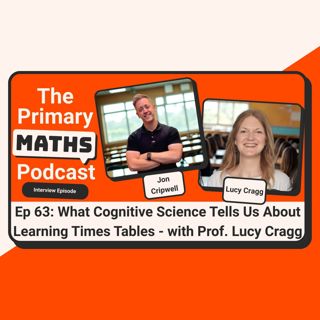
What Cognitive Science Tells Us About Learning Times Tables - with Professor Lucy Cragg

What Cognitive Science Tells Us About Learning Times Tables - with Professor Lucy Cragg

In this episode of The Primary Maths Podcast, Jon speaks with Lucy Cragg, Professor of Developmental Psychology at the University of Nottingham, about what cognitive science reveals about how children learn multiplication facts.

Lucy’s research explores executive function skills such as working memory, inhibitory control and cognitive flexibility, and how these shape children’s mathematical learning. The conversation dives into how multiplication facts are stored and retrieved, why certain errors (like 6 × 7 = 42) are so common, and what this tells us about the structure of memory.

Together, Jon and Lucy explore the distinction between fluency and understanding. While more pupils are improving their scores on England’s Multiplication Tables Check, Lucy explains why improved recall does not automatically translate into stronger applied mathematical reasoning. Drawing on findings from the ESRC-funded SUM Project, she discusses how children can improve fact recall without a corresponding gain in multiplicative understanding.

The episode also tackles maths anxiety, the impact of timed practice, and why speed may matter for testing but not necessarily for learning. Lucy shares practical insights for teachers, including the benefits of varied practice, careful use of multiple-choice formats, and ensuring that multiplication facts are connected to meaningful mathematical structures rather than learned in isolation.

This is a thoughtful and research-informed conversation for teachers and leaders who want to understand not just how to help children remember their times tables, but how to help them truly understand multiplication.

SUM Project website:

https://www.sumproject.org.uk/

Further reading and related articles:

Nine-year-olds in England sit a timed multiplication test – but using times tables is about more than quick recall:

https://theconversation.com/nine-year-olds-in-england-sit-timed-multiplication-test-but-using-times-tables-is-about-more-than-quick-recall-258320

Learning, using and applying multiplication facts – insights from research:

https://my.chartered.college/impact_article/learning-using-and-applying-multiplication-facts-insights-from-research/

Connect with Lucy Cragg on LinkedIn:

https://www.linkedin.com/in/lucy-cragg-b22b0a386/

Contact Lucy via email:

lucy.cragg@nottingham.ac.uk

Connect with Jon Cripwell on LinkedIn:

https://www.linkedin.com/in/joncripwell/

Subscribe to Jon’s Substack, The Primary Maths Podcast:

https://theprimarymathspodcast.substack.com/

About Professor Lucy Cragg

Professor Lucy Cragg is a developmental psychologist based in the School of Psychology at the University of Nottingham. Her research focuses on the development of executive function skills in children and the role these skills play in learning mathematics.

She led a recent ESRC-funded project investigating the cognitive factors involved in multiplication fact learning, examining both multiplication fact retrieval and its contribution to broader multiplicative understanding. Her work bridges cognitive science and classroom practice, helping educators better understand how memory, attention and inhibition influence mathematical learning.

She is passionate about making research accessible to teachers and welcomes contact from practitioners interested in applying cognitive science insights in the classroom.

The Podcast

The Primary Maths Podcast is for teachers and leaders who believe primary maths can be thoughtful, ambitious and inclusive. Hosted by Jon Cripwell, the show explores lesson design, mathematical habits, maths anxiety, problem solving, curriculum thinking and the research that shapes great teaching.

Denne episoden er hentet fra en åpen RSS-feed og er ikke publisert av Podme. Den kan derfor inneholde annonser.

Episoder(90)

Is the maths attainment gap getting wider?

Is the maths attainment gap getting wider?

Why do some pupils seem to thrive in maths while others struggle to access the same lesson?Jon and Becky discuss the latest PISA findings and the widening gap between higher and lower attainers, befor...

18 Sep 38min
How Big Is the Universe? | AfterMaths Summer Special

How Big Is the Universe? | AfterMaths Summer Special

How can the universe be 13.8 billion years old but the observable universe be around 93 billion light years across?In this AfterMaths Summer Special, Jon is joined by primary science specialist Sarah ...

4 Sep 42min
Can Maths Help You Win at Games?

Can Maths Help You Win at Games?

Can maths help you win at games?In this AfterMaths Summer Special, Jon and Becky explore the line between luck and strategy — and whether understanding the maths behind a game can actually give you an...

28 Aug 25min
Can Maths Predict the Future?

Can Maths Predict the Future?

Can maths really predict the future?We can predict the return of a comet decades in advance, but tomorrow's weather can still catch us completely by surprise. In this AfterMaths Summer Special, Jon an...

24 Aug 26min
The Maths of Getting Away: Routes, Queues & Google Maps

The Maths of Getting Away: Routes, Queues & Google Maps

Podcast Show NotesWhat makes a route the best route? The shortest distance? The quickest journey? The cheapest option? Or simply whichever one Google tells you to take?In this AfterMaths Summer Specia...

21 Aug 31min
Who Decided How Long a Metre Is? AfterMaths Summer Special 3

Who Decided How Long a Metre Is? AfterMaths Summer Special 3

Who decided how long a metre should be? Why is a mile 1,760 yards? And what connects the French Revolution, an expedition from Dunkirk to Barcelona and the speed of light?In this AfterMaths Summer Spe...

7 Aug 22min
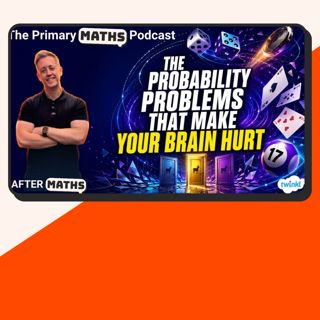
The Probability Problems That Make Your Brain Hurt - AfterMaths Summer Special 2 2026

The Probability Problems That Make Your Brain Hurt - AfterMaths Summer Special 2 2026

Probability often feels as though it should be intuitive, right up until the mathematics tells us that our instincts are completely wrong.In this AfterMaths Summer Special, Jon and Becky explore the s...

31 Jul 30min
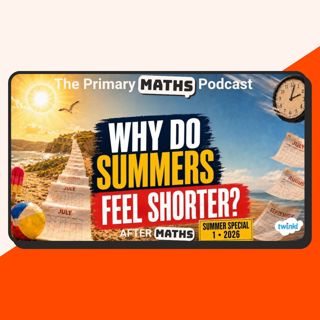
Why Do Summer Holidays Feel Shorter As We Get Older? Summer Special 1 2026

Why Do Summer Holidays Feel Shorter As We Get Older? Summer Special 1 2026

Why did the six-week summer holiday feel endless when we were children, yet now seems to disappear almost as soon as it begins?In the first of the 2026 Aftermaths Summer Specials, Jon and Becky explor...

28 Jul 29min

Populært innen Fakta

fastlegen
dine-penger-pengeradet
relasjonspodden-med-dora-thorhallsdottir-kjersti-idem
rss-strid
treningspodden
foreldreradet
rss-bisarr-historie
jakt-og-fiskepodden
rss-orjasater
hverdagspsyken
rss-kunsten-a-leve
takk-og-lov-med-anine-kierulf
sinnsyn
mikkels-paskenotter
rss-impressions-2
gravid-uke-for-uke
psykt-interessant
tomprat-med-gunnar-tjomlid
fryktlos
level-up-med-anniken-binz