
#241 – Richard Moulange on how now AI codes viable genomes from scratch and outperforms virologists at lab work — what could go wrong?

#241 – Richard Moulange on how now AI codes viable genomes from scratch and outperforms virologists at lab work — what could go wrong?

Last September, scientists used an AI model to design genomes for entirely new bacteriophages (viruses that infect bacteria). They then built them in a lab. Many were viable. And despite being entirely novel some even outperformed existing viruses from that family.


That alone is remarkable. But as today's guest — Dr Richard Moulange, one of the world's top experts on 'AI–Biosecurity' — explains, it's just one of many data points showing how AI is dissolving the barriers that have historically kept biological weapons out of reach.

For years, experts have reassured us that 'tacit knowledge' — the hands-on, hard-to-Google lab skills needed to work with dangerous pathogens — would prevent bad actors from weaponising biology. So far, they've been right.


But as of 2025 that reassurance is crumbling. The Virology Capabilities Test measures exactly this kind of troubleshooting expertise, and finds that modern AI models crushed top human virologists even in their self-declared area of greatest specialisation and expertise — 45% to 22%.

Meanwhile, Anthropic’s research shows PhD-level biologists getting meaningfully better at weapons-relevant tasks with AI assistance — with the effect growing with each new model generation.

Richard joins host Rob Wiblin to discuss all that plus:

  • What AI biology tools already exist
  • Why mid-tier actors (not amateurs) are the ones getting the most dangerous boost
  • The three main categories of defence we can pursue
  • Whether there’s a plausible path to a world where engineered pandemics become a thing of the past

This episode was recorded on January 16, 2026. Since recording this episode, Richard has seconded to the UK Government — please note that his views expressed here are entirely his own.

Links to learn more, video, and full transcript: https://80k.info/rm

Announcements:

  1. Our new book is available to preorder: 80,000 Hours: How to have a fulfilling career that does good is written by our cofounder Benjamin Todd. It’s a completely revised and updated edition of our existing career guide, with a big new updated section on AI — covering both the risks and the potential to steer it in a better direction, and how AI automation should affect your career planning and which skills one chooses to specialise in. Preorder now: https://geni.us/80000Hours
  2. We're hiring contract video editors for the podcast! For more information, check out the expression of interest page on the 80,000 Hours website: https://80k.info/video-editor

Chapters:

  • Cold open (00:00:00)
  • Who's Richard Moulange? (00:00:31)
  • AI can now design novel genomes (00:01:11)
  • The end of the 'tacit knowledge' barrier (00:04:34)
  • Are risks from bioterrorists overstated? (00:18:20)
  • The 3 key disasters AI makes more likely (00:22:41)
  • Which bad actors does AI help the most? (00:30:03)
  • Experts are more scary than amateurs (00:41:17)
  • Barriers to bioterrorists using AI (00:46:43)
  • AI biorisks are sometimes dismissed (and that's a huge mistake) (00:48:54)
  • Advanced AI biology tools we already have or will soon (01:04:10)
  • Rob argues that the situation is hopeless (01:09:49)
  • Intervention #1: Limit access (01:18:16)
  • Intervention #2: Get AIs to refuse to help (01:32:58)
  • Intervention #3: Surveillance and attribution (01:42:38)
  • Intervention #4: Universal vaccines and antivirals (01:56:38)
  • Intervention #5: Screen all orders for DNA (02:10:00)
  • AI companies talk about def/acc more than they fund it (02:19:52)
  • Can you build a profitable business solving this problem? (02:26:32)
  • This doesn't have to interfere with useful science (much) (02:30:56)
  • What are the best low-tech interventions? (02:33:01)
  • Richard's top request for AI companies (02:37:59)
  • Grok shows governments lack many legal levers (02:53:17)
  • Best ways listeners can help fix AI-Bio (02:56:24)
  • We might end all contagious disease in 20 years (03:03:37)


Video and audio editing: Dominic Armstrong, Milo McGuire, Luke Monsour, and Simon Monsour
Music: CORBIT
Camera operator: Jeremy Chevillotte
Transcripts and web: Elizabeth Cox and Katy Moore

Episoder(333)

#220 – Ryan Greenblatt on the 4 most likely ways for AI to take over, and the case for and against AGI in <8 years

#220 – Ryan Greenblatt on the 4 most likely ways for AI to take over, and the case for and against AGI in <8 years

Ryan Greenblatt — lead author on the explosive paper “Alignment faking in large language models” and chief scientist at Redwood Research — thinks there’s a 25% chance that within four years, AI will b...

8 Jul 20252h 50min
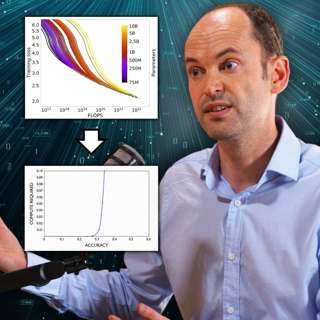
#219 – Toby Ord on graphs AI companies would prefer you didn't (fully) understand

#219 – Toby Ord on graphs AI companies would prefer you didn't (fully) understand

The era of making AI smarter just by making it bigger is ending. But that doesn’t mean progress is slowing down — far from it. AI models continue to get much more powerful, just using very different m...

24 Jun 20252h 48min
#218 – Hugh White on why Trump is abandoning US hegemony – and that’s probably good

#218 – Hugh White on why Trump is abandoning US hegemony – and that’s probably good

For decades, US allies have slept soundly under the protection of America’s overwhelming military might. Donald Trump — with his threats to ditch NATO, seize Greenland, and abandon Taiwan — seems hell...

12 Jun 20252h 48min

#217 – Beth Barnes on the most important graph in AI right now — and the 7-month rule that governs its progress

#217 – Beth Barnes on the most important graph in AI right now — and the 7-month rule that governs its progress

AI models today have a 50% chance of successfully completing a task that would take an expert human one hour. Seven months ago, that number was roughly 30 minutes — and seven months before that, 15 mi...

2 Jun 20253h 47min
Beyond human minds: The bewildering frontier of consciousness in insects, AI, and more

Beyond human minds: The bewildering frontier of consciousness in insects, AI, and more

What if there’s something it’s like to be a shrimp — or a chatbot?For centuries, humans have debated the nature of consciousness, often placing ourselves at the very top. But what about the minds of o...

23 Mai 20253h 34min

Don’t believe OpenAI’s “nonprofit” spin (emergency pod with Tyler Whitmer)

Don’t believe OpenAI’s “nonprofit” spin (emergency pod with Tyler Whitmer)

OpenAI’s recent announcement that its nonprofit would “retain control” of its for-profit business sounds reassuring. But this seemingly major concession, celebrated by so many, is in itself largely me...

15 Mai 20251h 12min

The case for and against AGI by 2030 (article by Benjamin Todd)

The case for and against AGI by 2030 (article by Benjamin Todd)

More and more people have been saying that we might have AGI (artificial general intelligence) before 2030. Is that really plausible? This article by Benjamin Todd looks into the cases for and against...

12 Mai 20251h

Emergency pod: Did OpenAI give up, or is this just a new trap? (with Rose Chan Loui)

Emergency pod: Did OpenAI give up, or is this just a new trap? (with Rose Chan Loui)

When attorneys general intervene in corporate affairs, it usually means something has gone seriously wrong. In OpenAI’s case, it appears to have forced a dramatic reversal of the company’s plans to si...

8 Mai 20251h 2min

Populært innen Fakta

fastlegen
dine-penger-pengeradet
relasjonspodden-med-dora-thorhallsdottir-kjersti-idem
foreldreradet
treningspodden
rss-strid-de-norske-borgerkrigene
mikkels-paskenotter
rss-bisarr-historie
jakt-og-fiskepodden
sinnsyn
rss-kunsten-a-leve
rss-sunn-okonomi
hverdagspsyken
tomprat-med-gunnar-tjomlid
rss-bak-luftfarten
ukast
fryktlos
gravid-uke-for-uke
lederskap-nhhs-podkast-om-ledelse
rss-kull