The 1:61,320 Ratio: Deconstructing Time Dilation, Tidal Solitons, and the Near-Extremal Black Hole of Interstellar

The 1:61,320 Ratio: Deconstructing Time Dilation, Tidal Solitons, and the Near-Extremal Black Hole of Interstellar

The $1:61,320$ Ratio: Deconstructing Time Dilation, Tidal Solitons, and the Near-Black Hole of InterstellarDescription

The 2014 motion picture Interstellar, directed by Christopher Nolan with lead scientific consultation from Nobel Laureate Kip Thorne, presents a unique case study in the intersection of narrative fiction and high-fidelity astrophysical simulation. The sequence depicting Miller's Planet—a water-covered terrestrial world orbiting the supermassive black hole Gargantua—serves as the film's primary crucible for exploring gravitational time dilation and orbital dynamics in curved spacetime.

The narrative premise defines the relativistic cost of exploration: one hour on the planetary surface equates to seven Earth-years, implying a massive time dilation factor of approximately 61,320:1. This episode provides an exhaustive deconstruction of the physics required to sustain such a scenario, synthesizing general relativistic geometry, orbital mechanics, and fluid dynamics.

Key topics we explore:
  • The Near-Extremal Kerr Solution: Initial critiques were grounded in the physics of non-rotating (Schwarzschild) black holes, where stable orbits cannot produce such extreme time dilation (maximum factor is ~1.22). We explain how the film’s premise is validated by specifying **Gargantua** as a **supermassive Kerr black hole** ($10^8 M_\odot$) with a necessary **near-extremal dimensionless spin parameter ($a_*$) of $1 - 1.3 \times 10^{-14}$**. This nearly maximal rotation fundamentally alters the structure of spacetime, allowing the Innermost Stable Circular Orbit (ISCO) to approach the event horizon.
  • Frame Dragging and Orbital Stability: The planet's stability is maintained because it orbits just slightly outside the event horizon, a position Thorne describes as "a pinch from the event horizon". This stable orbit is made possible by the centrifugal force imparted by **frame dragging** (or the "space whirl"). The rotation of space itself carries the planet along, stabilizing its position against the immense gravitational pull.
  • Tidal Survival and Density Requirements: We analyze the "Roche Limit Violation" critique and explain the pivotal counter-intuitive result: the tidal forces exerted at the event horizon are inversely proportional to the square of the black hole’s mass ($a_{tidal} \propto 1/M^2$). The supermassive nature of Gargantua ($10^8 M_\odot$) makes the tidal gradient across a planetary body gentler compared to a stellar-mass black hole. For Miller's Planet to survive tidal stretching, the calculation indicates it must possess a high density of approximately **10,000 kg/m³**.
  • Visualizing Spacetime Geometry: We examine the advanced visualization methodology developed for the film. The Double Negative (DNEG) visual effects team created the **Double Negative Gravitational Renderer (DNGR)**. This bespoke ray-tracing software solved the geodesic equations for photons in the Kerr metric, allowing for the accurate simulation of phenomena like gravitational lensing, the **Einstein Ring**, and the relativistic Doppler beaming observed in the black hole's accretion disk.

Denne episoden er hentet fra en åpen RSS-feed og er ikke publisert av Podme. Den kan derfor inneholde annonser.

Episoder(46)

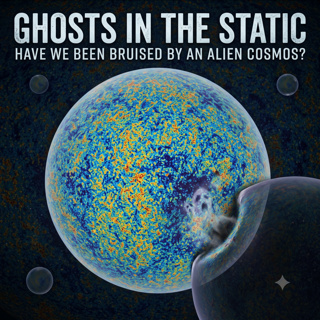
Ghosts in the Static: Have We Been Bruised by an Alien Cosmos?

Ghosts in the Static: Have We Been Bruised by an Alien Cosmos?

Imagine our entire observable universe is merely a single bubble expanding inside a highly energetic, unstable state of nothingness. Welcome to the paradigm of eternal inflation, where infinite bubble...

8 Sep 58min
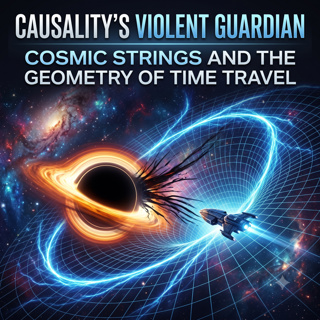
Causality’s Violent Guardian: Cosmic Strings and the Geometry of Time Travel

Causality’s Violent Guardian: Cosmic Strings and the Geometry of Time Travel

Time travel isn't a theoretical fantasy—it's a physical loophole waiting to be exploited by cosmic strings left over from the Big Bang. Discover how these cracks in spacetime could allow us to escape ...

1 Sep 52min
The Coulomb Shield: The Thinnest Line Between Us and Annihilation

The Coulomb Shield: The Thinnest Line Between Us and Annihilation

Look at your hands. Look at the walls around you, the ground beneath your feet, the air you are breathing right now. We’ve spent our entire lives believing that this—this ordinary, atomic reality—is t...

25 Aug 46min
The Cosmic Impurity: Why the Death of Reality Might Be Intentional

The Cosmic Impurity: Why the Death of Reality Might Be Intentional

What if the comforting laws of physics are just a temporary, fragile illusion waiting to shatter?In this mind-bending episode, we confront the unsettling reality of the "False Vacuum"—a metastable sta...

11 Aug 43min
The Tabletop Apocalypse: How Physicists Are Simulating the Death of Reality

The Tabletop Apocalypse: How Physicists Are Simulating the Death of Reality

What if the fundamental laws of our universe are just a temporary, fragile illusion?In this mind-bending episode, we explore the terrifying concept of the "False Vacuum"—a metastable state of existenc...

28 Jul 43min
Catalysts of Doom: Black Holes and the Higgs Vacuum

Catalysts of Doom: Black Holes and the Higgs Vacuum

Episode Summary:We like to believe the universe is built on a solid foundation, but modern physics suggests we are standing on thin ice. The Higgs field implies our universe exists in a "false vacuum"...

14 Jul 36min
The Glass Cosmos: False Vacuums, Strangelets, and the Speed-of-Light Apocalypse

The Glass Cosmos: False Vacuums, Strangelets, and the Speed-of-Light Apocalypse

What if the fundamental laws of physics are just a temporary, fragile phase? In this mind-bending episode of The Dark Universe, we stare into the cosmological abyss of "vacuum metastability." We explo...

25 Jun 38min

The Smoking Gun at the Edge of Time

The Smoking Gun at the Edge of Time

The first fraction of a second after creation was so violent it scarred spacetime itself. We can't build a particle accelerator the size of the galaxy to test our theories, so we have to become cosmic...

18 Jun 27min

Populært innen Vitenskap

fastlegen
romkapsel
tingenes-tilstand
jss
liberal-halvtime
forskningno
sinnsyn
rekommandert
villmarksliv
rss-paradigmepodden
fjellsportpodden
tomprat-med-gunnar-tjomlid
grunnstoffene
nordnorsk-historie
rss-nysgjerrige-norge
tidlose-historier
psykopoden
rss-rekommandert
rss-inn-til-kjernen-med-sunniva-rose
smart-forklart