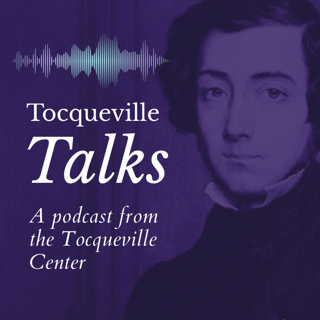
24. Why Everything Feels Increasingly Unreal — Beth and Rob L'Arrivée

24. Why Everything Feels Increasingly Unreal — Beth and Rob L'Arrivée

Why does everything feel increasingly unreal?

The people most trapped in abstraction are often the people consuming the most information.

Tocqueville saw this danger almost 200 years ago.

In this episode of Tocqueville Talks, Beth L'Arrivée and Rob L'Arrivée explore one of Alexis de Tocqueville's most penetrating insights: democratic societies encourage citizens to think in general ideas, abstractions, and public opinion rather than in the concrete realities immediately around them.

The result is a strange paradox. We know more. We discuss more. We consume more information. Yet we often struggle to see what is right in front of us.

Tocqueville believed this tendency could be resisted—but only through habits that cultivate judgment.

One of those habits appears in the writings of thinkers such as Plato, Montesquieu, Al-Farabi, Nietzsche, and Tocqueville himself. Rather than supplying ready-made conclusions, they leave premises unstated, compress arguments, create tensions, and force readers to complete the argument for themselves. Their goal is not simply to communicate ideas, but to train the mind.

The other habit is self-government.

Townships. Juries. Associations. Local institutions.

Places where citizens must confront real people, real problems, and real consequences rather than distant abstractions and fashionable opinions.

What do Tocqueville's New England townships and the greatest works of political philosophy have in common?

Both demand judgment.

Both resist abstraction.

Both force us back into reality.

Topics include:

  • Why democratic citizens tend toward abstraction

  • Tocqueville on public opinion and freedom of thought

  • Why information does not necessarily produce understanding

  • Plato, Montesquieu, Al-Farabi, Nietzsche, and Tocqueville as teachers

  • Reading as an education in judgment

  • Great Books and liberal education

  • Self-government and civic character

  • The difference between America and France

  • How free societies cultivate citizens capable of seeing reality clearly

At its heart, this episode asks a question that feels increasingly urgent:

How do we learn to see what is right in front of us?

Denne episoden er hentet fra en åpen RSS-feed og er ikke publisert av Podme. Den kan derfor inneholde annonser.

Episoder(32)

32. The NSA Director on Special Forces, Cyber, AI & the Threats Ahead

32. The NSA Director on Special Forces, Cyber, AI & the Threats Ahead

What does a career in Special Forces teach you about the threats America faces today?General Joshua Rudd has spent his career at the intersection of military service, national security, and a rapidly ...

1 Okt 36min

31. Finland's President Alexander Stubb on Political Philosophy, Power & a World in Transition

31. Finland's President Alexander Stubb on Political Philosophy, Power & a World in Transition

What can political philosophy teach a president about leadership, power, and a changing international order?In this episode of Tocqueville Talks, Alexander Stubb, President of the Republic of Finland,...

24 Sep 31min

30. Why College Should Challenge What You Believe | Tocqueville Fellows on Learning to Disagree

30. Why College Should Challenge What You Believe | Tocqueville Fellows on Learning to Disagree

What if the purpose of college isn't to confirm what you believe—but to teach you how to question it?In this episode of Tocqueville Talks, Furman University students Laura Grace McSwain and Liza Sherb...

21 Sep 22min

29. The Big Questions Facing American Democracy | Tocqueville Talks 2026–27 Preview

29. The Big Questions Facing American Democracy | Tocqueville Talks 2026–27 Preview

What are the biggest questions facing American democracy—and how can universities create spaces where they are seriously debated?In this season-opening episode of Tocqueville Talks, Tocqueville Center...

10 Sep 30min

28. Why Americans Are So Patriotic | Tocqueville's Surprising Answer

28. Why Americans Are So Patriotic | Tocqueville's Surprising Answer

Why does patriotism seem so powerful in America—and what happens when it begins to disappear?As Americans celebrate the nation's 250th anniversary, Alexis de Tocqueville's reflections on patriotism ma...

10 Jul 23min

27. Why the Old Political Order Is Cracking | Populism, MAGA, and the Future of Democracy

27. Why the Old Political Order Is Cracking | Populism, MAGA, and the Future of Democracy

For generations, politics in Europe and America was dominated by large, stable political parties. Today, those old political alignments are breaking down.Why are voters abandoning established parties?...

3 Jul 35min

26. What Swimming Can Teach Us About Democracy | Tocqueville's Forgotten Insight

26. What Swimming Can Teach Us About Democracy | Tocqueville's Forgotten Insight

What can a neighborhood swim league teach us about democracy?More than you might think.When Alexis de Tocqueville visited America in 1831, he was astonished by what he called associations—ordinary cit...

25 Jun 41min

25. Is the Postwar Order Ending? Europe, Trump, Ukraine, and the Future of the West — Eleanor Beardsley

25. Is the Postwar Order Ending? Europe, Trump, Ukraine, and the Future of the West — Eleanor Beardsley

For eighty years, Europe and the United States built a common political, economic, and military order.Today, many Europeans wonder whether that world is ending.In this episode of Tocqueville Talks, Br...

18 Jun 27min

Populært innen Politikk og nyheter

giver-og-gjengen-vg
aftenpodden
forklart
aftenpodden-usa
popradet
fotballpodden-2
stopp-verden
dine-penger-pengeradet
rss-espen-lee-usensurert
det-store-bildet
rss-gukild-johaug
nokon-ma-ga
hanna-de-heldige
aftenbla-bla
rss-penger-polser-og-politikk
e24-podden
rss-ness
frokostshowet-pa-p5
bt-dokumentar-2
saken