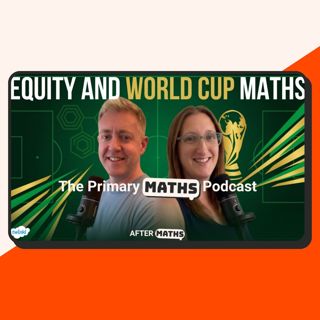
World Cup Maths, Equity and Oracy in the Primary Classroom

World Cup Maths, Equity and Oracy in the Primary Classroom

World Cup Maths, Equity and Oracy in the Primary Classroom

In this episode of the Primary Maths Podcast, Jon and Becky talk end-of-year school chaos, transition days, classroom moves, and the strange joy of finding a trolley when you really need one.

The main discussion begins with reflections from the East Midlands West Maths Hub summer conference, where the focus was on equity in maths. Jon shares the powerful question at the heart of the day: who gets to participate in mathematical thinking, and what do we need to do differently in our lesson design so that all pupils can take part?

Jon and Becky explore the difference between equality and equity, and consider how barriers in maths lessons are not always about individual pupils, but about the structures, routines and expectations around them. They discuss how silent classrooms, prior attainment labels, narrow learning objectives and the rush to find the correct answer can sometimes limit opportunities for mathematical thinking.

There is also a focus on oracy in maths: why talk matters, how pupils benefit from explaining, reasoning and justifying, and why an incorrect answer can be just as valuable as a correct one when we take time to explore the thinking behind it.

Later in the episode, attention turns to the World Cup and the many ways teachers can use it as a rich context for maths. Jon shares some World Cup facts and figures, including the first men’s World Cup in Uruguay in 1930, goal totals from past tournaments, stadium capacities, group tables, averages and goal difference.

Jon and Becky suggest practical classroom ideas across the primary phase, including:

  • counting, sorting, comparing and creating simple pictograms in EYFS and Year 1;
  • using tables, match results and points totals in Years 2 and 3;
  • exploring goal difference, averages, stadium capacities, fairness and predictions in Years 4, 5 and 6;
  • asking open-ended questions such as “What maths can you see?” while watching or looking at images from a match.

There is plenty here for teachers looking for meaningful end-of-year maths activities, especially when half the class is at transition day, sports day practice, or mysteriously missing because of something involving a clipboard.

Whether you love football, tolerate football, or only notice it when it interrupts your usual television schedule, this episode is full of ideas for using real-world numbers, live data and sporting excitement to get children talking, thinking and reasoning mathematically.

Denne episoden er hentet fra en åpen RSS-feed og er ikke publisert av Podme. Den kan derfor inneholde annonser.

Episoder(90)

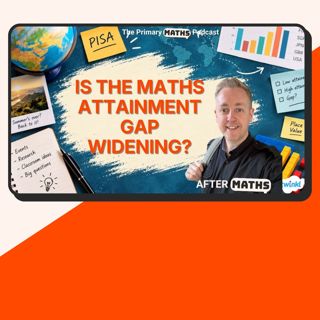
Is the maths attainment gap getting wider?

Is the maths attainment gap getting wider?

Why do some pupils seem to thrive in maths while others struggle to access the same lesson?Jon and Becky discuss the latest PISA findings and the widening gap between higher and lower attainers, befor...

18 Sep 38min
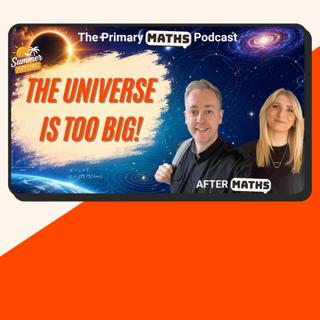
How Big Is the Universe? | AfterMaths Summer Special

How Big Is the Universe? | AfterMaths Summer Special

How can the universe be 13.8 billion years old but the observable universe be around 93 billion light years across?In this AfterMaths Summer Special, Jon is joined by primary science specialist Sarah ...

4 Sep 42min
Can Maths Help You Win at Games?

Can Maths Help You Win at Games?

Can maths help you win at games?In this AfterMaths Summer Special, Jon and Becky explore the line between luck and strategy — and whether understanding the maths behind a game can actually give you an...

28 Aug 25min
Can Maths Predict the Future?

Can Maths Predict the Future?

Can maths really predict the future?We can predict the return of a comet decades in advance, but tomorrow's weather can still catch us completely by surprise. In this AfterMaths Summer Special, Jon an...

24 Aug 26min
The Maths of Getting Away: Routes, Queues & Google Maps

The Maths of Getting Away: Routes, Queues & Google Maps

Podcast Show NotesWhat makes a route the best route? The shortest distance? The quickest journey? The cheapest option? Or simply whichever one Google tells you to take?In this AfterMaths Summer Specia...

21 Aug 31min
Who Decided How Long a Metre Is? AfterMaths Summer Special 3

Who Decided How Long a Metre Is? AfterMaths Summer Special 3

Who decided how long a metre should be? Why is a mile 1,760 yards? And what connects the French Revolution, an expedition from Dunkirk to Barcelona and the speed of light?In this AfterMaths Summer Spe...

7 Aug 22min
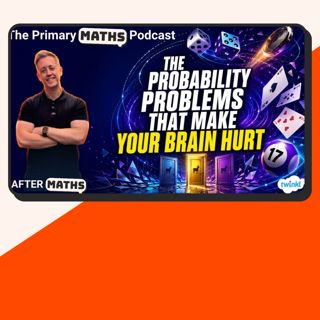
The Probability Problems That Make Your Brain Hurt - AfterMaths Summer Special 2 2026

The Probability Problems That Make Your Brain Hurt - AfterMaths Summer Special 2 2026

Probability often feels as though it should be intuitive, right up until the mathematics tells us that our instincts are completely wrong.In this AfterMaths Summer Special, Jon and Becky explore the s...

31 Jul 30min
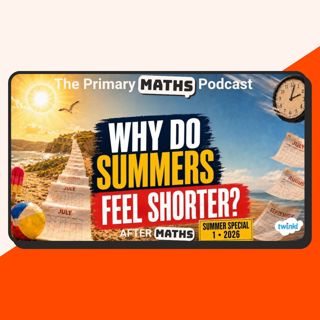
Why Do Summer Holidays Feel Shorter As We Get Older? Summer Special 1 2026

Why Do Summer Holidays Feel Shorter As We Get Older? Summer Special 1 2026

Why did the six-week summer holiday feel endless when we were children, yet now seems to disappear almost as soon as it begins?In the first of the 2026 Aftermaths Summer Specials, Jon and Becky explor...

28 Jul 29min

Populært innen Fakta

fastlegen
dine-penger-pengeradet
relasjonspodden-med-dora-thorhallsdottir-kjersti-idem
rss-strid
treningspodden
foreldreradet
rss-bisarr-historie
jakt-og-fiskepodden
rss-orjasater
hverdagspsyken
rss-kunsten-a-leve
takk-og-lov-med-anine-kierulf
sinnsyn
mikkels-paskenotter
rss-impressions-2
gravid-uke-for-uke
psykt-interessant
tomprat-med-gunnar-tjomlid
fryktlos
level-up-med-anniken-binz