The Starless Galaxy That Shouldn’t Exist - But Does

The Starless Galaxy That Shouldn’t Exist - But Does

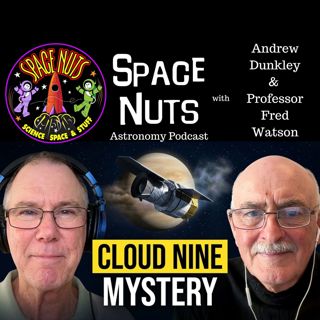
Space Nuts: Spanish Eclipse, Nancy Grace Roman Launch, Cloud Nine, and Venus's Mysterious Clouds
Andrew Dunkley and Professor Fred Watson cover four big astronomy stories in this episode, from Fred’s trip to view a sunset eclipse in Spain to the launch of the Nancy Grace Roman Space Telescope. They also unpack a starless dwarf galaxy called Cloud Nine and a new way of thinking about the strange dark material in Venus’s clouds.
Guests and speakers
Andrew Dunkley - Host, frames the news, asks listener questions, and guides the discussion.
Professor Fred Watson - Astronomer at large, explains the eclipse, the Roman telescope, Cloud Nine, and Venus’s clouds.
Key topics
In this episode, Fred recounts the Spanish eclipse expedition
The eclipse was only 9 degrees above the western horizon at totality, making the viewing conditions unusually challenging.
He and Marnie led a 16-person tour through France, Spain, and Switzerland before settling near Santander in northern Spain.
They staked out a viewing site 2 kilometers from the hotel, set up a gazebo, and had to tie it down to a car to keep it from blowing away.
The weather looked threatening, but a hole opened in the cloud just before totality, giving them a clear view of the corona.
Fred described the yellowish corona, pink hydrogen clouds, and the crowd of around 2,000 people.
We discuss the Nancy Grace Roman Space Telescope launch
Andrew watched the launch live after being nudged by his own brain at the right moment.
Fred noted the launch was flawless, with 27 Merlin motors firing.
The telescope is headed for the L2 Lagrange point, about 1.5 million kilometers away.
Roman is a 2.4-meter Hubble-class telescope but with 100 times the field of view.
Its wide-angle infrared design should enable major surveys of dark matter, dark energy, and exoplanets via its coronagraph.
Fred explains why Cloud Nine matters
Cloud Nine is described as a starless dwarf galaxy about 14 million light years away.
It lies near Messier 94 and was studied using the Gran Telescopio Canarias and its Hypercam instrument.
The deep exposure was 2.36 hours, yet the team found no convincing stellar population.
Fred says theory suggests the gas may be too hot to cool and collapse into stars because of the ultraviolet background radiation after reionization.
He says Cloud Nine may be the first strong example of a galaxy predicted by standard cosmology but never before clearly identified.
Venus’s clouds are still puzzling astronomers
Fred explains that Venus appears yellowish because we see the top of its cloud layer, especially in visible light.
In ultraviolet, Venus shows dramatic global cloud patterns caused by an as-yet unidentified absorber.
The new study uses radiative transfer modeling to constrain what the unknown absorber could be.
The team compares Venus’s cloud droplets to cigarette smoke, tiny particles that look light-colored when dispersed but could become dark sludge in bulk.
The result suggests the absorber must be very efficient, very concentrated, or both, but it is not being claimed as evidence of life.


Become a supporter of this podcast: https://www.spreaker.com/podcast/space-nuts-astronomy-insights-cosmic-discoveries--2631155/support.

Denne episoden er hentet fra en åpen RSS-feed og er ikke publisert av Podme. Den kan derfor inneholde annonser.

Episoder(670)

Mars Gullies Aren't Made by Water: The Surprising Dry Ice Answer

Mars Gullies Aren't Made by Water: The Surprising Dry Ice Answer

Perseverance drove to the edge of an ancient Martian lake expecting a beach and found the inside of a volcano — rock that water has been through at least three separate times. Europe's Jupiter probe c...

24 Sep 32min
Navigating the Cosmic Questions: Gravity Assists, Neutrinos, and Time Dilation Explained

Navigating the Cosmic Questions: Gravity Assists, Neutrinos, and Time Dilation Explained

Space Nuts: Q&A on BepiColombo, Neutrinos, and Time DilationIn this Q&A edition of Space Nuts, hosts Andrew Dunkley and Professor Fred Watson dive into a series of intriguing listener questions that s...

21 Sep 30min
Why Venus May Have Lost Its Moon Forever

Why Venus May Have Lost Its Moon Forever

Sponsor Link:This episode of Space Nuts is brought to you with the support of NordVPN. your first stop for online privavcy. To check out our special offer with a 30 day money back guarantee, visit www...

17 Sep 33min

Your Questions Answered: The Mysteries of Jupiter and the Sun

Your Questions Answered: The Mysteries of Jupiter and the Sun

Sponsor Link:This episode of Space Nuts is brought to with the support of NordVPN. To grab our special NordVPN deal, simply visit www.nordvpn.com/spacenuts ....take control of your online privacy beca...

14 Sep 32min
The Dark Matter Hint That Could Rewrite Physics

The Dark Matter Hint That Could Rewrite Physics

Space Nuts: Dark matter clues, Saturn’s new decagon, Mars and Titan missions.Andrew Dunkley and Professor Fred Watson cover a packed astronomy episode that moves from a tentative dark matter signal to...

10 Sep 30min

Cosmic Q&A: From Redshift to the Moon's Hidden Temperatures

Cosmic Q&A: From Redshift to the Moon's Hidden Temperatures

Space Nuts: Q&A on the Swift Satellite, Redshift, and Hypothetical White HolesIn this engaging Q&A edition of Space Nuts, hosts Andrew Dunkley and Professor Fred Watson dive into a myriad of intriguin...

7 Sep 30min

Waves, Signals, and Cosmic Aromas: A Q&A Journey Through Space

Waves, Signals, and Cosmic Aromas: A Q&A Journey Through Space

In this intriguing Q&A episode of Space Nuts, hosts Andrew Dunkley and Professor Jonti Horner tackle a variety of cosmic queries from listeners. Join them as they explore the fascinating world of radi...

31 Aug 37min

Populært innen Vitenskap

fastlegen
romkapsel
tingenes-tilstand
jss
liberal-halvtime
forskningno
rekommandert
sinnsyn
tomprat-med-gunnar-tjomlid
villmarksliv
rss-paradigmepodden
fjellsportpodden
rss-nysgjerrige-norge
nordnorsk-historie
grunnstoffene
rss-rekommandert
tidlose-historier
rss-inn-til-kjernen-med-sunniva-rose
psykopoden
smart-forklart