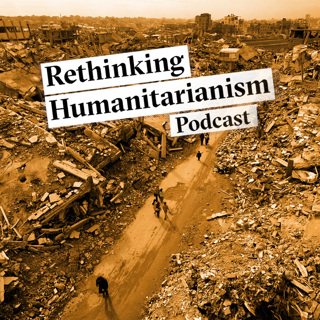
What we've learned about how change happens | Rethinking Humanitarianism

What we've learned about how change happens | Rethinking Humanitarianism

The humanitarian system isn't short on identity crises, soul-searching, and reform promises. So why does a system so good at diagnosing its problems struggle to change?

This final episode of Rethinking Humanitarianism and Start Network's collaborative series examines the financial and political roadblocks preventing change, why diversifying who humanitarians feel accountable to could lead to progress, the reality that change is already happening in myriad ways outside the sector's reform attempts, and what humanitarians might learn from activist movements.

Guests
Kia Howson, researcher at Start Network
Irwin Loy, senior policy editor at The New Humanitarian

Key moments
[04:40] – Why keep diagnosing the system if nothing changes?
[16:01] – "Aid is not a cause" – survival and dignity are
[17:26] – From a humanitarian system to an ecosystem
[22:43] – Diversify who humanitarians feel accountable to
[32:11] – Who's filling the void? Local groups, private actors, and competing narratives
[41:01] – What should be supported as the formal system recedes?
[55:44] – Listening and finding common ground in a polarised sector
[1:08:11] – "Change is an action," not just a commitment

Got a question or feedback? Email podcast@thenewhumanitarian.org or post on social media using the hashtag #RethinkingHumanitarianism.

This episode was made in collaboration with Start Network as part of a series that explores what really drives change in the humanitarian system, and what it tells us about future efforts to transform the system for the better.

Denne episoden er hentet fra en åpen RSS-feed og er ikke publisert av Podme. Den kan derfor inneholde annonser.

Episoder(100)

What Palestinians want for Gaza's future | Rethinking Humanitarianism

What Palestinians want for Gaza's future | Rethinking Humanitarianism

Three years into Israel's genocide in Gaza, the US-led Board of Peace is already trying to determine the strip's future reconstruction plans. But what about the more than two million Palestinians who ...

8 Okt 45min
Should humanitarianism return to its activist roots? | Rethinking Humanitarianism

Should humanitarianism return to its activist roots? | Rethinking Humanitarianism

Can embracing activism inspire public support for aid, and rejuvenate humanitarianism itself? Today's guests explain why – and how – humanitarians should go from advocacy to activism. Chloé Fiona Ludd...

17 Sep 1h 16min

Will aid-for-hire become the new normal? | Rethinking Humanitarianism

Will aid-for-hire become the new normal? | Rethinking Humanitarianism

In the previous episode, Fogbow CEO Brook Jerue questioned why the aid sector was so "infatuated" and critical of his company – a small private American firm delivering aid in high‑conflict contexts l...

10 Sep 38min

The rise of privatised aid: A conversation with Fogbow | Rethinking Humanitarianism

The rise of privatised aid: A conversation with Fogbow | Rethinking Humanitarianism

When private companies employ former military personnel and work with controversial political actors in the name of humanitarian aid, should they still follow humanitarian principles? And who holds th...

8 Sep 1h 4min

Grassroots aid is here to disturb the system | Rethinking Humanitarianism

Grassroots aid is here to disturb the system | Rethinking Humanitarianism

For Fanta Toure, community-led crisis response efforts like mutual aid are not an emergent movement as some in the international aid system see it, but rather a return "to the way things are supposed ...

27 Aug 1h 23min

Somalia's plan to break free from aid dependence | Rethinking Humanitarianism

Somalia's plan to break free from aid dependence | Rethinking Humanitarianism

For Abdihakim Ainte, a senior Somali government official, the international humanitarian system's sudden contraction has been both a "cataclysmic" shock – with devastating immediate consequences – and...

20 Aug 48min

Will big donors "smell the coffee" or get left behind? | Rethinking Humanitarianism

Will big donors "smell the coffee" or get left behind? | Rethinking Humanitarianism

Less than a year ago, Colum Wilson left his position at the helm of the humanitarian department in one of the world's largest donor governments. After more than two decades with the UK government, Wil...

13 Aug 49min

Populært innen Politikk og nyheter

giver-og-gjengen-vg
aftenpodden
aftenpodden-usa
popradet
forklart
fotballpodden-2
stopp-verden
det-store-bildet
rss-gukild-johaug
rss-espen-lee-usensurert
nokon-ma-ga
hanna-de-heldige
dine-penger-pengeradet
rss-ness
aftenbla-bla
e24-podden
frokostshowet-pa-p5
bt-dokumentar-2
ta-dokumentar
unitedno