
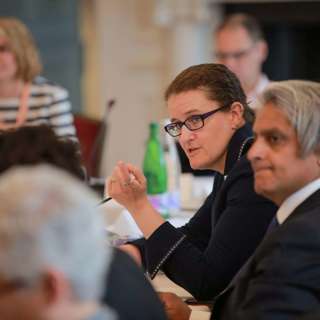
#97 – Mike Berkowitz on keeping the US a liberal democratic country

#97 – Mike Berkowitz on keeping the US a liberal democratic country

Donald Trump’s attempt to overturn the results of the 2020 election split the Republican party. There were those who went along with it — 147 members of Congress raised objections to the official certification of electoral votes — but there were others who refused. These included Brad Raffensperger and Brian Kemp in Georgia, and Vice President Mike Pence.

Although one could say that the latter Republicans showed great courage, the key to the split may lie less in differences of moral character or commitment to democracy, and more in what was being asked of them. Trump wanted the first group to break norms, but he wanted the second group to break the law.

And while norms were indeed shattered, laws were upheld.

Today’s guest, Mike Berkowitz, executive director of the Democracy Funders Network, points out a problem we came to realize throughout the Trump presidency: So many of the things that we thought were laws were actually just customs.

Links to learn more, summary and full transcript.

So once you have leaders who don’t buy into those customs — like, say, that a president shouldn’t tell the Department of Justice who it should and shouldn’t be prosecuting — there’s nothing preventing said customs from being violated.

And what happens if current laws change?

A recent Georgia bill took away some of the powers of Georgia's Secretary of State — Brad Raffensberger. Mike thinks that's clearly retribution for Raffensperger's refusal to overturn the 2020 election results. But he also thinks it means that the next time someone tries to overturn the results of the election, they could get much farther than Trump did in 2020.

In this interview Mike covers what he thinks are the three most important levers to push on to preserve liberal democracy in the United States:
1. Reforming the political system, by e.g. introducing new voting methods
2. Revitalizing local journalism
3. Reducing partisan hatred within the United States

Mike says that American democracy, like democracy elsewhere in the world, is not an inevitability. The U.S. has institutions that are really important for the functioning of democracy, but they don't automatically protect themselves — they need people to stand up and protect them.

In addition to the changes listed above, Mike also thinks that we need to harden more norms into laws, such that individuals have fewer opportunities to undermine the system.

And inasmuch as laws provided the foundation for the likes of Raffensperger, Kemp, and Pence to exhibit political courage, if we can succeed in creating and maintaining the right laws — we may see many others following their lead.

As Founding Father James Madison put it: “If men were angels, no government would be necessary. If angels were to govern men, neither external nor internal controls on government would be necessary.”

Mike and Rob also talk about:
• What sorts of terrible scenarios we should actually be worried about, i.e. the difference between being overly alarmist and properly alarmist
• How to reduce perverse incentives for political actors, including those to overturn election results
• The best opportunities for donations in this space
• And much more

Chapters:

  • Rob’s intro (00:00:00)
  • The interview begins (00:02:01)
  • What we should actually be worried about (00:05:03)
  • January 6th, 2021 (00:11:03)
  • Trump’s defeat (00:16:44)
  • Improving incentives for representatives (00:30:55)
  • Signs of a loss of confidence in American democratic institutions (00:44:58)
  • Most valuable political reforms (00:54:39)
  • Revitalising local journalism (01:08:07)
  • Reducing partisan hatred (01:21:53)
  • Should workplaces be political? (01:31:40)
  • Mistakes of the left (01:36:50)
  • Risk of overestimating the problem (01:39:56)
  • Charitable giving (01:48:13)
  • How to shortlist projects (01:56:42)
  • Speaking to Republicans (02:04:15)
  • Patriots & Pragmatists and The Democracy Funders Network (02:12:51)
  • Rob’s outro (02:32:58)


Producer: Keiran Harris.
Audio mastering: Ben Cordell.
Transcriptions: Sofia Davis-Fogel.

Episoder(333)

#12 - Beth Cameron works to stop you dying in a pandemic. Here’s what keeps her up at night.

#12 - Beth Cameron works to stop you dying in a pandemic. Here’s what keeps her up at night.

“When you're in the middle of a crisis and you have to ask for money, you're already too late.” That’s Dr Beth Cameron, who leads Global Biological Policy and Programs at the Nuclear Threat Initiative...

25 Okt 20171h 45min

#11 - Spencer Greenberg on speeding up social science 10-fold & why plenty of startups cause harm

#11 - Spencer Greenberg on speeding up social science 10-fold & why plenty of startups cause harm

Do most meat eaters think it’s wrong to hurt animals? Do Americans think climate change is likely to cause human extinction? What is the best, state-of-the-art therapy for depression? How can we make ...

17 Okt 20171h 29min
#10 - Nick Beckstead on how to spend billions of dollars preventing human extinction

#10 - Nick Beckstead on how to spend billions of dollars preventing human extinction

What if you were in a position to give away billions of dollars to improve the world? What would you do with it? This is the problem facing Program Officers at the Open Philanthropy Project - people l...

11 Okt 20171h 51min
#9 - Christine Peterson on how insecure computers could lead to global disaster, and how to fix it

#9 - Christine Peterson on how insecure computers could lead to global disaster, and how to fix it

Take a trip to Silicon Valley in the 70s and 80s, when going to space sounded like a good way to get around environmental limits, people started cryogenically freezing themselves, and nanotechnology l...

4 Okt 20171h 45min
#8 - Lewis Bollard on how to end factory farming in our lifetimes

#8 - Lewis Bollard on how to end factory farming in our lifetimes

Every year tens of billions of animals are raised in terrible conditions in factory farms before being killed for human consumption. Over the last two years Lewis Bollard – Project Officer for Farm An...

27 Sep 20173h 16min

#7 - Julia Galef on making humanity more rational, what EA does wrong, and why Twitter isn’t all bad

#7 - Julia Galef on making humanity more rational, what EA does wrong, and why Twitter isn’t all bad

The scientific revolution in the 16th century was one of the biggest societal shifts in human history, driven by the discovery of new and better methods of figuring out who was right and who was wrong...

13 Sep 20171h 14min
#6 - Toby Ord on why the long-term future matters more than anything else & what to do about it

#6 - Toby Ord on why the long-term future matters more than anything else & what to do about it

Of all the people whose well-being we should care about, only a small fraction are alive today. The rest are members of future generations who are yet to exist. Whether they’ll be born into a world th...

6 Sep 20172h 8min
#5 - Alex Gordon-Brown on how to donate millions in your 20s working in quantitative trading

#5 - Alex Gordon-Brown on how to donate millions in your 20s working in quantitative trading

Quantitative financial trading is one of the highest paying parts of the world’s highest paying industry. 25 to 30 year olds with outstanding maths skills can earn millions a year in an obscure set of...

28 Aug 20171h 45min

Populært innen Fakta

fastlegen
dine-penger-pengeradet
relasjonspodden-med-dora-thorhallsdottir-kjersti-idem
rss-strid-de-norske-borgerkrigene
foreldreradet
mikkels-paskenotter
treningspodden
rss-bisarr-historie
jakt-og-fiskepodden
rss-sunn-okonomi
sinnsyn
tomprat-med-gunnar-tjomlid
rss-kunsten-a-leve
hagespiren-podcast
rss-bak-luftfarten
ukast
fryktlos
hverdagspsyken
rss-mind-body-podden
gravid-uke-for-uke