
Podcast 582:  Gadolinium - The Contrast of MRI

Podcast 582: Gadolinium - The Contrast of MRI

Contributor: Michael Hunt, MD

Educational Pearls:

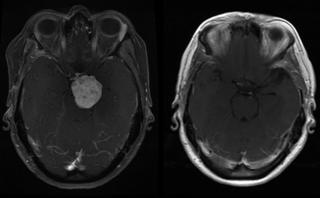
  • Contrast agents are commonly used for X-rays and CT's to better characterize disease, but contrast doesn't work with MRI. That's where the element Gadolinium comes into play.
  • Gadolinium, element 64, is ferromagnetic (attracted to iron) below 68 degrees and above that temperature it's paramagnetic which makes it useful in MRI (Magnetic Resonance Imaging).
  • Gadolinium is toxic alone, but when paired with chelators it can be used in humans and allows for better characterization of tumors or abnormal tissue on MRI.
  • It helps identify this abnormal tissue because when MRI causes polarization of our body's cells, the gadolinium, which has the maximum number of unpaired electrons in its orbital shells, alters the rate of decay in abnormal tissue highlighting abnormalities on imaging.
  • Gadolinium can also be used in the treatment of cancers because it collects in the cells of abnormal tissue, allowing for more targeted therapies.
  • In people exposed to gadolinium, the anaphylaxis rate is low, below 1/1000, and in rare cases there are reports of kidney injury and nephrogenic systemic fibrosis which is why it's not recommended in renal failure patients.

References

1)Ibrahim MA, Hazhirkarzar B, Dublin AB. Magnetic Resonance Imaging (MRI) Gadolinium. [Updated 2020 Mar 9]. In: StatPearls [Internet]. Treasure Island (FL): StatPearls Publishing; 2020 Jan-. Available from: https://www.ncbi.nlm.nih.gov/books/NBK482487/

2)Pasquini L, Napolitano A, Visconti E, et al. Gadolinium-Based Contrast Agent-Related Toxicities [published correction appears in CNS Drugs. 2018 May 15;:]. CNS Drugs. 2018;32(3):229-240. doi:10.1007/s40263-018-0500-1

Summarized by Jackson Roos, MS4 | Edited by Erik Verzemnieks, MD

Denne episoden er hentet fra en åpen RSS-feed og er ikke publisert av Podme. Den kan derfor inneholde annonser.

Episoder(1177)

Podcast 1022: Emergent Dialysis

Podcast 1022: Emergent Dialysis

Contributor: Taylor Lynch, MD Educational Pearls: When a patient who missed dialysis presents to the emergency department, our clinical concern is who needs to be admitted to the hospital for emerge...

21 Sep 4min

Podcast 1021: Pulmonary Edema From Naloxone Administration

Podcast 1021: Pulmonary Edema From Naloxone Administration

Contributor: Travis Barlock, MD Educational Pearls: What is pulmonary edema?  Pulmonary edema is the accumulation of fluid initially in the interstitium of the lungs, that when severe enough can als...

14 Sep 4min

Podcast 1020: Benign Paroxysmal Positional Vertigo (BPPV)

Podcast 1020: Benign Paroxysmal Positional Vertigo (BPPV)

Contributor: Alec Coston, MD Educational Pearls: Benign Paroxysmal Positional Vertigo (BPPV) Common inner ear condition that can cause dizziness Diagnosis of BPPV can help to avoid admissions and ...

7 Sep 6min

Podcast 1019: Trauma Blunt Cardiovascular Injuries (BCVI)

Podcast 1019: Trauma Blunt Cardiovascular Injuries (BCVI)

Contributor: Aaron Lessen, MD Educational Pearls:  Blunt cerebrovascular injury (BCVI) BCVI is a traumatic injury to the carotid or vertebral arteries Patients may initially have no neurologic sy...

31 Aug 3min

Podcast 1018: Occult Ventricular Fibrillation on Echocardiography

Podcast 1018: Occult Ventricular Fibrillation on Echocardiography

Contributor: Aaron Lessen, MD Educational Pearls: Big question in cardiac arrest: is the rhythm shockable? Shockable: ventricular fibrillation (VF) and pulseless ventricular tachycardia Non-sho...

24 Aug 2min

Podcast 1017: CPR Hand Placement

Podcast 1017: CPR Hand Placement

Contributor: Taylor Lynch, MD Educational Pearls:  CPR is an important life-saving measure designed for anyone to perform. Chest compressions works by two mechanisms:  Cardiac pump: Direct squ...

17 Aug 2min

Podcast 1016: Hypokalemia

Podcast 1016: Hypokalemia

Contributor: Meghan Hurley, MD Educational Pearls: What is hypokalemia? Hypokalemia is when the measured blood level of potassium falls below 3.5 mEq/L (normal 3.5 - 5.2 mEq/L).  Can generally be ...

10 Aug 6min

Podcast 1015: Calcium in Hyperkalemia

Podcast 1015: Calcium in Hyperkalemia

Contributor: Meghan Hurley, MD Educational Pearls: What is hyperkalemia? Hyperkalemia is when the measured blood level of potassium reaches above 5.2 - 5.5 mEq/L (normal 3.5 - 5.2 mEq/L).  What ar...

3 Aug 7min

Populært innen Vitenskap

fastlegen
romkapsel
tingenes-tilstand
jss
liberal-halvtime
forskningno
rekommandert
sinnsyn
tomprat-med-gunnar-tjomlid
villmarksliv
rss-paradigmepodden
fjellsportpodden
rss-nysgjerrige-norge
nordnorsk-historie
grunnstoffene
rss-rekommandert
tidlose-historier
rss-inn-til-kjernen-med-sunniva-rose
psykopoden
smart-forklart