Using functional traits to identify conservation priorities for the world's crocodylians
Ecology Podcast31 Aug 2022

Using functional traits to identify conservation priorities for the world's crocodylians

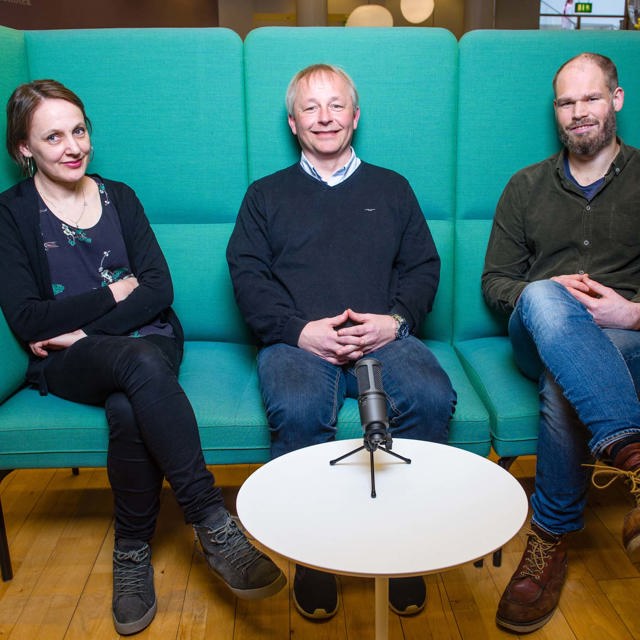
In this podcast for Functional Ecology, Assistant Editor, Frank Harris, sits down with Phoebe Griffith—a researcher from the Institute of Zoology, London, and the Wildlife Conservation Research Unit, Oxford University—to discuss her recently published paper ‘Using functional traits to identify conservation priorities for the world's crocodylians.’ To understand better the functional diversity of crocodylians, Griffiths et al. collected a database of functional traits of all species of crocodylians. These traits are measurable qualities – such as skull shape or saltwater tolerance – that allow us to understand the different ecological role of species, and how similar and different species are from one another. Read the paper here: https://besjournals.onlinelibrary.wiley.com/doi/full/10.1111/1365-2435.14140 For those that are hard of hearing, a transcript of the interview is available here: https://fesummaries.wordpress.com/2022/08/05/conserving-the-ecological-diversity-of-crocodylians/ Check out Phoebe's Edge of Existence blogpost for some great pictures and content: https://www.edgeofexistence.org/blog/crying-crocodile-tears-the-disappearing-diversity-of-crocodilians-and-their-ecological-roles/ To find out about and support ongoing croc conservation efforts, please do check out the following links: 1. https://www.edgeofexistence.org/fellow/jailabdeen-a/ 2. https://www.edgeofexistence.org/fellow/emmanuel-amoah/ Crocodylians have surprisingly diverse ecological roles, from the huge, highly aquatic and mostly fish-eating gharial to the tiny African dwarf crocodiles which can catch prey on land below the rainforest canopy. Sadly, over half of all crocodylians are threatened with extinction. If these threatened species go extinct, we will lose the diversity of ecological roles that they represent. Functional diversity is an important aspect of biodiversity to understand and conserve.

Denne episoden er hentet fra en åpen RSS-feed og er ikke publisert av Podme. Den kan derfor inneholde annonser.

Episoder(284)

ELM Network | Episode 5: Leading with noble intent, with Professor Sue Hartley

ELM Network | Episode 5: Leading with noble intent, with Professor Sue Hartley

As part of our 'Community' series, we’re launching the Emerging Leadership Management (ELM) Network, hosted by Rob Brooker, Thorunn Helgason, and Pen Holland. This is the podcast for people who love t...

21 Sep 42min

“All ecosystems are gendered” | an interview with Dr Robyn James

“All ecosystems are gendered” | an interview with Dr Robyn James

In the latest BES podcast, alumni committee member of the EDGE network Dr Trisha Gopalakrishna chats with Dr Robyn James about the challenges and strategies to tackle gender (in)equity in environmenta...

16 Sep 40min

Which red sea fish will invade the Mediterranean sea next? | The story behind the paper

Which red sea fish will invade the Mediterranean sea next? | The story behind the paper

For today's episode, Ivy is joined by Shahar Chaikin, author of "Native habitat affinities predict fish invasions with post-invasion habitat shifts". We discussed the story behind the paper and his ex...

19 Aug 21min

Plastic social buffering of environmental variation | Special Feature for Journal of Animal Ecology

Plastic social buffering of environmental variation | Special Feature for Journal of Animal Ecology

For today's episode, Ivy spoke with Dr David Fisher about his recently published Special Feature titled "Flexible friends: Plastic social buffering of environmental variation", co-edited by Natalie Pi...

11 Aug 13min
Spots or stripes? Identifying animals based on their patterns | The story behind the paper

Spots or stripes? Identifying animals based on their patterns | The story behind the paper

In this episode, we speak to András Zábó and Aamir Ahmad, about their paper 'RAPID: Real-time animal pattern re-identification on edge devices, an open-source tool for field deployment'. We discuss t...

23 Jul 25min
Lessening human-wildlife conflict | The story behind the paper

Lessening human-wildlife conflict | The story behind the paper

In today's episode, Anna is joined by Douglas Sheil and Emmanuel Akampurira, authors of a recently published paper in People and Nature, "Supporting interventions to lessen human-wildlife conflict". ...

10 Jul 48min
Does geography affect life history? A case study in Storks | The story behind the paper

Does geography affect life history? A case study in Storks | The story behind the paper

In this episode we talk to Matia Muller about his recently published paper 'Assessment of large-scale spatial variation in age-specific survival and age at first breeding in a long-lived species', whi...

30 Jun 21min
What a changing Arctic means for little auks | The story behind the paper

What a changing Arctic means for little auks | The story behind the paper

For today's episode, Ivy is joined by Martyna Syposz, author of "Snowmelt predicts earlier breeding across the latitudinal range of an Arctic nesting seabird, the Little Auk (Alle alle)". We discussed...

22 Jun 25min

Populært innen Vitenskap

fastlegen
romkapsel
liberal-halvtime
jss
tingenes-tilstand
forskningno
tomprat-med-gunnar-tjomlid
rekommandert
sinnsyn
villmarksliv
rss-paradigmepodden
fjellsportpodden
rss-nysgjerrige-norge
rss-kunstig-intelligens-med-elisabeth-maren-og-morten
rss-rekommandert
tidlose-historier
nordnorsk-historie
rss-inn-til-kjernen-med-sunniva-rose
psykopoden
grunnstoffene