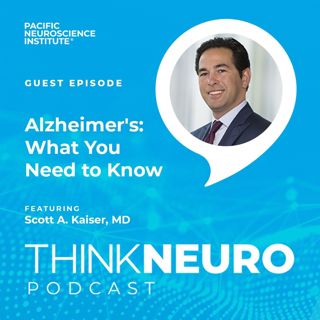
Alzheimer's: What You Need to Know | Scott A. Kaiser, MD - Guest Podcast
Think Neuro18 Des 2024

Alzheimer's: What You Need to Know | Scott A. Kaiser, MD - Guest Podcast

Alzheimer’s disease is a progressive neurological disorder that affects the brain’s function and causes a gradual decline in cognitive function, including memory, thinking, and behavior. It is the most common cause of dementia, accounting for approximately 70% of all cases of dementia.

The exact cause of Alzheimer’s disease is not fully understood, but it is believed to be a combination of genetic, environmental, and lifestyle factors. The disease is characterized by the accumulation of abnormal proteins in the brain, which interfere with the communication between brain cells and cause their death over time.

There is no cure for Alzheimer’s disease, but there are medications available that can help manage the symptoms and slow the progression of the disease. These medications work by increasing the levels of neurotransmitters in the brain, which can improve communication between brain cells and delay the onset of more severe symptoms.

Lifestyle changes, such as regular exercise, a healthy diet, and cognitive stimulation, may also be helpful in managing the symptoms of Alzheimer’s disease. Additionally, it is essential to work closely with a healthcare professional experienced in treating Alzheimer’s disease to develop an appropriate treatment plan.

While Alzheimer’s disease is a devastating condition that affects millions of people worldwide, early detection and treatment can help individuals maintain their quality of life for as long as possible.

Dr. Scott Kaiser, a board-certified family physician and geriatrician, is the Director of Geriatric Cognitive Health and provides specialty geriatric medical consultations at the Pacific Brain Health Center. Focused on the needs of older patients, he works with his colleagues to provide an integrated and holistic approach to their cognitive challenges. With this “whole person” approach, Dr. Kaiser works to connect patients and their families with a broad range of resources to support their overall health and well being.

Denne episoden er hentet fra en åpen RSS-feed og er ikke publisert av Podme. Den kan derfor inneholde annonser.

Episoder(315)

78. Revolutionizing Brain Tumor Surgery with Minimally Invasive Techniques with Daniel Kelly, MD

78. Revolutionizing Brain Tumor Surgery with Minimally Invasive Techniques with Daniel Kelly, MD

The world of brain surgery has changed dramatically over the past generation. Surgeons are able to remove many tumors and other problems from the brain, often using new approaches that have much short...

19 Aug 52min
Enhanced Recovery After Surgery (ERAS): The All-Important Pre-Operative Phase

Enhanced Recovery After Surgery (ERAS): The All-Important Pre-Operative Phase

Walavan Sivakumar, MD, explains how Enhanced Recovery After Surgery (ERAS) is used at PNI to help patients with brain tumors through the neurosurgical process. ERAS unfolds in three phases, and Dr. Si...

12 Aug 5min
Dopamine Neuron Cell Replacement Therapy for Parkinson's Disease with Melita Petrossian, MD

Dopamine Neuron Cell Replacement Therapy for Parkinson's Disease with Melita Petrossian, MD

Parkinson's disease begins with the quiet loss of the brain cells that make dopamine, and dopamine is what carries your movement, your mood and the drive that gets you through the day. As those cells ...

5 Aug 5min
77. The Little Gland with a Very Big Job with Garni Barkhoudarian, MD

77. The Little Gland with a Very Big Job with Garni Barkhoudarian, MD

For a tiny organ, the pituitary gland carries outsized responsibilities in the human body. The size of a pea, the so-called “master gland” produces vital hormones that regulate many important bodily f...

15 Jul 58min
Spotlight Replay - Episode 23: Scanning the Eye for Signs of Multiple Sclerosis | Dr. Barbara Giesser and Dr. Howard Krauss

Spotlight Replay - Episode 23: Scanning the Eye for Signs of Multiple Sclerosis | Dr. Barbara Giesser and Dr. Howard Krauss

July is Healthy Vision Month, and the National Eye Institute—part of the National Institutes of Health—reminds us to take care of our eyes, by eating a healthy diet and exercising, and also by underst...

1 Jul 39min
76. Getting the Right Diagnosis for Facial Paralysis with Dr. Amit Kochhar

76. Getting the Right Diagnosis for Facial Paralysis with Dr. Amit Kochhar

Every medical treatment needs to start with a diagnosis, but sometimes that diagnosis proves elusive. Sometimes it may appear that a person has one thing needing treatment, and after that treatment do...

17 Jun 33min
Spotlight Replay - Episode 56: Dr. Michael Yong on Seasonal Allergies

Spotlight Replay - Episode 56: Dr. Michael Yong on Seasonal Allergies

If you suffer from seasonal allergies, you probably kept a close eye on the pollen count this spring—and you may have felt those all-too-familiar symptoms that affect one in five people: Congestion, s...

10 Jun 39min
Chronic Subdural Hematoma with Ashkan Mowla, MD

Chronic Subdural Hematoma with Ashkan Mowla, MD

When blood collects in the skull outside the brain and below the outermost layer of tissue surrounding the brain (dura), a subdural hematoma results. This may occur due to head trauma when it is calle...

27 Mai 1min

Populært innen Vitenskap

fastlegen
tingenes-tilstand
romkapsel
rss-nysgjerrige-norge
jss
liberal-halvtime
tomprat-med-gunnar-tjomlid
sinnsyn
rss-paradigmepodden
rekommandert
forskningno
smart-forklart
fjellsportpodden
villmarksliv
dekodet-2
rss-inn-til-kjernen-med-sunniva-rose
vett-og-vitenskap-med-gaute-einevoll
rss-rekommandert
diagnose
tidlose-historier