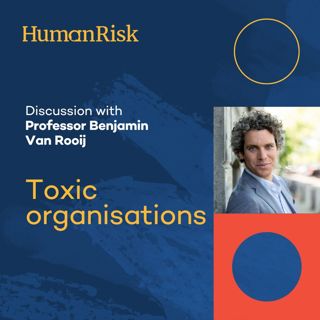
Professor Benjamin Van Rooij on Toxic Organisations

Professor Benjamin Van Rooij on Toxic Organisations

What makes an organisation toxic, and how can we spot the signs before it’s too late? What are the common traits that make seemingly unrelated organisations, ranging from the Catholic Church to corporations, do harm?

On this episode, I’m joined once again by one of my favourite guests — Professor Benjamin van Rooij — for a deep dive into the hidden dangers of organisational life.

Benjamin and his co-author, Professor Nicholas Lord, are working on a new book (working title) Toxic: Organisations Gone Bad, which explores not just headline-grabbing scandals, but the patterns of behaviour and structures that consistently lead organisations to cause harm.

Summary
In our discussion, we unpack how organisational processes — like silencing, secrecy, and the relentless pursuit of unrealistic goals — can multiply risk.

Benjamin explains why organisations, both public and private, can become “toxic” not simply due to bad people or poor oversight, but because of a combination of systemic dynamics and cultural norms that reward silence, over-ambition, and passive harm.

We also discuss why the term “toxic” itself is both useful and problematic, and how understanding these dynamics can help leaders make better decisions before disaster strikes; whether it’s Facebook’s role in spreading misinformation, Wells Fargo’s aggressive sales targets, or the normalization of deviance at Chernobyl and Enron, Benjamin helps us trace the common threads that connect seemingly unrelated crises.

And, true to form, he doesn’t offer simplistic solutions — instead, he gives us tools to ask better questions, challenge dominant narratives, and push for root-cause thinking over box-ticking fixes.

Guest Biography
Benjamin is Professor in Law and Society and Director of Research at the School of Law at the University of Amsterdam, as well as a Global Professor of Law at the University of California, Irvine.

In his academic work, Benjamin specialises in understanding how laws and regulations operate within real-world organisational settings, focusing on compliance, harm, and institutional accountability. He blends criminology, behavioural science, and legal studies to explore why people and institutions obey (or disobey) rules, and what systems best support ethical behaviour.

Previous appearances
On COVID Compliance 🎧 👉 https://www.humanriskpodcast.com/professor-benjamin-van-rooij-on-1/
On Questioning Compliance 🎧 👉 https://www.humanriskpodcast.com/professor-benjamin-van-rooij-on-questioning-compliance/
On The Behavioral Code 🎧 👉 https://www.humanriskpodcast.com/professor-benjamin-van-rooij-on/
On Compliance 2.0 with Professor Danny Sokol 🎧 👉 https://www.humanriskpodcast.com/professors-benjamin-van-rooij/
On Measuring Compliance with Professor Melissa Rorie 🎧 👉 https://www.humanriskpodcast.com/professors-melissa-rorie-benjamin-van-rooij-on-measuring-compliance/

Links
Benjamin's profile at UVA: https://www.uva.nl/en/profile/r/o/b.vanrooij/b.vanrooij.html?cb
The Behavior Code: https://www.penguinrandomhouse.com/books/676270/the-behavioral-code-by-benjamin-van-rooij-and-adam-fine/

AI Generated Timestamped Summary
[00:00:00] Introduction to toxic organisations and examples from Netflix-level scandals
[00:01:00] Benjamin van Rooij’s background and new book with Nicholas Lord
[00:03:00] Organisations as multipliers of harm, active vs passive harm
[00:04:00] The inductive approach — identifying patterns across scandals
[00:05:00] Why the term “toxic” is used despite its flaws
[00:06:00] How scandals like VW, Enron, and Boeing capture our imagination
[00:07:00] How the media and society react to scandals: harm → individuals → system
[00:08:00] Bad apples vs the “orchard” — systems shaping behaviour
[00:10:00] Connecting dots across different kinds of organisations
[00:11:00] Organisational secrecy and silencing — beyond simple fear
[00:13:00] Examples: Chernobyl, 3M, Enron — passive and active silencing
[00:14:00] Leadership failure patterns — neglect and irresponsibility
[00:15:00] Identifying patterns through reading, criminology, and org science
[00:16:00] How case studies were selected and why some were excluded
[00:19:00] Similar patterns across companies, churches, and political parties
[00:20:00] Book opens with contrast: Communist Party famine vs Purdue Pharma
[00:21:00] Unrealistic targets — why they’re the most important insight
[00:23:00] The mismatch between organisational goals and available means
[00:25:00] Scale and complexity: why modern orgs are different
[00:28:00] Limitations of simple solutions — complexity and nuance matter
[00:29:00] Leaders must balance ambition and safety, long-term vs short-term
[00:30:00] Why most harmful processes aren’t illegal — and that’s the problem
[00:32:00] Comparing organisational toxicity to viruses — some survive, some don’t
[00:34:00] Groupthink and cultural dynamics — the dangers of agreement
[00:36:00] Asking questions as a powerful organisational intervention
[00:38:00] Why we often don’t know what’s bad for us — lacking language or insight
[00:41:00] Empowering employees to ask the right questions backed by theory
[00:42:00] Why short-term thinking is embedded in systems and markets
[00:45:00] The overuse and misuse of “culture” as an explanation
[00:47:00] The need for genuine root-cause analysis
[00:48:00] Compliance playbooks vs reality — solutions don’t always fit
[00:51:00] The gap between what we do and what works — “compliance theatre”
[00:54:00] Good times can sow the seeds of harm — ambition blinds risk
[00:56:00] Organisations as overstretched systems — especially with scale
[00:58:00] Social media companies as a case of toxic organisational harm
[01:01:00] Retweet buttons, algorithms and unintended consequences
[01:02:00] Finalising the book and expanding it to include social media
[01:03:00] New project: The US executive branch as a potentially toxic organisation
[01:05:00] Conclusion and final reflections

Denne episoden er hentet fra en åpen RSS-feed og er ikke publisert av Podme. Den kan derfor inneholde annonser.

Episoder(382)

Dr Nina Burrowes on All Reasonable Steps: The Psychology of Sexual Harassment Prevention

Dr Nina Burrowes on All Reasonable Steps: The Psychology of Sexual Harassment Prevention

What does it actually take to prevent sexual harassment at work? Policies, training, reporting mechanisms and statements of zero tolerance are one thing. Creating a workplace where sexual harassment i...

25 Sep 1h 6min
Professor Alex Edmans on the Madness of Markets — Why Smart People Make Crazy Decisions

Professor Alex Edmans on the Madness of Markets — Why Smart People Make Crazy Decisions

What can financial markets teach us about human behaviour? Why might the size of a CEO’s signature tell us something useful about the company they run? And why, even when smart investors know somethin...

13 Sep 1h 1min
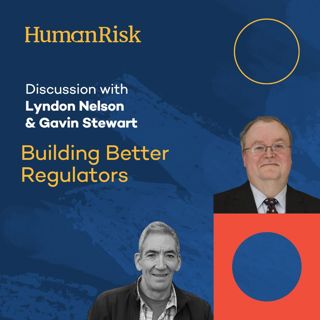
Lyndon Nelson & Gavin Stewart on Building Better Regulators

Lyndon Nelson & Gavin Stewart on Building Better Regulators

What if understanding regulation could help us spot when politicians are promising the impossible? Regulation sounds simple in theory. Something poses a risk, so we create rules and a regulator to con...

7 Sep 1h 23min
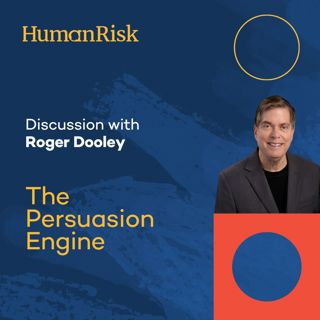
Roger Dooley on The Persuasion Engine

Roger Dooley on The Persuasion Engine

What if AI could help us understand people better, rather than simply replacing what humans do?Episode summaryHow can we use AI to become better at persuasion, communication and understanding human be...

1 Sep 59min
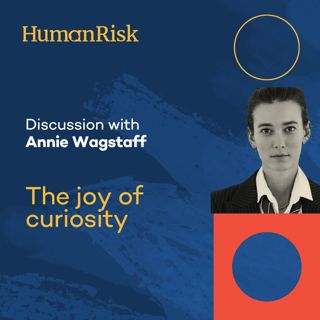
Annie Wagstaff on The Joy of Curiosity

Annie Wagstaff on The Joy of Curiosity

What’s the last thing you learned simply because you wanted to know?Episode summaryWhy do we feel the need to justify what we learn? My guest on this episode is Annie Wagstaff, a musician and composer...

23 Aug 1h
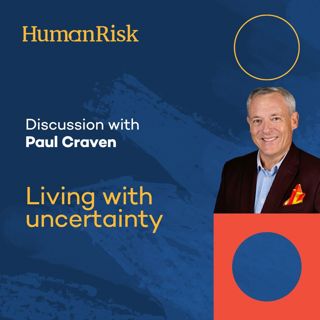
Paul Craven on Living With Uncertainty

Paul Craven on Living With Uncertainty

What happens when someone who spends his life thinking about risk, decision-making and human behaviour is confronted with an uncertainty he simply can’t control?Episode summaryMy guest is Paul Craven,...

15 Aug 51min
Benji Wilson on why we rate everything

Benji Wilson on why we rate everything

Why do we rate everything and why do we do so on a scale of one to five stars? What happens when systems designed to help us make better choices start influencing our behaviour in ways we don’t necess...

8 Aug 1h 4min
Mark Heywood on The Stories We Tell About Ourselves

Mark Heywood on The Stories We Tell About Ourselves

What parts of yourself have you learned to hide in order to be taken seriously? My guest on this episode is Mark Heywood, a friend of the show, returning guest and someone I've collaborated with on a ...

2 Aug 1h 21min

Populært innen Vitenskap

fastlegen
romkapsel
liberal-halvtime
jss
tingenes-tilstand
forskningno
tomprat-med-gunnar-tjomlid
rekommandert
sinnsyn
villmarksliv
rss-paradigmepodden
fjellsportpodden
rss-nysgjerrige-norge
rss-kunstig-intelligens-med-elisabeth-maren-og-morten
rss-rekommandert
tidlose-historier
nordnorsk-historie
rss-inn-til-kjernen-med-sunniva-rose
psykopoden
grunnstoffene