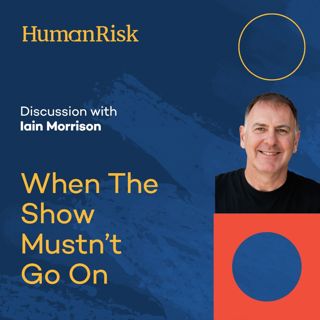
Iain Morrison on When The Show Mustn't Go On

Iain Morrison on When The Show Mustn't Go On

We’ve all heard the phrase ‘the show must go on’. But when shouldn’t the show go on? To help me answer that, I’m speaking to someone who has spent 35 years managing some of Australia’s most iconic large-scale events — from Taylor Swift concerts to public city spectacles with crowds over 200,000, and corporate experiences — and has often faced the question: when should the show really stop?

My guest is Iain Morrison, wh,o as well as having a background in events, is now the CEO of a startup that builds hyper‑accurate 3D and VR plans for event venues.

Episode Summary
In this episode, I dig into what happens when the entertainment world’s credo — “the show must go on” — becomes a liability, and what it feels like backstage to carry that kind of responsibility.

Iain explains the importance of having show‑stop protocols long before trouble arrives — whether it’s crowd crush, heart attacks in the crowd, or approaching severe weather. He explains how event organisers need to make decisions in advance so that nobody freezes under pressure, and ensure everyone is aligned on who can stop the show, and how and when to restart it.

We also delve into the emotional toll of the event industry — the brutal hours, constant touring, adrenaline highs, and the realities of burnout. Ian talks candidly about putting people at risk by cutting critical breaks and how easily event teams can burn out.

Finally, he walks me through his pivot: building a tech startup that uses 3D planning and virtual models to give event teams a fully visual planning tool — reducing surprises, improving safety, and supporting better decisions from the very first draft.

GUEST BIOGRAPHY
Iain is an event manager with over three decades of experience in running major concerts, festivals, and public spectacles across Australia. He has helped deliver live shows for acts like Taylor Swift, U2, Foo Fighters, major public events on the Sydney Harbour Bridge and Domain Concert series, with crowds ranging from 5,000 to over 200,000.

From high school theatre beginnings to early work at Opera Australia and the Sydney Opera House, Ian transitioned into corporate events, the Olympics, and large public outdoor events. He has worked in high-pressure environments where crowd safety, terrorism threats, public order, and weather call-offs were part of the job on a daily basis.

About two years ago, he moved from event delivery to event technology — as CEO and co‑founder of The Imagination Collaborative, Ian now leads a startup building hyper‑accurate 3D and VR planning tools. These digital twins help event teams visualise venue layouts, crowd flows, sightlines, signage, camera positions, evacuation routes and more—before anything is built on site.

AI-GENERATED TIMESTAMPED SUMMARY
[00:00:00] Introduction

[00:02:00] Ian’s backstory: school theatre → university → Opera House → major events

[00:05:00] Scale of events: from 5,000 attendees to crowds of over 200,000

[00:08:00] Types of risk at live events: crowd crush, terrorism threats, medical events

[00:12:00] Why events remain largely unregulated worldwide

[00:15:00] Concept of a “show stop”: planning for what enables safe cancellation or pause

[00:20:00] Decision‑making under stress: protocols versus ego-based pressure

[00:25:00] Real scenarios: thunderstorms, crowd reaction, and restart challenges

[00:28:00] Emotional cost on crews: burnout, long hours, compressed touring schedules

[00:32:00] Industry taboo around mental health and burnout; making it safer for staff

[00:36:00] Ian’s use of social media to spark conversations on stress, safety and standards

[00:40:00] Introduction to Ian’s startup: detailed planning with 3D environments and VR

[00:44:00] How the tool works: drone scans, venue models, client interaction in virtual space

[00:48:00] Benefits: fewer surprises, better sightlines, optimised signage, cost savings

[00:51:00] Future plans: integrating crowd simulation, digital twin models, global expansion

[00:55:00] Final reflections: the trade‑offs of delivering magic vs ensuring safety

[00:57:00] Wrap‑up

LINKS
Iain on LinkedIn - https://www.linkedin.com/in/iainmorrison1/

Iain’s website - https://iainmorrison.global/

Iain’s startup, The Imagination Collaborative - https://www.theimaginationcollaborative.com/

Denne episoden er hentet fra en åpen RSS-feed og er ikke publisert av Podme. Den kan derfor inneholde annonser.

Episoder(382)

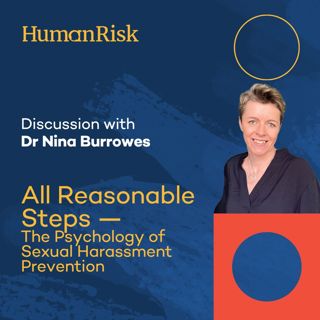
Dr Nina Burrowes on All Reasonable Steps: The Psychology of Sexual Harassment Prevention

Dr Nina Burrowes on All Reasonable Steps: The Psychology of Sexual Harassment Prevention

What does it actually take to prevent sexual harassment at work? Policies, training, reporting mechanisms and statements of zero tolerance are one thing. Creating a workplace where sexual harassment i...

25 Sep 1h 6min
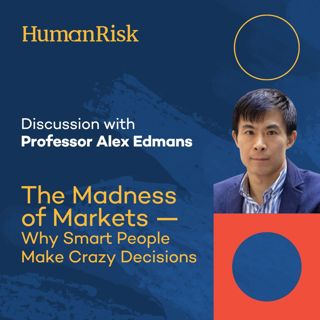
Professor Alex Edmans on the Madness of Markets — Why Smart People Make Crazy Decisions

Professor Alex Edmans on the Madness of Markets — Why Smart People Make Crazy Decisions

What can financial markets teach us about human behaviour? Why might the size of a CEO’s signature tell us something useful about the company they run? And why, even when smart investors know somethin...

13 Sep 1h 1min
Lyndon Nelson & Gavin Stewart on Building Better Regulators

Lyndon Nelson & Gavin Stewart on Building Better Regulators

What if understanding regulation could help us spot when politicians are promising the impossible? Regulation sounds simple in theory. Something poses a risk, so we create rules and a regulator to con...

7 Sep 1h 23min
Roger Dooley on The Persuasion Engine

Roger Dooley on The Persuasion Engine

What if AI could help us understand people better, rather than simply replacing what humans do?Episode summaryHow can we use AI to become better at persuasion, communication and understanding human be...

1 Sep 59min
Annie Wagstaff on The Joy of Curiosity

Annie Wagstaff on The Joy of Curiosity

What’s the last thing you learned simply because you wanted to know?Episode summaryWhy do we feel the need to justify what we learn? My guest on this episode is Annie Wagstaff, a musician and composer...

23 Aug 1h
Paul Craven on Living With Uncertainty

Paul Craven on Living With Uncertainty

What happens when someone who spends his life thinking about risk, decision-making and human behaviour is confronted with an uncertainty he simply can’t control?Episode summaryMy guest is Paul Craven,...

15 Aug 51min
Benji Wilson on why we rate everything

Benji Wilson on why we rate everything

Why do we rate everything and why do we do so on a scale of one to five stars? What happens when systems designed to help us make better choices start influencing our behaviour in ways we don’t necess...

8 Aug 1h 4min
Mark Heywood on The Stories We Tell About Ourselves

Mark Heywood on The Stories We Tell About Ourselves

What parts of yourself have you learned to hide in order to be taken seriously? My guest on this episode is Mark Heywood, a friend of the show, returning guest and someone I've collaborated with on a ...

2 Aug 1h 21min

Populært innen Vitenskap

fastlegen
romkapsel
tingenes-tilstand
jss
liberal-halvtime
forskningno
rekommandert
sinnsyn
tomprat-med-gunnar-tjomlid
villmarksliv
rss-paradigmepodden
fjellsportpodden
rss-nysgjerrige-norge
nordnorsk-historie
grunnstoffene
rss-rekommandert
tidlose-historier
rss-inn-til-kjernen-med-sunniva-rose
psykopoden
smart-forklart