

Episode 13 and 14 DOUBLE-ALBUM Preview
Subscribe on iTunes Subscribe on Google Play Subscribe on Stitcher In this double-album edition of our preview episodes, we're talking about research on transitioning to adulthood for individuals with autism. In addition to our typical review of research related to the subject, we've got an interview with Dr. Peter Gerhardt, a leader in spreading awareness of the crisis that is special education services for adults. On the lighter side of things: the results of our filler speech challenge! Only one can win, though everyone gets candy. Also, errata featuring a fun link from a listener about standard celeration charts. Listen to the full episodes over the next two weeks (yes, back-to-back episodes) for maximum information and discussion. Articles for next week: Gerhardt, P.F. & Lainer, I. (2011). Addressing the needs of adolescents and adults with autism: A crisis on the horizon. Journal of Contemporary Psychoherapy, 41, 37-45. doi 10.1007/s10879-010-9160-2 And, while not a research article, a parent's perspective on the transition process: "Luke's best chance: One man's fight for his autistic son" from Rolling Stone magazine Articles for the week after that: Burke, R.V., Andersen, M.N., Bowen, S.L., Howard, M.R., & Allen, K.D. (2010). Evaluation of two instruction methods to increase employment options for young adults with autism spectrum disorders. Research in Developmental Disabilities, 31, 1223-1233. doi: 10.1016/j.ridd.2010.07.023 Dotto-Fojut, K.M., Reeve, K.F., Townsend, D.B., & Progar, P.R. (2011). Teaching adolescents with autism to describe a problem and request assistance during simulated vocational tasks. Research in Autism Spectrum Disorders, 5, 826-833. doi: 10.1016/j.rasd.2010.09.012
17 Aug 201620min

Episode 12 - Research Grab Bag
Subscribe on iTunes Subscribe on Google Play Subscribe on Stitcher This week we take out three articles from our research grab bag, three articles related only by our enjoyment of the subject matter. Diana teaches us all the merits of good yoga poses, Rob chides everyone for all of their filler responses, and Jackie uses bark collars to keep the hosts behaving. Plus, Rob breaks our brand new mixer and we all reiterate Skinner's proposition that applied behavior analysis is the cat's pajamas. That "cat's pajamas" part might be a paraphrase. Articles discussed this episode: Protopopova, A., Kisten, D., & Wynne, C. (2016). Evaluating a humane alternative to the bark collar: Automated differential reinforcement of not barking in a home-alone setting. Journal of Applied Behavior Analysis, 49, 1-10. doi:10.1002/jaba.334 Mancuso, C. & Miltenberger, R.G. (2016). Using habit reversal to decrease filled pauses in public speaking. Journal of Applied Behavior Analysis, 49, 188-192. doi: 10.1002/jaba.267 Gruber, D.J. & Poulson, C.L. (2016). Graduated guidance delivered by parents to teach yoga to children with developmental delays. Journal of Applied Behavior Analysis, 49, 193-198. doi: 10.1002/jaba.260 If you're interested in ordering CEs for listening to this episode, click here to go to the store page. You'll need to enter your name, BCBA #, and the two episode secret code words to complete the purchase. Email us at abainsidetrack@gmail.com for further assistance.
10 Aug 20161h 18min
Episode 12 Preview
Subscribe on iTunes Subscribe on Google Play Subscribe on Stitcher It's research grab bag time! Next week, we're discussing three articles only linked by our interest in the subject matter. But first, Rob reads some listener mail while Jackie and Diana prepare to give a speech. How many times will they say "um" or "like"? Email us with the answer for a chance at a CE credit. Articles for next week: Protopopova, A., Kisten, D., & Wynne, C. (2016). Evaluating a humane alternative to the bark collar: Automated differential reinforcement of not barking in a home-alone setting. Journal of Applied Behavior Analysis, 49, 1-10. doi:10.1002/jaba.334 Mancuso, C. & Miltenberger, R.G. (2016). Using habit reversal to decrease filled pauses in public speaking. Journal of Applied Behavior Analysis, 49, 188-192. doi: 10.1002/jaba.267 Gruber, D.J. & Poulson, C.L. (2016). Graduated guidance delivered by parents to teach yoga to children with developmental delays. Journal of Applied Behavior Analysis, 49, 193-198. doi: 10.1002/jaba.260
3 Aug 201622min

Episode 11 - Preventing Errors in Discrete Trial Training
Subscribe on iTunes Subscribe on Google Play Subscribe on Stitcher Rather than pull your hair out about that discrete trial program that JUST...ISN'T...WORKING, why not listen to us discuss some possible solutions. We review research on minimizing overselectivity using a differential observing response and on using more salient behavior-consequence relations all in the name of helping you avoid those pesky DTT error patterns. Plus, we share the secrets of remembering the 140 Crayola crayon colors, literal reinforcer stacking, and Rob's Boston accent. Articles discussed this episode: Dube, W.V, & McIlvane, W.J. (1999). Reduction of stimulus overselectivity with nonverbal differential observing responses. Journal of Applied Behavior Analysis, 32, 25-33. doi: 10.1901/jaba.1999.32-25 Fisher, W.W., Pawich, T.L., Dickes, N., Paden, A.R., & Toussaint, K. (2014). Increasing the saliency of behavior-consequence relations for children with autism who exhibit persistent errors. Journal of Applied Behavior Analysis, 47, 738-748. doi: 10.1002/jaba.172 If you're interested in ordering CEs for listening to this episode, click here to go to the store page. You'll need to enter your name, BCBA #, and the two episode secret code words to complete the purchase. Email us at abainsidetrack@gmail.com for further assistance.
27 Jul 20161h 10min
Episode 11 Preview
Subscribe on iTunes Subscribe on Google Play Subscribe on Stitcher In preparing to talk about avoiding errors during discrete trial training, we take some time to celebrate milestones, thank our listeners, and discuss some interesting feedback. And, to stay hip with the kids, we try our hand at a YouTube stream. Articles for next week: Dube, W.V, & McIlvane, W.J. (1999). Reduction of stimulus overselectivity with nonverbal differential observing responses. Journal of Applied Behavior Analysis, 32, 25-33. doi: 10.1901/jaba.1999.32-25 Fisher, W.W., Pawich, T.L., Dickes, N., Paden, A.R., & Toussaint, K. (2014). Increasing the saliency of behavior-consequence relations for children with autism who exhibit persistent errors. Journal of Applied Behavior Analysis, 47, 738-748. doi: 10.1002/jaba.172
20 Jul 201614min
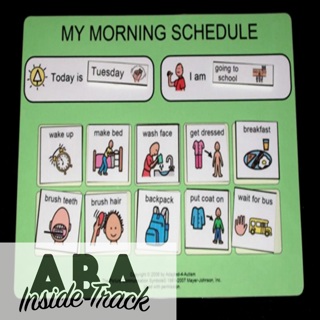
Episode 10 - Picture Activity Schedules
Subscribe on iTunes Subscribe on Google Play Subscribe on Stitcher This week we're looking at using picture activity schedules to increase play and social interactions. We spill the beans, break the ice, hide, seek, and jump into the wood chips all in the name of extending the literature on this excellent technology. And, without a visual schedule, we let Rob review an article with humorous results. Well, they would have been humorous, but he does all the editing. Articles discussed this episode: Betz, A., Higbee, T.E., & Reagon, K.A. (2008). Using joint activity schedules to promote peer engagement in preschoolers with autism. Journal of Applied Behavior Analysis, 41, 237-241. doi: 10.1901/jaba.2008.41-237 Brodhead, M.T., Higbee, T.S., Pollard, J.S., Akers, J.S., & Gerencser, K.R. (2014). The use of linked activity schedules to teach children with autism to play hide-and-seek. Journal of Applied Behavior Analysis, 47, 645-650. doi: 10.1002/jaba.145 Akers, J.S., Higbee, T.S., Pollard, J.S., Pellegrino, A.J., & Gerencser, K.R. (2016). An evaluation of photographic activity schedules to increase independent playground skills in young children with autism. Journal of Applied Behavior Analysis, 49, 1-6. doi: 10.1002/jaba.327 If you're interested in ordering CEs for listening to this episode, click here to go to the store page. You'll need to enter your name, BCBA #, and the two episode secret code words to complete the purchase. Email us at abainsidetrack@gmail.com for further assistance.
13 Jul 20161h 7min
Episode 10 Preview
Subscribe on iTunes Subscribe on Google Play Subscribe on Stitcher Diana and Jackie hold down the fort in this preview of articles we'll be discussing next week on the topic of picture-activity schedules. Please don't mistake our rituals of cleaning as a reflection on the utility of a PAS. It's just us, we swear. Articles for next week: Betz, A., Higbee, T.E., & Reagon, K.A. (2008). Using joint activity schedules to promote peer engagement in preschoolers with autism. Journal of Applied Behavior Analysis, 41, 237-241. doi: 10.1901/jaba.2008.41-237 Brodhead, M.T., Higbee, T.S., Pollard, J.S., Akers, J.S., & Gerencser, K.R. (2014). The use of linked activity schedules to teach children with autism to play hide-and-seek. Journal of Applied Behavior Analysis, 47, 645-650. doi: 10.1002/jaba.145 Akers, J.S., Higbee, T.S., Pollard, J.S., Pellegrino, A.J., & Gerencser, K.R. (2016). An evaluation of photographic activity schedules to increase independent playground skills in young children with autism. Journal of Applied Behavior Analysis, 49, 1-6. doi: 10.1002/jaba.327
6 Jul 20169min

Episode 9 - Choice
Subscribe on iTunes Subscribe on Google Play Subscribe on Stitcher Dr Allen Karsina drops by to share his research on choice. We review some key facts in the literature on choice, how manipulations to choice-making schedules affect the value of choice, and whether we should believe the hype about choice. Don't forget to listen all the way through to hear about exciting research using our family members as participants and for a delightful poetry jam to round out the episode. You chose to subscribe. Articles discussed this episode: Karsina, A., Thompson, R.H., & Rodriguez, N.M. (2011). Effects of a history of differential reinforcement on preference for choice. Journal of the Experimental Analysis of Behavior, 95, 189-202. doi:10.1901/jeab.2011.95-189 Fisher, W.W., Thompson, R.H., Piazza, C.C., Crosland, K., & Gotjen, D. (1997). On the relative reinforcing effects of choice and differential consequences. Journal of Applied Behavior Analysis, 30, 423-438. doi:10.1901/jaba.197.30-423 Tiger, J.H., Hanley, G.P., & Hernandez, E. (2006). An evaluation of the value of choice with preschool children. Journal of Applied Behavior Analysis, 39, 1-16. doi:10.1901/jaba.2006.158-04 If you're interested in ordering CEs for listening to this episode, click here to go to the store page. You'll need to enter your name, BCBA #, and the two episode secret code words to complete the purchase. Email us at abainsidetrack@gmail.com for further assistance.
29 Jun 20161h 20min