Dr Nikolay Kukushkin on Memory

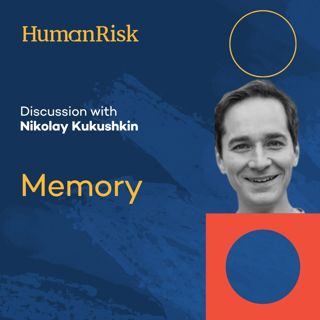
Dr Nikolay Kukushkin on Memory

What if your body is learning things your mind doesn’t know? What if memory wasn't just something that our brain has?

Episode Summary
On this episode, I'm exploring a bold idea with neuroscientist Dr Nikolay Kukushkin: memory doesn’t just live in the brain. It might be a basic property of life itself. We unpack how scientists define memory (behavioural change over time) versus how the rest of us use the word, and why that distinction matters—from sea slugs to kidney cells. I ask the “muscle memory” question we all carry, and we separate the metaphor from the biology: your basal ganglia automate behaviours, but your muscle cells do literally adapt to patterned use.

We go deep on “patterns.” Nikolay’s work shows that even non-neural cells can detect minute-scale timing differences—preferring spaced pulses over a single crammed dose. That has huge implications for learning, exercise, nutrition, and even medicine; it suggests timing might be as important as quantity. We also talk about sleep as essential “synaptic housekeeping,” why false memories are an adaptive feature (not a failure), and what it really means to “run out of memory” in our overstimulated world.

Finally, we tilt at the big questions: how consciousness might have evolved, why Plato’s model of perception eerily echoes today’s top-down/bottom-up neuroscience, and what AI still lacks—learning patterns in time within an embodied world. If you’ve ever crammed for an exam, worried about forgetting your own name, or wondered what your cells are quietly learning from your daily routines, this one will rewire how you think about memory.

Guest Biography — Dr Nikolay Kukushkin
Dr Nikolay Kukushkin is a Clinical Associate Professor at NYU. His book One Hand Clapping: Unraveling the Mystery of the Human Mind traces how consciousness emerged from the natural world; the original Russian edition won the Enlightener (Prosvetitel) Award and the Alexander Belyaev Medal.

His recent research (Nature Communications, Nov 2024) showed that non-neural human cells display the classic “spacing effect,” suggesting memory-like temporal patterning beyond the brain.

AI-Generated Timestamped Summary
[00:00:00] Cold open: reframing memory as cellular, not just neural.
[00:01:00] Scientists’ definition of memory vs everyday usage.
[00:03:00] From behaviour change to cellular change; beyond “plugging a muscle into a brain.”
[00:05:00] All cells have experiences; “pattern matters.”
[00:06:00] Muscle memory: basal ganglia automation vs literal muscle adaptation.
[00:07:00] Shared molecular machinery: “use it or lose it” in brain and muscle.
[00:08:00] Nikolay’s path: from molecules to minds; bottom-up neuroscience.
[00:09:00] Protein quality control: molecular barcodes and cellular “conversations.”
[00:11:00] Why sea slugs: short path from molecules to behaviour.
[00:13:00] Hypothesis leap: if single neurons learn from pulses, could kidney cells?
[00:14:00] The experiment: four 3-min pulses vs one 12-min pulse (spacing wins).
[00:16:00] What’s uniquely neural: synapses and specific connectivity; where salience arises.
[00:19:00] Memory without awareness; non-neural systems can store patterns.
[00:20:00] Applications: exercise, diet, medicine; timing as a lever.
[00:23:00] The dark mirror: life as obsessive optimisation if we over-pattern.
[00:24:00] Personal practice: being mindful of inputs, attention as filter.
[00:26:00] Debunking “10% of the brain” and the sleep–memory link.
[00:28:00] Sleep weakens synapses; deprivation leads to saturation and hallucinations.
[00:30:00] The social-media “soup” analogy for saturated memory.
[00:32:00] Names, identity and rehearsal; de-naming as degradation.
[00:33:00] Reconsolidation: why false memories are a feature we need.
[00:34:00] 9/11/Challenger studies: how memories drift with time.
[00:36:00] Ebbinghaus and the spacing effect across species and systems.
[00:39:00] Cramming vs spacing: initial strength and decay rates.
[00:41:00] The forgetting curve and why “more” can decay slower in memory.
[00:42:00] “My whole life is one big experiment on my brain.”
[00:43:00] Practical “tip”: fix attention first; follow interest, not force.
[00:45:00] Attention economy and selective inputs as memory hygiene.
[00:48:00] From smoking to scrolling: a future of information hygiene.
[00:50:00] One Hand Clapping: why it feels special to be you.
[00:54:00] Plato’s “two fires”: ancient echoes of top-down/bottom-up perception.
[00:58:00] Intuition as hidden associations; LLMs as an analogy.
[01:00:00] AI: excitement, unease, and the risk of outsourcing humanness.
[01:03:00] What AI lacks: learning patterns in time without a body.
[01:05:00] Close and thanks.
[01:06:00] Outro and calls to action.

Links
Nikolay's website - https://www.nikolaykukushkin.com/


His NYC profile - https://liberalstudies.nyu.edu/about/faculty-listing/nikolay-kukushkin.html

His book 'One Hand Clapping' - https://www.nikolaykukushkin.com/press-1

'Memory Takes Time': research into how wemory is not confined to a particular location or locations in the brain - https://www.cell.com/neuron/fulltext/S0896-62731730467-1

Herman Ebbinghaus - https://en.wikipedia.org/wiki/Hermann_Ebbinghaus and The Ebbinghaus Illusion: https://en.wikipedia.org/wiki/Ebbinghaus_illusion

Denne episoden er hentet fra en åpen RSS-feed og er ikke publisert av Podme. Den kan derfor inneholde annonser.

Episoder(382)

Dr Nina Burrowes on All Reasonable Steps: The Psychology of Sexual Harassment Prevention

Dr Nina Burrowes on All Reasonable Steps: The Psychology of Sexual Harassment Prevention

What does it actually take to prevent sexual harassment at work? Policies, training, reporting mechanisms and statements of zero tolerance are one thing. Creating a workplace where sexual harassment i...

25 Sep 1h 6min
Professor Alex Edmans on the Madness of Markets — Why Smart People Make Crazy Decisions

Professor Alex Edmans on the Madness of Markets — Why Smart People Make Crazy Decisions

What can financial markets teach us about human behaviour? Why might the size of a CEO’s signature tell us something useful about the company they run? And why, even when smart investors know somethin...

13 Sep 1h 1min
Lyndon Nelson & Gavin Stewart on Building Better Regulators

Lyndon Nelson & Gavin Stewart on Building Better Regulators

What if understanding regulation could help us spot when politicians are promising the impossible? Regulation sounds simple in theory. Something poses a risk, so we create rules and a regulator to con...

7 Sep 1h 23min
Roger Dooley on The Persuasion Engine

Roger Dooley on The Persuasion Engine

What if AI could help us understand people better, rather than simply replacing what humans do?Episode summaryHow can we use AI to become better at persuasion, communication and understanding human be...

1 Sep 59min
Annie Wagstaff on The Joy of Curiosity

Annie Wagstaff on The Joy of Curiosity

What’s the last thing you learned simply because you wanted to know?Episode summaryWhy do we feel the need to justify what we learn? My guest on this episode is Annie Wagstaff, a musician and composer...

23 Aug 1h
Paul Craven on Living With Uncertainty

Paul Craven on Living With Uncertainty

What happens when someone who spends his life thinking about risk, decision-making and human behaviour is confronted with an uncertainty he simply can’t control?Episode summaryMy guest is Paul Craven,...

15 Aug 51min
Benji Wilson on why we rate everything

Benji Wilson on why we rate everything

Why do we rate everything and why do we do so on a scale of one to five stars? What happens when systems designed to help us make better choices start influencing our behaviour in ways we don’t necess...

8 Aug 1h 4min
Mark Heywood on The Stories We Tell About Ourselves

Mark Heywood on The Stories We Tell About Ourselves

What parts of yourself have you learned to hide in order to be taken seriously? My guest on this episode is Mark Heywood, a friend of the show, returning guest and someone I've collaborated with on a ...

2 Aug 1h 21min

Populært innen Vitenskap

fastlegen
romkapsel
tingenes-tilstand
jss
liberal-halvtime
forskningno
sinnsyn
rekommandert
villmarksliv
rss-paradigmepodden
fjellsportpodden
tomprat-med-gunnar-tjomlid
grunnstoffene
nordnorsk-historie
rss-nysgjerrige-norge
tidlose-historier
psykopoden
rss-rekommandert
rss-inn-til-kjernen-med-sunniva-rose
smart-forklart