
#227 – Helen Toner on the geopolitics of AGI in China and the Middle East

#227 – Helen Toner on the geopolitics of AGI in China and the Middle East

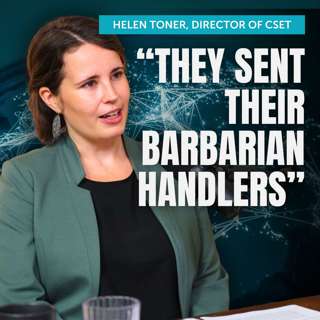
With the US racing to develop AGI and superintelligence ahead of China, you might expect the two countries to be negotiating how they’ll deploy AI, including in the military, without coming to blows. But according to Helen Toner, director of the Center for Security and Emerging Technology in DC, “the US and Chinese governments are barely talking at all.”

Links to learn more, video, and full transcript: https://80k.info/ht25

In her role as a founder, and now leader, of DC’s top think tank focused on the geopolitical and military implications of AI, Helen has been closely tracking the US’s AI diplomacy since 2019.

“Over the last couple of years there have been some direct [US–China] talks on some small number of issues, but they’ve also often been completely suspended.” China knows the US wants to talk more, so “that becomes a bargaining chip for China to say, ‘We don’t want to talk to you. We’re not going to do these military-to-military talks about extremely sensitive, important issues, because we’re mad.'”

Helen isn’t sure the groundwork exists for productive dialogue in any case. “At the government level, [there’s] very little agreement” on what AGI is, whether it’s possible soon, whether it poses major risks. Without shared understanding of the problem, negotiating solutions is very difficult.

Another issue is that so far the Chinese Communist Party doesn’t seem especially “AGI-pilled.” While a few Chinese companies like DeepSeek are betting on scaling, she sees little evidence Chinese leadership shares Silicon Valley’s conviction that AGI will arrive any minute now, and export controls have made it very difficult for them to access compute to match US competitors.

When DeepSeek released R1 just three months after OpenAI’s o1, observers declared the US–China gap on AI had all but disappeared. But Helen notes OpenAI has since scaled to o3 and o4, with nothing to match on the Chinese side. “We’re now at something like a nine-month gap, and that might be longer.”

To find a properly AGI-pilled autocracy, we might need to look at nominal US allies. The US has approved massive data centres in the UAE and Saudi Arabia with “hundreds of thousands of next-generation Nvidia chips” — delivering colossal levels of computing power.

When OpenAI announced this deal with the UAE, they celebrated that it was “rooted in democratic values,” and would advance “democratic AI rails” and provide “a clear alternative to authoritarian versions of AI.”

But the UAE scores 18 out of 100 on Freedom House’s democracy index. “This is really not a country that respects rule of law,” Helen observes. Political parties are banned, elections are fake, dissidents are persecuted.

If AI access really determines future national power, handing world-class supercomputers to Gulf autocracies seems pretty questionable. The justification is typically that “if we don’t sell it, China will” — a transparently false claim, given severe Chinese production constraints. It also raises eyebrows that Gulf countries conduct joint military exercises with China and their rulers have “very tight personal and commercial relationships with Chinese political leaders and business leaders.”

In today’s episode, host Rob Wiblin and Helen discuss all that and more.

This episode was recorded on September 25, 2025.

CSET is hiring a frontier AI research fellow! https://80k.info/cset-role
Check out its careers page for current roles: https://cset.georgetown.edu/careers/

Chapters:

  • Cold open (00:00:00)
  • Who’s Helen Toner? (00:01:02)
  • Helen’s role on the OpenAI board, and what happened with Sam Altman (00:01:31)
  • The Center for Security and Emerging Technology (CSET) (00:07:35)
  • CSET’s role in export controls against China (00:10:43)
  • Does it matter if the world uses US AI models? (00:21:24)
  • Is China actually racing to build AGI? (00:27:10)
  • Could China easily steal AI model weights from US companies? (00:38:14)
  • The next big thing is probably robotics (00:46:42)
  • Why is the Trump administration sabotaging the US high-tech sector? (00:48:17)
  • Are data centres in the UAE “good for democracy”? (00:51:31)
  • Will AI inevitably concentrate power? (01:06:20)
  • “Adaptation buffers” vs non-proliferation (01:28:16)
  • Will the military use AI for decision-making? (01:36:09)
  • “Alignment” is (usually) a terrible term (01:42:51)
  • Is Congress starting to take superintelligence seriously? (01:45:19)
  • AI progress isn't actually slowing down (01:47:44)
  • What's legit vs not about OpenAI’s restructure (01:55:28)
  • Is Helen unusually “normal”? (01:58:57)
  • How to keep up with rapid changes in AI and geopolitics (02:02:42)
  • What CSET can uniquely add to the DC policy world (02:05:51)
  • Talent bottlenecks in DC (02:13:26)
  • What evidence, if any, could settle how worried we should be about AI risk? (02:16:28)
  • Is CSET hiring? (02:18:22)

Video editing: Luke Monsour and Simon Monsour
Audio engineering: Milo McGuire, Simon Monsour, and Dominic Armstrong
Music: CORBIT
Coordination, transcriptions, and web: Katy Moore

Episoder(333)

'95% of AI Pilots Fail': The hidden agenda behind the viral stat that misled millions

'95% of AI Pilots Fail': The hidden agenda behind the viral stat that misled millions

You might have heard that '95% of corporate AI pilots' are failing. It was one of the most widely cited AI statistics of 2025, parroted by media outlets everywhere. It helped trigger a Nasdaq selloff ...

28 Apr 10min

#242 – Will MacAskill on how we survive the 'intelligence explosion,' AI character, and the case for 'viatopia'

#242 – Will MacAskill on how we survive the 'intelligence explosion,' AI character, and the case for 'viatopia'

Hundreds of millions already turn to AI on the most personal of topics — therapy, political opinions, and how to treat others. And as AI takes over more of the economy, the character of these systems ...

22 Apr 3h 9min

Risks from power-seeking AI systems (article narration by Zershaaneh Qureshi)

Risks from power-seeking AI systems (article narration by Zershaaneh Qureshi)

Hundreds of prominent AI scientists and other notable figures signed a statement in 2023 saying that mitigating the risk of extinction from AI should be a global priority. At 80,000 Hours, we’ve consi...

16 Apr 1h 29min

How scary is Claude Mythos? 303 pages in 21 minutes

How scary is Claude Mythos? 303 pages in 21 minutes

With Claude Mythos we have an AI that knows when it's being tested, can obscure its reasoning when it wants, and is better at breaking into (and out of) computers than any human alive. Rob Wiblin work...

10 Apr 21min

Village gossip, pesticide bans, and gene drives: 17 experts on the future of global health

Village gossip, pesticide bans, and gene drives: 17 experts on the future of global health

What does it really take to lift millions out of poverty and prevent needless deaths?In this special compilation episode, 17 past guests — including economists, nonprofit founders, and policy advisors...

7 Apr 4h 6min

What everyone is missing about Anthropic vs the Pentagon. And: The Meta leaks are worse than you think.

What everyone is missing about Anthropic vs the Pentagon. And: The Meta leaks are worse than you think.

When the Pentagon tried to strong-arm Anthropic into dropping its ban on AI-only kill decisions and mass domestic surveillance, the company refused. Its critics went on the attack: Anthropic and its s...

3 Apr 20min

#241 – Richard Moulange on how now AI codes viable genomes from scratch and outperforms virologists at lab work — what could go wrong?

#241 – Richard Moulange on how now AI codes viable genomes from scratch and outperforms virologists at lab work — what could go wrong?

Last September, scientists used an AI model to design genomes for entirely new bacteriophages (viruses that infect bacteria). They then built them in a lab. Many were viable. And despite being entirel...

31 Mar 3h 7min

#240 – Samuel Charap on how a Ukraine ceasefire could accidentally set Europe up for a bigger war

#240 – Samuel Charap on how a Ukraine ceasefire could accidentally set Europe up for a bigger war

Many people believe a ceasefire in Ukraine will leave Europe safer. But today's guest lays out how a deal could potentially generate insidious new risks — leaving us in a situation that's equally dang...

24 Mar 1h 12min

Populært innen Fakta

fastlegen
dine-penger-pengeradet
relasjonspodden-med-dora-thorhallsdottir-kjersti-idem
treningspodden
foreldreradet
mikkels-paskenotter
rss-bisarr-historie
rss-strid-de-norske-borgerkrigene
jakt-og-fiskepodden
rss-sunn-okonomi
sinnsyn
hverdagspsyken
hagespiren-podcast
rss-bak-luftfarten
tomprat-med-gunnar-tjomlid
rss-kunsten-a-leve
rss-sarbar-med-lotte-erik
ukast
rss-mind-body-podden
fryktlos