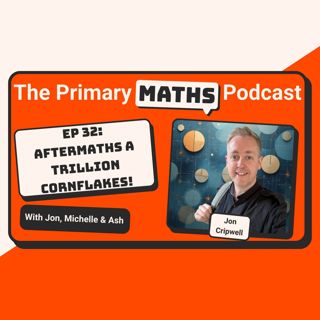

AfterMaths: A Trillion Cornflakes!

AfterMaths: A Trillion Cornflakes!

In this Aftermaths episode, Jon is joined once again by Sally Cole (standing in heroically for Becky!) for a wide-ranging Friday debrief. Together they unpack a huge week in maths education, from the launch of the brand-new Twinkl Maths app on iOS to the University of Nottingham’s State of the Nation review — plus a Maths of Life segment that dives into the mind-bending scale of a trillion.

This week’s conversation pulls together classroom practice, national trends, early years pedagogy and variation theory in the way only an Aftermaths episode can.


⭐ What We Talk About


• The new Twinkl Maths App on iOS

What’s inside it, how it helps with fluency, MTC practice, SEND-friendly settings, and why the Skills Safari is grounded in the Ready-to-Progress criteria.


• Why multiplication and division deserve more curriculum time

Jon reflects on a full-day session with SCITT students and why multiplicative thinking underpins fractions, scaling and upper KS2 success.


• Insights from the latest maths education report

Including:

– Why reception pupils begin with overwhelmingly positive attitudes towards maths

– A surprising link between attitudes and month of birth

– Why most primary teachers feel under-prepared due to workload

– The Key Stage 2 → Key Stage 3 transition problem

– Why early attainment predicts GCSE outcomes far more than we’d like

– Maths anxiety in Year 7 (40% reporting high anxiety)


• The EYFS problem for maths leads

Most maths leads teach in Year 6 — and feel least confident about early years. Jon gives a shout-out to Twinkl PD’s EYFS maths course.


• Maths of Life: How big is a trillion?

Following Elon Musk’s headline-grabbing pay deal, Jon explores the staggering scale of a trillion using comparisons involving seconds, sand, cornflakes, blades of grass and Welsh geography.

– 1 trillion seconds = 31,709 years

– 1 trillion grains of sand = a small bucket

– 1 trillion cornflakes = 55 Olympic swimming pools

– 1 trillion blades of grass = would cover Wales 12 times

– UK long-scale vs US short-scale number names


• Key takeaways from Jon Bee’s interview on variation theory

Sally and Jon unpack:

– The difference between variation and variety

– Procedural vs conceptual variation

– Jon Bee’s “procedural shock” example

– Why representation choices matter

– How schema-building across key stages keeps children engaged

– The importance of teaching what multiplication means, not just how to execute it

Denne episoden er hentet fra en åpen RSS-feed og er ikke publisert av Podme. Den kan derfor inneholde annonser.

Episoder(90)

Is the maths attainment gap getting wider?

Is the maths attainment gap getting wider?

Why do some pupils seem to thrive in maths while others struggle to access the same lesson?Jon and Becky discuss the latest PISA findings and the widening gap between higher and lower attainers, befor...

18 Sep 38min
How Big Is the Universe? | AfterMaths Summer Special

How Big Is the Universe? | AfterMaths Summer Special

How can the universe be 13.8 billion years old but the observable universe be around 93 billion light years across?In this AfterMaths Summer Special, Jon is joined by primary science specialist Sarah ...

4 Sep 42min

Can Maths Help You Win at Games?

Can Maths Help You Win at Games?

Can maths help you win at games?In this AfterMaths Summer Special, Jon and Becky explore the line between luck and strategy — and whether understanding the maths behind a game can actually give you an...

28 Aug 25min
Can Maths Predict the Future?

Can Maths Predict the Future?

Can maths really predict the future?We can predict the return of a comet decades in advance, but tomorrow's weather can still catch us completely by surprise. In this AfterMaths Summer Special, Jon an...

24 Aug 26min

The Maths of Getting Away: Routes, Queues & Google Maps

The Maths of Getting Away: Routes, Queues & Google Maps

Podcast Show NotesWhat makes a route the best route? The shortest distance? The quickest journey? The cheapest option? Or simply whichever one Google tells you to take?In this AfterMaths Summer Specia...

21 Aug 31min
Who Decided How Long a Metre Is? AfterMaths Summer Special 3

Who Decided How Long a Metre Is? AfterMaths Summer Special 3

Who decided how long a metre should be? Why is a mile 1,760 yards? And what connects the French Revolution, an expedition from Dunkirk to Barcelona and the speed of light?In this AfterMaths Summer Spe...

7 Aug 22min
The Probability Problems That Make Your Brain Hurt - AfterMaths Summer Special 2 2026

The Probability Problems That Make Your Brain Hurt - AfterMaths Summer Special 2 2026

Probability often feels as though it should be intuitive, right up until the mathematics tells us that our instincts are completely wrong.In this AfterMaths Summer Special, Jon and Becky explore the s...

31 Jul 30min
Why Do Summer Holidays Feel Shorter As We Get Older? Summer Special 1 2026

Why Do Summer Holidays Feel Shorter As We Get Older? Summer Special 1 2026

Why did the six-week summer holiday feel endless when we were children, yet now seems to disappear almost as soon as it begins?In the first of the 2026 Aftermaths Summer Specials, Jon and Becky explor...

28 Jul 29min

Populært innen Fakta

fastlegen
dine-penger-pengeradet
relasjonspodden-med-dora-thorhallsdottir-kjersti-idem
rss-strid
treningspodden
foreldreradet
rss-bisarr-historie
jakt-og-fiskepodden
rss-orjasater
hverdagspsyken
rss-kunsten-a-leve
takk-og-lov-med-anine-kierulf
sinnsyn
mikkels-paskenotter
rss-impressions-2
gravid-uke-for-uke
psykt-interessant
tomprat-med-gunnar-tjomlid
fryktlos
level-up-med-anniken-binz