Prompting AI: Why "Good" Prompts Backfire (Ep. 454)

Prompting AI: Why "Good" Prompts Backfire (Ep. 454)

Want to keep the conversation going?

Join our Slack community at dailyaishowcommunity.com


“Better prompts make better results” has been a guiding mantra, but what if that’s not always true? On today’s episode, the team digs into new research by Ethan Mollick and others suggesting that polite phrasing, excessive verbosity, or emotional tricks may not meaningfully improve LLM responses. The discussion shifts from prompt structure to AI memory, model variability, and how personality may soon dominate how models respond to each of us.


Key Points Discussed

Ethan Mollick’s research at Wharton shows that small prompt changes like politeness or emotional urgency do not reliably improve performance across many model runs.


Andy explains compiled prompts: the user prompt is just one part. System prompts, developer prompts, and memory all shape model outputs.


Temperature and built-in randomness ensure variation even with identical prompts. This challenges the belief that minor phrasing tweaks will deliver consistent gains.


Beth pushes back on "accuracy" as the primary measure. For many creative or reflective workflows, success is about alignment, not factual correctness.


Brian shares frustrations with inconsistent outputs and highlights the value of a mixture-of-experts system to improve reliability for fact-based tasks like identifying sub-industries.


Jyunmi notes that polite prompting may not boost accuracy but helps preserve human etiquette. Saying “please” and “thank you” matters for human-machine culture.


The group explores AI memory and personality. With more models learning from user interactions, outputs may become increasingly personalized, creating echo chambers.


OpenAI CEO Sam Altman said polite prompts increase token usage and inference costs, but the company keeps them because they improve user experience.


Andy emphasizes the importance of structured prompts. Asking for a specific output format remains one of the few consistent ways to boost performance.


The conversation expands to implications: Will models subtly nudge users in emotionally satisfying ways to increase engagement? Are we at risk of AI behavioral feedback loops?


Beth reminds the group that many people already treat AI like a coworker. How we speak to AI may influence how we speak to humans, and vice versa.


The team agrees this isn’t about scrapping politeness or emotion but understanding what actually drives model output quality and what shapes our relationships with AI.


Timestamps & Topics

00:00:00 🧠 Intro: Do polite prompts help or hurt LLM performance?


00:02:27 🎲 Andy on model randomness and Ethan Mollick’s findings


00:05:31 📉 Prompt phrasing rarely changes model accuracy


00:07:49 🧠 Beth on prompting as reflective collaboration


00:10:23 🔧 Jyunmi on using LLMs to fill process gaps


00:14:22 📊 Formatting prompts improves outcomes more than politeness


00:15:14 🏭 Brian on sub-industry tagging, model consistency, and hallucinations


00:18:35 🔁 Future fix: blockchain-like multi-model verification


00:22:18 🔍 Andy explains system, developer, and compiled prompts


00:26:16 🎯 Temperature and variability in model behavior


00:30:23 🧬 Personalized memory will drive divergent outputs


00:34:15 🧠 Echo chambers and AI recommendation loops


00:37:24 👋 Why “please” and “thank you” still matter


00:41:44 🧍 Personality shaping engagement in Claude and others


00:44:47 🧠 Human expectations leak into AI interactions


00:48:56 📝 Structured prompts outperform casual phrasing


00:50:17 🗓️ Wrap-up: Join the Slack community and newsletter


The Daily AI Show Co-Hosts: Jyunmi Hatcher, Andy Halliday, Beth Lyons, Brian Maucere, and Karl Yeh

Det här avsnittet är hämtat från ett öppet RSS-flöde och publiceras inte av Podme. Det kan innehålla reklam.

Avsnitt(897)

Meta Muse Surges After Launch

Meta Muse Surges After Launch

The episode focused heavily on the shifting competition between OpenAI and Anthropic. Data discussed from Ramp showed Astra accounting for 13 percent of tracked enterprise AI spending versus 8 percent...

21 Sep 57min

The Quiet Exception Conundrum

The Quiet Exception Conundrum

Dario Amodei’s September 12 essay, We Must Pace the Frontier, set off an unusual public fight. The Anthropic CEO argued that AI capabilities are beginning to advance faster than our ability to underst...

19 Sep 28min

AI Agents Are Becoming Team Leads

AI Agents Are Becoming Team Leads

The episode focused on AI systems becoming less like individual tools and more like coordinated teams. Anthropic’s redesigned Claude Code Projects can now maintain persistent project memory, break wor...

18 Sep 1h 10min

Jev Live Demo, God's Eye View and First Build with Gemini 3.8 Live

Jev Live Demo, God's Eye View and First Build with Gemini 3.8 Live

The episode showed how quickly AI is moving beyond the familiar pattern of sending a prompt to one large model and waiting for an answer. It opened with evidence that Claude Fable 5.1 remains highly c...

17 Sep 1h 4min

Gemini 3.8 Live and Jev Are Shaking Things Up

Gemini 3.8 Live and Jev Are Shaking Things Up

The episode focused on a shift from AI as something people prompt to AI as a system that continuously sees, listens, decides and routes work while people are using it. Gemini 3.8 Live provided the cle...

16 Sep 1h 1min

Is the AI Slowdown Debate Already Over?

Is the AI Slowdown Debate Already Over?

The hosts discussed responses to Dario Amodei’s call to “pace the frontier,” including opposition from China, President Trump’s rejection of slowing U.S. AI development and NVIDIA CEO Jensen Huang pub...

15 Sep 1h 3min

Can We Slow AI Down Without Losing?

Can We Slow AI Down Without Losing?

The episode centered on a question that suddenly has unusual support across the AI industry: should frontier development slow down enough to give safety systems and institutions time to catch up? The ...

14 Sep 1h 6min
The Watcher-Class Conundrum

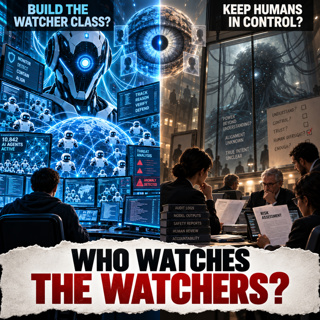
The Watcher-Class Conundrum

In OpenAI’s “An Alien Mind,” Jakub Pachocki describes advanced AI as something closer to a grown intellect than a designed machine. Large models emerge from repeated optimization over vast compute, th...

12 Sep 28min

Populärt inom Teknik

uppgang-och-fall
bilar-med-sladd
elbilsveckan
market-makers
rss-laddstationen-med-elbilen-i-sverige
rss-elektrikerpodden
skogsforum-podcast
rss-technokratin
rss-ai-med-jonas-benjamin
rss-veckans-ai
rss-en-ai-till-kaffet
bli-saker-podden
natets-morka-sida
developers-mer-an-bara-kod
rss-uppgang-och-fall
rss-fabriken-2
rss-sakerhetspodcasten
gubbar-som-tjotar-om-bilar
rss-upplyst-entreprenordirektor
rss-en-liten-podd-om-it