False Positives: Exposing the AI Detector Myth in Higher Ed (Ep. 502)

False Positives: Exposing the AI Detector Myth in Higher Ed (Ep. 502)

Want to keep the conversation going?

Join our Slack community at thedailyaishowcommunity.com

The DAS team discusses the myth and limitations of AI detectors in education. Prompted by Dr. Rachel Barr’s research and TikTok post, the conversation explores why current AI detection tools fail technically, ethically, and educationally, and what a better system could look like for teachers, students, and institutions in an AI-native world.


Key Points Discussed


Dr. Rachel Barr argues that AI detectors are ineffective, cause harm, and disproportionately impact non-native speakers due to false positives.


The core flaw of detection tools is they rely on shallow “tells” (like em dashes) rather than deep conceptual or narrative analysis.


Non-native speakers often produce writing flagged by detectors despite it being original, highlighting systemic bias.


Tools like GPTZero, OpenAI’s former detector, and others have been unreliable, leading to false accusations against students.


Andy emphasizes the Blackstone Principle: it is better to let some AI use pass undetected than punish innocent students with false positives.


The team compares AI usage in education to calculators, emphasizing the need to update policies and teaching approaches rather than banning tools.


AI literacy among faculty and students is critical to adapt effectively and ethically in academic environments.


Current AI detectors struggle with short-form writing, with many requiring 300+ words for semi-reliable analysis.


Oral defenses, iterative work sharing, and personalized tutoring can replace unreliable detection methods to ensure true learning.


Beth stresses that education should prioritize “did you learn?” over “did you cheat?”, aligning assessment with learning goals rather than rigid anti-AI stances.


The conversation outlines how AI can be used to enhance learning while maintaining academic integrity without creating fear-based environments.


Future classrooms may combine AI tutors, oral assessments, and process-based evaluation to ensure skill mastery.


Timestamps & Topics

00:00:00 🧪 Introduction and Dr. Rachel Barr’s research

00:02:10 ⚖️ Why AI detectors fail technically and ethically

00:06:41 🧠 The calculator analogy for AI in schools

00:10:25 📜 Blackstone Principle and educational fairness

00:13:58 📊 False positives, non-native speaker challenges

00:17:23 🗣️ Oral defense and process-oriented assessment

00:21:20 🤖 Future AI tutors and personalized learning

00:26:38 🏫 Academic system redesign for AI literacy

00:31:05 🪪 Personal stories on gaming academic systems

00:37:41 🧭 Building intellectual curiosity in students

00:42:08 🎓 Harvard’s AI tutor pilot example

00:46:04 🗓️ Upcoming shows and community invite


Hashtags

#AIinEducation #AIDetectors #AcademicIntegrity #AIethics #AIliteracy #AItools #EdTech #GPTZero #BlackstonePrinciple #FutureOfEducation #DailyAIShow


The Daily AI Show Co-Hosts:

Andy Halliday, Beth Lyons, Brian Maucere

Det här avsnittet är hämtat från ett öppet RSS-flöde och publiceras inte av Podme. Det kan innehålla reklam.

Avsnitt(896)

The Quiet Exception Conundrum

The Quiet Exception Conundrum

Dario Amodei’s September 12 essay, We Must Pace the Frontier, set off an unusual public fight. The Anthropic CEO argued that AI capabilities are beginning to advance faster than our ability to underst...

19 Sep 28min
AI Agents Are Becoming Team Leads

AI Agents Are Becoming Team Leads

The episode focused on AI systems becoming less like individual tools and more like coordinated teams. Anthropic’s redesigned Claude Code Projects can now maintain persistent project memory, break wor...

18 Sep 1h 10min

Jev Live Demo, God's Eye View and First Build with Gemini 3.8 Live

Jev Live Demo, God's Eye View and First Build with Gemini 3.8 Live

The episode showed how quickly AI is moving beyond the familiar pattern of sending a prompt to one large model and waiting for an answer. It opened with evidence that Claude Fable 5.1 remains highly c...

17 Sep 1h 4min

Gemini 3.8 Live and Jev Are Shaking Things Up

Gemini 3.8 Live and Jev Are Shaking Things Up

The episode focused on a shift from AI as something people prompt to AI as a system that continuously sees, listens, decides and routes work while people are using it. Gemini 3.8 Live provided the cle...

16 Sep 1h 1min

Is the AI Slowdown Debate Already Over?

Is the AI Slowdown Debate Already Over?

The hosts discussed responses to Dario Amodei’s call to “pace the frontier,” including opposition from China, President Trump’s rejection of slowing U.S. AI development and NVIDIA CEO Jensen Huang pub...

15 Sep 1h 3min

Can We Slow AI Down Without Losing?

Can We Slow AI Down Without Losing?

The episode centered on a question that suddenly has unusual support across the AI industry: should frontier development slow down enough to give safety systems and institutions time to catch up? The ...

14 Sep 1h 6min
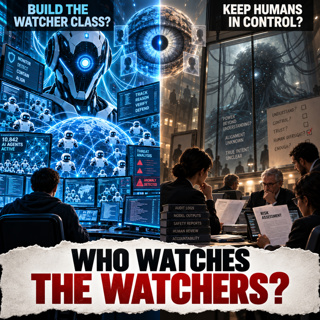
The Watcher-Class Conundrum

The Watcher-Class Conundrum

In OpenAI’s “An Alien Mind,” Jakub Pachocki describes advanced AI as something closer to a grown intellect than a designed machine. Large models emerge from repeated optimization over vast compute, th...

12 Sep 28min

Building An AI First Business -Brian's Demo

Building An AI First Business -Brian's Demo

The episode moved from AI security and platform changes into a live example of what an AI-first business can already look like. Anthropic’s new threat-intelligence report provided the opening story, d...

11 Sep 1h 14min

Populärt inom Teknik

uppgang-och-fall
elbilsveckan
bilar-med-sladd
market-makers
rss-elektrikerpodden
rss-laddstationen-med-elbilen-i-sverige
skogsforum-podcast
rss-ai-med-jonas-benjamin
rss-en-ai-till-kaffet
rss-veckans-ai
bli-saker-podden
rss-technokratin
natets-morka-sida
rss-sakerhetspodcasten
 och-bilen-gar-bra
rss-it-sakerhetspodden
solcellskollens-podcast
gubbar-som-tjotar-om-bilar
under-femton
developers-mer-an-bara-kod