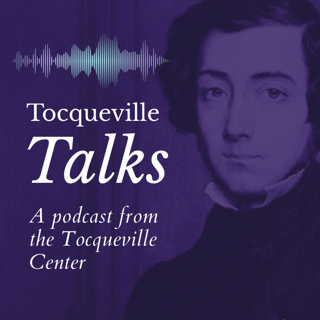
20. Faith, Politics, and the Search for Truth: A Year in Review — The Tocqueville Fellows

20. Faith, Politics, and the Search for Truth: A Year in Review — The Tocqueville Fellows

What happens when a year of serious conversation forces you to rethink what you believe?

In this episode of Tocqueville Talks, Brent Nelsen sits down with Tocqueville Fellows Makena Wyngaard and Lane Lytle for an end-of-year reflection on the ideas, debates, and questions that shaped their intellectual journey. Drawing on a full year of lectures, discussions, and retreats, the conversation explores how students wrestle with the intersection of faith, politics, economics, and education in real time.

From debates over globalization and trade policy to conversations about religion in American public life, this episode captures the deeper purpose of the Tocqueville Center: not to provide easy answers, but to cultivate the habits of thought necessary to confront complex problems.

Students reflect on key moments from the year, including discussions of globalization, higher education, and religion in politics. They revisit debates sparked by speakers such as Mark Lilla and consider how categories like “progressive” and “reactionary” shape modern political discourse. They also examine tensions within their own thinking—especially when it comes to integrating religious belief with political judgment.

At the center of the conversation is a difficult but essential question: What does it mean to act politically as a person of faith?

Lane Lytle reflects candidly on how the program challenged his assumptions about voting, Christian nationalism, and the relationship between theology and public policy. Rather than offering simple conclusions, he describes an ongoing struggle to distinguish between religious conviction and political identity.Makena Wyngaard emphasizes a different but related insight: the recognition of complexity. Over the course of the year, she encountered a series of interconnected problems—economic inequality, institutional trust, globalization, and cultural division—that resist simple solutions. Instead of clarity, she found something more valuable: a deeper awareness of how much remains uncertain, and a renewed commitment to pursuing truth.

Key themes include:

  • The relationship between faith and political decision-making
  • Progressive vs. reactionary frameworks in modern politics
  • Globalization, economic policy, and competing visions of the market
  • The crisis of trust in institutions and its cultural roots
  • The purpose of higher education beyond career preparation
  • The challenge of forming judgment in a complex and divided society

The episode also reflects on the distinctive experience of the Tocqueville Fellows program: sustained engagement with difficult ideas, meaningful dialogue across differences, and the freedom to question one’s own assumptions.

As Brent Nelsen puts it, the goal is simple but demanding: to ask the big questions—and to go deep.

Det här avsnittet är hämtat från ett öppet RSS-flöde och publiceras inte av Podme. Det kan innehålla reklam.

Avsnitt(31)

31. Finland's President Alexander Stubb on Political Philosophy, Power & a World in Transition

31. Finland's President Alexander Stubb on Political Philosophy, Power & a World in Transition

What can political philosophy teach a president about leadership, power, and a changing international order?In this episode of Tocqueville Talks, Alexander Stubb, President of the Republic of Finland,...

24 Sep 31min

30. Why College Should Challenge What You Believe | Tocqueville Fellows on Learning to Disagree

30. Why College Should Challenge What You Believe | Tocqueville Fellows on Learning to Disagree

What if the purpose of college isn't to confirm what you believe—but to teach you how to question it?In this episode of Tocqueville Talks, Furman University students Laura Grace McSwain and Liza Sherb...

21 Sep 22min

29. The Big Questions Facing American Democracy | Tocqueville Talks 2026–27 Preview

29. The Big Questions Facing American Democracy | Tocqueville Talks 2026–27 Preview

What are the biggest questions facing American democracy—and how can universities create spaces where they are seriously debated?In this season-opening episode of Tocqueville Talks, Tocqueville Center...

10 Sep 30min

28. Why Americans Are So Patriotic | Tocqueville's Surprising Answer

28. Why Americans Are So Patriotic | Tocqueville's Surprising Answer

Why does patriotism seem so powerful in America—and what happens when it begins to disappear?As Americans celebrate the nation's 250th anniversary, Alexis de Tocqueville's reflections on patriotism ma...

10 Juli 23min

27. Why the Old Political Order Is Cracking | Populism, MAGA, and the Future of Democracy

27. Why the Old Political Order Is Cracking | Populism, MAGA, and the Future of Democracy

For generations, politics in Europe and America was dominated by large, stable political parties. Today, those old political alignments are breaking down.Why are voters abandoning established parties?...

3 Juli 35min

26. What Swimming Can Teach Us About Democracy | Tocqueville's Forgotten Insight

26. What Swimming Can Teach Us About Democracy | Tocqueville's Forgotten Insight

What can a neighborhood swim league teach us about democracy?More than you might think.When Alexis de Tocqueville visited America in 1831, he was astonished by what he called associations—ordinary cit...

25 Juni 41min

25. Is the Postwar Order Ending? Europe, Trump, Ukraine, and the Future of the West — Eleanor Beardsley

25. Is the Postwar Order Ending? Europe, Trump, Ukraine, and the Future of the West — Eleanor Beardsley

For eighty years, Europe and the United States built a common political, economic, and military order.Today, many Europeans wonder whether that world is ending.In this episode of Tocqueville Talks, Br...

18 Juni 27min

24. Why Everything Feels Increasingly Unreal — Beth and Rob L'Arrivée

24. Why Everything Feels Increasingly Unreal — Beth and Rob L'Arrivée

Why does everything feel increasingly unreal?The people most trapped in abstraction are often the people consuming the most information.Tocqueville saw this danger almost 200 years ago.In this episode...

11 Juni 22min
Populärt inom Politik & nyheter

svenska-fall
aftonbladet-krim
fordomspodden
p3-krim
rss-krimstad
flashback-forever
rss-expressen-dok
spar
aftonbladet-daily
rss-vad-fan-hande
rss-sanning-konsekvens
svd-ledarredaktionen
rss-krimreportrarna
politiken
omni-podd
rss-flodet
rss-utopia-2
en-runda-till
rss-frandfors-horna
motiv