257. Iron Lady out, Grey Man in

257. Iron Lady out, Grey Man in

With the poll tax, Thatcher took one bad decision to many.

From the point of view of orthodox Thatcherite thought, it sounded like a good idea. She’d been working for years to shrink the state but, while she could herself cut public spending at national level, local government could keep racking it up if it so chose. She’d introduced rate capping to limit how far local councils could raise local taxes.

The poll tax – officially the Community Charge – was the next step. In the old system, with local taxation based on house values, it was the rich that paid the most even though it was the poor that mainly benefited from local services. A flat rate tax per head – which the Community Charge was, hence the derogatory name Poll Tax – would, the theory suggested, give poor voters a direct relationship with local taxation and expenditure, making them less likely to vote for council candidates who would push for increased local spending.

In fact, the tax was seen as unfair and its introduction led angry protests that on occasion led to rioting.

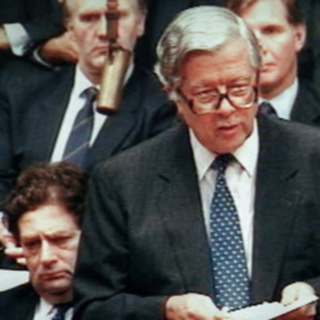
It wasn’t, though, the poll tax that directly ended Thatcher’s time at the top. Instead, it was another row with one of her closest colleagues. Already Michael Heseltine, in 1986, and Nigel Lawson, in 1989, had been significant figures – so-called ‘big beasts’ – leaving her government. Now, in the autumn of 1990, she fell out with Geoffrey Howe. He too resigned and in his resignation speech talked about how his loyalty was divided between Thatcher herself and the country or party.

The day after his resignation, Heseltine announced he would challenge Thatcher for the Tory leadership. In the resulting election, like Heath against her, she won the first round but by too narrow a margin to prevent a second round. Like Health against her, she resigned.

It wasn’t Heseltine, however, who replaced her. On the contrary, much to many people’s surprise, it was John Major, who’d only been elected to parliament in 1979 and only served in cabinet since 1986, who came through as the compromise candidate Tory MPs could rally behind. He became party leader and Prime Minister.

And then, much to everyone’s surprise again, he went on, partly helped by campaigning errors by Neil Kinnock’s Labour Party, to win the election in 1992. The Tories had won four general elections in a row. But now that would return the grey man to Downing Street rather than the Iron Lady.

A very different proposition…


Illustration: Geoffrey Howe delivering his resignation speech to the Commons, 13 November 1990, with Nigel Lawson sitting next to him. Photo PA from the Guardian.

Music: Bach Partita #2c by J Bu licensed under an Attribution-NonCommercial-No Derivatives (aka Music Sharing) 3.0 International License


Avsnitt(275)

258. Major’s bastards and Labour’s deal

258. Major’s bastards and Labour’s deal

By winning the 1992 general election, John Major had gained his own mandate to form a government, instead of imply inheriting Margaret Thatcher’s. He’d shown himself capable of leading the Conservativ...

31 Aug 202514min
256. Maggie losing it

256. Maggie losing it

Having looked last week at how Maggie Thatcher was running out of options for how to carve out a new role for Britain on the world stage, this week we look at how things were going at home. After all,...

17 Aug 202514min
255. Maggie: lioness or poodle?

255. Maggie: lioness or poodle?

Maggie Thatcher in 1987 pulled off a trick that had eluded all other British Prime Ministers of the twentieth century: she won three general elections in a row. Even more, she won a second Commons lan...

10 Aug 202514min
254. Maggie reaching the top

254. Maggie reaching the top

Thatcher’s victories, including a general election landslide and breaking the miners’ strike, emboldened her to launch another phase in the reduction of the role of the state in the British economy. N...

3 Aug 202514min
253. The Enemy Within

253. The Enemy Within

What had converted Maggie Thatcher from something of a lame duck into a front runner for the next British general election?While the economy had begun to pick up, that had been patchy at best, with so...

27 Juli 202514min
252. Iron Lady

252. Iron Lady

Mrs Thatcher’s first term in office was one of the great get out of jail events. She came into office intent on braking with the Keynesianism and social democracy of the postwar consensus. She drew on...

20 Juli 202514min
251. Unlucky Jim

251. Unlucky Jim

In 1976, Jim Callaghan took over from Harold Wilson as leader of the Labour Party and British Prime Minister. He was a competent politician, though not an outstanding one. He did his job well, but he ...

13 Juli 202514min

Populärt inom Historia

massmordarpodden
historiska-brott
p3-historia
kod-katastrof
olosta-mord
historiepodden-se
motiv
rss-historiska-brottslingar
historianu-med-urban-lindstedt
rss-massmordarpodden
rss-seriemordarpodden
rss-historien-om-2
krigshistoriepodden
rss-brottsligt
harrisons-dramatiska-historia
militarhistoriepodden
nu-blir-det-historia
bedragare
palmemordet
rss-folkets-historia