265. War in a unipolar world

265. War in a unipolar world

By the latter part of the twentieth century, the world had become unipolar. The Soviet Empire collapsed even more rapidly than the British one had after the Berlin Wall fell in 1989. China was not yet the force it is today. The US was at the pinnacle of its global power.

That made it all the more unbearable that it came under assault within its own borders by the terrorists of the 9/11 attack in 2001. A reaction was inevitable. We saw last time how it invaded Afghanistan, but that seemed barely justified since there’s no evidence of Afghan involvement in the attacks. By 2003, the US as ready to turn its military aggression against another nation in what it called its ‘war on terror’, a strange notion of waging war against an abstract noun.

Concretely, its new target was Iraq. Sadly, however, Iraqi contact with the 9/11 attacks had proved as difficult to substantiate as Afghanistan’s. But the US put together an international coalition for war there, as it had once before in 1990-91, to throw Iraqi invaders out of Kuwait.

This though would be much smaller coalition, with fewer nations prepared to support President George ‘Dubya’ Bush’s new campaign. It didn’t help that it looked suspiciously at least partly aimed at completing the work of his own father, George HW Bush, who’d been president during the previous war on Iraq, by bringing down the dictator Saddam Hussein.

One of the nations right alongside the US was Britain. That would leave a lasting mark on Tony Blair’s legacy. Which might as a result not have been quite as glowing as he might have liked.

Our subject for next week.


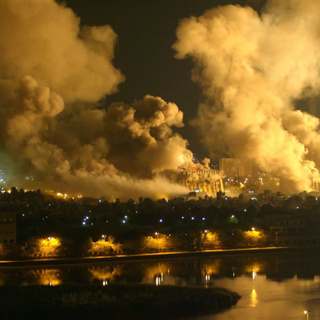
Illustration: Government buildings burning in Baghdad following a US airstrike in March 2003. Photo Ramzi Haidar / AFP / Getty from ‘The Atlantic’

Music: Bach Partita #2c by J Bu licensed under an Attribution-NonCommercial-No Derivatives (aka Music Sharing) 3.0 International License


Avsnitt(275)

250. Return of the crisis man

250. Return of the crisis man

When Harold Wilson formed his second government, he immediately faced a major crisis inherited from Heath’s administration: the coalminers were on strike, a state of Emergency (Heath’s fifth in four y...

6 Juli 202514min
249. Who governs Britain?

249. Who governs Britain?

How did Heath end up calling an election on the question of who governed the country? Especially as the choice he seemed to be offering was between him and the minders. This episode traces the impact ...

5 Juli 202514min
248. Withered Heath

248. Withered Heath

Ted Heath’s government had to deal with two problems drawn from Britain’s postimperial standing: • adapting to its loss of global status, by negotiating, at the third time of asking and for the first ...

22 Juni 202514min
247. Hopes dashed

247. Hopes dashed

After talking last week about his government’s achievements in the social sphere, this episode looks at the difficulties Wilson faced in economics and foreign affairs.One way Wilson explored to addres...

15 Juni 202514min
246. The sixties, swinging - high and low

246. The sixties, swinging - high and low

According to the English poet Philip Larkin, the sixties saw the invention of sexual intercourse. While that may not be quite the case, it was certainly a time when a lot of people decided that it was...

8 Juni 202514min
245. Pressures preventing progress

245. Pressures preventing progress

The Wilson government got off to a pretty sticky start, with the new Prime Minister learning, more or less as he arrived at Downing Street in October 1964, that the trade deficit for the year was like...

1 Juni 202514min
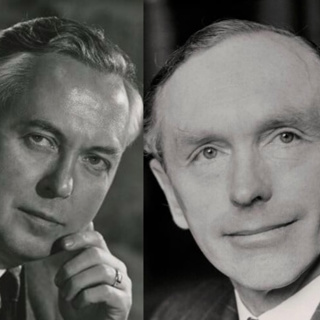
244. Harold gets Home

244. Harold gets Home

Here we’re focusing on the changes that took place in Britain after Supermac (Harold Macmillan) stood down as Prime Minister.A lot of how that went depended on the Opposition formed by the Labour Part...

25 Maj 202514min

243. Sex, spies and a slippery slope

243. Sex, spies and a slippery slope

Last time we looked at the continuing disintegration of the British Empire. In this episode we look at two other key aspects of Macmillan’s foreign policy, Britain’s relations with the US and with pot...

18 Maj 202515min

Populärt inom Historia

massmordarpodden
historiska-brott
p3-historia
kod-katastrof
olosta-mord
historiepodden-se
motiv
rss-historiska-brottslingar
historianu-med-urban-lindstedt
rss-massmordarpodden
rss-seriemordarpodden
rss-historien-om-2
krigshistoriepodden
rss-brottsligt
harrisons-dramatiska-historia
militarhistoriepodden
nu-blir-det-historia
bedragare
palmemordet
rss-folkets-historia