265. War in a unipolar world

265. War in a unipolar world

By the latter part of the twentieth century, the world had become unipolar. The Soviet Empire collapsed even more rapidly than the British one had after the Berlin Wall fell in 1989. China was not yet the force it is today. The US was at the pinnacle of its global power.

That made it all the more unbearable that it came under assault within its own borders by the terrorists of the 9/11 attack in 2001. A reaction was inevitable. We saw last time how it invaded Afghanistan, but that seemed barely justified since there’s no evidence of Afghan involvement in the attacks. By 2003, the US as ready to turn its military aggression against another nation in what it called its ‘war on terror’, a strange notion of waging war against an abstract noun.

Concretely, its new target was Iraq. Sadly, however, Iraqi contact with the 9/11 attacks had proved as difficult to substantiate as Afghanistan’s. But the US put together an international coalition for war there, as it had once before in 1990-91, to throw Iraqi invaders out of Kuwait.

This though would be much smaller coalition, with fewer nations prepared to support President George ‘Dubya’ Bush’s new campaign. It didn’t help that it looked suspiciously at least partly aimed at completing the work of his own father, George HW Bush, who’d been president during the previous war on Iraq, by bringing down the dictator Saddam Hussein.

One of the nations right alongside the US was Britain. That would leave a lasting mark on Tony Blair’s legacy. Which might as a result not have been quite as glowing as he might have liked.

Our subject for next week.


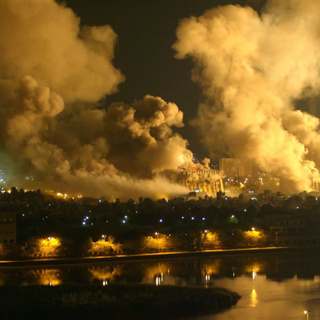
Illustration: Government buildings burning in Baghdad following a US airstrike in March 2003. Photo Ramzi Haidar / AFP / Getty from ‘The Atlantic’

Music: Bach Partita #2c by J Bu licensed under an Attribution-NonCommercial-No Derivatives (aka Music Sharing) 3.0 International License


Avsnitt(275)

242. A wind of change driving the retreat from empire

242. A wind of change driving the retreat from empire

‘The wind of change’ was the other famous phrase of Harold Macmillan’s, along with ‘You’ve never had it so good’. It came in a speech in which he talked about how a movement had grown up in many count...

4 Maj 202514min
241. Supermac: you've never had it so good

241. Supermac: you've never had it so good

Macmillan overcame the terrible legacy of the Suez catastrophe and, running an economy focused on growth to fund increasing living standards, giving him the opportunity to annouce that people had neve...

27 Apr 202514min
240. Suez: nail in the imperial coffin

240. Suez: nail in the imperial coffin

Anthony Eden started his premiership well, chalking up a general election win and the lowest level of unemployment Britain has seen at any time since the Second World War. Little else went well, howev...

20 Apr 202514min
239. Winston back, Winston out

239. Winston back, Winston out

The old man was back. The Conservatives won the 1951 election and Winston Churchill returned to Downing Street. And he really was an old man – nearly 77 when he took office. To many, he it seemed incr...

13 Apr 202514min
238. Decline to defeat

238. Decline to defeat

Circumstances seemed unfavourable for a Labour victory in a 1950 election but, when it was held, Attlee managed to lead his party to the second win in its history. It took a majority of the popular vo...

6 Apr 202514min
237. Citizen socialism at home, resisting the Soviets abroad

237. Citizen socialism at home, resisting the Soviets abroad

What Attlee’s government had shown was that, though it regarded itself as Socialist, it was a very distinctive kind of Socialism and heavily influenced by Liberal thinking. Where a more Marxist Social...

30 Mars 202514min
236. Greyness at home, decline abroad

236. Greyness at home, decline abroad

Of the five ‘giant evils’ William Beveridge identified, the Attlee government set out to deal with want through social security, squalor through better housing, ignorance through more schooling and di...

23 Mars 202514min
235. Clem against the Evil Giants

235. Clem against the Evil Giants

In the July 1945 general election, the British public offered Winston Churchill, as he put it himself, the ‘order of the boot’. A victorious war Prime Minister was kicked out. In his place, his deputy...

16 Mars 202514min

Populärt inom Historia

massmordarpodden
historiska-brott
p3-historia
kod-katastrof
olosta-mord
historiepodden-se
motiv
rss-historiska-brottslingar
historianu-med-urban-lindstedt
rss-massmordarpodden
rss-seriemordarpodden
rss-historien-om-2
krigshistoriepodden
rss-brottsligt
harrisons-dramatiska-historia
militarhistoriepodden
nu-blir-det-historia
bedragare
palmemordet
rss-folkets-historia