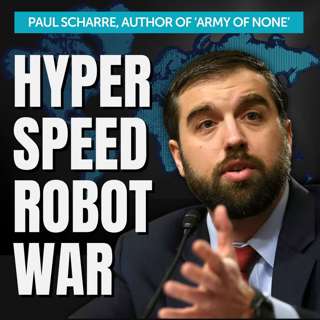

#231 – Paul Scharre on how AI-controlled robots will and won't change war

#231 – Paul Scharre on how AI-controlled robots will and won't change war

In 1983, Stanislav Petrov, a Soviet lieutenant colonel, sat in a bunker watching a red screen flash “MISSILE LAUNCH.” Protocol demanded he report it to superiors, which would very likely trigger a retaliatory nuclear strike. Petrov didn’t. He reasoned that if the US were actually attacking, they wouldn’t fire just 5 missiles — they’d empty the silos. He bet the fate of the world on a hunch that his machine was broken. He was right.

Paul Scharre, the former Army Ranger who led the Pentagon team that wrote the US military’s first policy on autonomous weapons, has a question: What would an AI have done in Petrov’s shoes? Would an AI system have been flexible and wise enough to make the same judgement? Or would it immediately launch a counterattack?

Paul joins host Luisa Rodriguez to explain why we are hurtling toward a “battlefield singularity” — a tipping point where AI increasingly replaces humans in much of the military, changing the way war is fought with speed and complexity that outpaces humans’ ability to keep up.

Links to learn more, video, and full transcript: https://80k.info/ps

Militaries don’t necessarily want to take humans out of the loop. But Paul argues that the competitive pressure of warfare creates a “use it or lose it” dynamic. As former Deputy Secretary of Defense Bob Work put it: “If our competitors go to Terminators, and their decisions are bad, but they’re faster, how would we respond?”

Once that line is crossed, Paul warns we might enter an era of “flash wars” — conflicts that spiral out of control as quickly and inexplicably as a flash crash in the stock market, with no way for humans to call a timeout.

In this episode, Paul and Luisa dissect what this future looks like:

  • Swarming warfare: Why the future isn’t just better drones, but thousands of cheap, autonomous agents coordinating like a hive mind to overwhelm defences.
  • The Gatling gun cautionary tale: The inventor of the Gatling gun thought automating fire would reduce the number of soldiers needed, saving lives. Instead, it made war significantly deadlier. Paul argues AI automation could do the same, increasing lethality rather than creating “bloodless” robot wars.
  • The cyber frontier: While robots have physical limits, Paul argues cyberwarfare is already at the point where AI can act faster than human defenders, leading to intelligent malware that evolves and adapts like a biological virus.
  • The US-China “adoption race”: Paul rejects the idea that the US and China are in a spending arms race (AI is barely 1% of the DoD budget). Instead, it’s a race of organisational adoption — one where the US has massive advantages in talent and chips, but struggles with bureaucratic inertia that might not be a problem for an autocratic country.

Paul also shares a personal story from his time as a sniper in Afghanistan — watching a potential target through his scope — that fundamentally shaped his view on why human judgement, with all its flaws, is the only thing keeping war from losing its humanity entirely.

This episode was recorded on October 23-24, 2025.

Chapters:

• Cold open (00:00:00)
• Who’s Paul Scharre? (00:00:45)
• How will AI and automation transform the nature of war? (00:01:18)
• Why would militaries take humans out of the loop? (00:12:26)
• AI in nuclear command, control, and communications (00:19:02)
• Nuclear stability and deterrence (00:36:33)
• What to expect over the next few decades (00:46:58)
• Financial and human costs of future “hyperwar” scenarios (00:51:18)
• AI warfare and the balance of power (01:07:31)
• Barriers to getting to automated war (01:12:04)
• Failure modes of autonomous weapons systems (01:17:33)
• Could autonomous weapons systems actually make us safer? (01:31:01)
• Is Paul overall optimistic or pessimistic about increasing automation in the military? (01:36:55)
• Paul’s takes on AGI’s transformative potential and whether natsec people buy it (01:39:15)
• Cyberwarfare (01:48:33)
• US-China balance of power and surveillance with AI (02:04:33)
• Policy and governance that could make us safer (02:31:22)
• How Paul’s experience in the Army informed his feelings on military automation (02:43:24)

Video and audio editing: Dominic Armstrong, Milo McGuire, Luke Monsour, and Simon Monsour
Music: CORBIT
Coordination, transcripts, and web: Katy Moore

Denne episoden er hentet fra en åpen RSS-feed og er ikke publisert av Podme. Den kan derfor inneholde annonser.

Episoder(341)

How a small team of activists helped pass America's landmark AI safety laws | Sneha Revanur, Encode AI

How a small team of activists helped pass America's landmark AI safety laws | Sneha Revanur, Encode AI

Six years ago, aged just 15, Sneha Revanur founded the AI advocacy nonprofit Encode AI — back when AI felt like a niche issue. Now the world’s caught up with her, and she’s ready to share everything s...

8 Jul 52min

We can guess what intergalactic war would look like. And strangely, it matters.

We can guess what intergalactic war would look like. And strangely, it matters.

Intergalactic war is probably billions of years away — yet physics can already tell us how it ends. And strangely that conclusion is relevant to decisions people have to make today.In this video, Rob ...

18 Jun 15min

How AI could create the world’s biggest problems (article by Zershaaneh Qureshi)

How AI could create the world’s biggest problems (article by Zershaaneh Qureshi)

Imagine you’re living 15,000 years ago. Your people are hunter-gatherers and you sleep under the stars. If someone told you humans would one day build cities with millions of people, fly through the a...

11 Jun 1h 29min

#245 – Rohin Shah on what it's really like to run AGI safety at Google DeepMind (and where I disagree with 'doomers')

#245 – Rohin Shah on what it's really like to run AGI safety at Google DeepMind (and where I disagree with 'doomers')

Most people working on AI safety think without a massive effort AI systems will probably end up with goals catastrophically different from humanity’s. Today’s guest, Rohin Shah — head of AGI Safety an...

2 Jun 2h 48min

What makes for a dream job? | Benjamin Todd

What makes for a dream job? | Benjamin Todd

What actually makes a job fulfilling? It's not what most career advice tells you. "Follow your passion" sounds inspiring, but it's misleading — and the research backs that up.Drawing on hundreds of st...

28 Mai 28min

#244 – Benjamin Todd on how we’re updating our career advice for the strangest time in history

#244 – Benjamin Todd on how we’re updating our career advice for the strangest time in history

The average career is 80,000 hours long. With AI advancing so rapidly, the hours you have left in your career matter more than ever.Some leading AI researchers think there’s a 10% chance that AI syste...

26 Mai 1h 6min

Can AIs already start 'rogue deployments' inside AI companies? (Landmark new METR report)

Can AIs already start 'rogue deployments' inside AI companies? (Landmark new METR report)

A red-teamer was embedded inside Anthropic for three weeks, told to imagine he was an evil Claude, and asked to figure out how to launch a ‘rogue AI deployment’ without getting caught. It’s one part o...

20 Mai 20min

#243 – 'Godfather of AI' Yoshua Bengio: "I now see a path" to safe superintelligent AI

#243 – 'Godfather of AI' Yoshua Bengio: "I now see a path" to safe superintelligent AI

The co-inventor of modern AI and the most cited living scientist believes he's figured out how to ensure AI is honest, incapable of deception, and never goes rogue. Yoshua Bengio – Turing Award Winner...

7 Mai 2h 35min

Populært innen Fakta

fastlegen
dine-penger-pengeradet
relasjonspodden-med-dora-thorhallsdottir-kjersti-idem
rss-kunsten-a-leve
foreldreradet
mikkels-paskenotter
treningspodden
sinnsyn
rss-sarbar-med-lotte-erik
rss-strid-de-norske-borgerkrigene
gravid-uke-for-uke
jakt-og-fiskepodden
tomprat-med-gunnar-tjomlid
fryktlos
uroskolen
rss-var-forste-kaffe
rss-mind-body-podden
hagespiren-podcast
rss-impressions-2
fra-null-til-hund