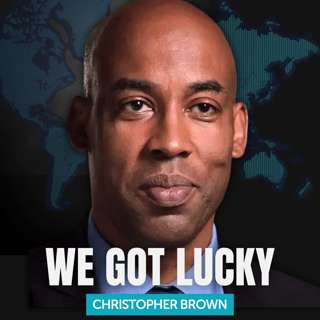

#145 Classic episode – Christopher Brown on why slavery abolition wasn't inevitable

#145 Classic episode – Christopher Brown on why slavery abolition wasn't inevitable

In many ways, humanity seems to have become more humane and inclusive over time. While there’s still a lot of progress to be made, campaigns to give people of different genders, races, sexualities, ethnicities, beliefs, and abilities equal treatment and rights have had significant success.

It’s tempting to believe this was inevitable — that the arc of history “bends toward justice,” and that as humans get richer, we’ll make even more moral progress.

But today's guest Christopher Brown — a professor of history at Columbia University and specialist in the abolitionist movement and the British Empire during the 18th and 19th centuries — believes the story of how slavery became unacceptable suggests moral progress is far from inevitable.

Rebroadcast: This episode was originally aired in February 2023.

Links to learn more, video, and full transcript: https://80k.link/CLB

While most of us today feel that the abolition of slavery was sure to happen sooner or later as humans became richer and more educated, Christopher doesn't believe any of the arguments for that conclusion pass muster. If he's right, a counterfactual history where slavery remains widespread in 2023 isn't so far-fetched.

As Christopher lays out in his two key books, Moral Capital: Foundations of British Abolitionism and Arming Slaves: From Classical Times to the Modern Age, slavery has been ubiquitous throughout history. Slavery of some form was fundamental in Classical Greece, the Roman Empire, in much of the Islamic civilisation, in South Asia, and in parts of early modern East Asia, Korea, China.

It was justified on all sorts of grounds that sound mad to us today. But according to Christopher, while there’s evidence that slavery was questioned in many of these civilisations, and periodically attacked by slaves themselves, there was no enduring or successful moral advocacy against slavery until the British abolitionist movement of the 1700s.

That movement first conquered Britain and its empire, then eventually the whole world. But the fact that there's only a single time in history that a persistent effort to ban slavery got off the ground is a big clue that opposition to slavery was a contingent matter: if abolition had been inevitable, we’d expect to see multiple independent abolitionist movements thoroughly history, providing redundancy should any one of them fail.

Christopher argues that this rarity is primarily down to the enormous economic and cultural incentives to deny the moral repugnancy of slavery, and crush opposition to it with violence wherever necessary.

Mere awareness is insufficient to guarantee a movement will arise to fix a problem. Humanity continues to allow many severe injustices to persist, despite being aware of them. So why is it so hard to imagine we might have done the same with forced labour?

In this episode, Christopher describes the unique and peculiar set of political, social and religious circumstances that gave rise to the only successful and lasting anti-slavery movement in human history. These circumstances were sufficiently improbable that Christopher believes there are very nearby worlds where abolitionism might never have taken off.

Christopher and host Rob Wiblin also discuss:

  • Various instantiations of slavery throughout human history
  • Signs of antislavery sentiment before the 17th century
  • The role of the Quakers in early British abolitionist movement
  • The importance of individual “heroes” in the abolitionist movement
  • Arguments against the idea that the abolition of slavery was contingent
  • Whether there have ever been any major moral shifts that were inevitable

Chapters:

  • Rob's intro (00:00:00)
  • Cold open (00:01:45)
  • Who's Christopher Brown? (00:03:00)
  • Was abolitionism inevitable? (00:08:53)
  • The history of slavery (00:14:35)
  • Signs of antislavery sentiment before the 17th century (00:19:24)
  • Quakers (00:32:37)
  • Attitudes to slavery in other religions (00:44:37)
  • Quaker advocacy (00:56:28)
  • Inevitability and contingency (01:06:29)
  • Moral revolution (01:16:39)
  • The importance of specific individuals (01:29:23)
  • Later stages of the antislavery movement (01:41:33)
  • Economic theory of abolition (01:55:27)
  • Influence of knowledge work and education (02:12:15)
  • Moral foundations theory (02:20:43)
  • Figuring out how contingent events are (02:32:42)
  • Least bad argument for why abolition was inevitable (02:41:45)
  • Were any major moral shifts inevitable? (02:47:29)

Producer: Keiran Harris
Audio mastering: Milo McGuire
Transcriptions: Katy Moore

Episoder(333)

Rob Wiblin on human nature, new technology, and living a happy, healthy & ethical life

Rob Wiblin on human nature, new technology, and living a happy, healthy & ethical life

This is a cross-post of some interviews Rob did recently on two other podcasts — Mission Daily (from 2m) and The Good Life (from 1h13m). Some of the content will be familiar to regular listeners — bu...

13 Mai 20192h 18min
#57 – Tom Kalil on how to do the most good in government

#57 – Tom Kalil on how to do the most good in government

You’re 29 years old, and you’ve just been given a job in the White House. How do you quickly figure out how the US Executive Branch behemoth actually works, so that you can have as much impact as poss...

23 Apr 20192h 50min

#56 - Persis Eskander on wild animal welfare and what, if anything, to do about it

#56 - Persis Eskander on wild animal welfare and what, if anything, to do about it

Elephants in chains at travelling circuses; pregnant pigs trapped in coffin sized crates at factory farms; deers living in the wild. We should welcome the last as a pleasant break from the horror, rig...

15 Apr 20192h 57min

#55 – Lutter & Winter on founding charter cities with outstanding governance to end poverty

#55 – Lutter & Winter on founding charter cities with outstanding governance to end poverty

Governance matters. Policy change quickly took China from famine to fortune; Singapore from swamps to skyscrapers; and Hong Kong from fishing village to financial centre. Unfortunately, many governmen...

31 Mar 20192h 31min

#54 – OpenAI on publication norms, malicious uses of AI, and general-purpose learning algorithms

#54 – OpenAI on publication norms, malicious uses of AI, and general-purpose learning algorithms

OpenAI’s Dactyl is an AI system that can manipulate objects with a human-like robot hand. OpenAI Five is an AI system that can defeat humans at the video game Dota 2. The strange thing is they were bo...

19 Mar 20192h 53min

#53 - Kelsey Piper on the room for important advocacy within journalism

#53 - Kelsey Piper on the room for important advocacy within journalism

“Politics. Business. Opinion. Science. Sports. Animal welfare. Existential risk.” Is this a plausible future lineup for major news outlets? Funded by the Rockefeller Foundation and given very little ...

27 Feb 20192h 34min

Julia Galef and Rob Wiblin on an updated view of the best ways to help humanity

Julia Galef and Rob Wiblin on an updated view of the best ways to help humanity

This is a cross-post of an interview Rob did with Julia Galef on her podcast Rationally Speaking. Rob and Julia discuss how the career advice 80,000 Hours gives has changed over the years, and the big...

17 Feb 201956min
#52 - Glen Weyl on uprooting capitalism and democracy for a just society

#52 - Glen Weyl on uprooting capitalism and democracy for a just society

Pro-market economists love to wax rhapsodic about the capacity of markets to pull together the valuable local information spread across all of society about what people want and how to make it. But wh...

8 Feb 20192h 44min

Populært innen Fakta

fastlegen
dine-penger-pengeradet
relasjonspodden-med-dora-thorhallsdottir-kjersti-idem
foreldreradet
treningspodden
rss-strid-de-norske-borgerkrigene
mikkels-paskenotter
rss-bisarr-historie
jakt-og-fiskepodden
sinnsyn
rss-kunsten-a-leve
rss-sunn-okonomi
hverdagspsyken
tomprat-med-gunnar-tjomlid
rss-bak-luftfarten
ukast
fryktlos
gravid-uke-for-uke
lederskap-nhhs-podkast-om-ledelse
rss-kull