
#56 - Persis Eskander on wild animal welfare and what, if anything, to do about it

#56 - Persis Eskander on wild animal welfare and what, if anything, to do about it

Elephants in chains at travelling circuses; pregnant pigs trapped in coffin sized crates at factory farms; deers living in the wild. We should welcome the last as a pleasant break from the horror, right?

Maybe, but maybe not. While we tend to have a romanticised view of nature, life in the wild includes a range of extremely negative experiences.

Many animals are hunted by predators, and constantly have to remain vigilant about the risk of being killed, and perhaps experiencing the horror of being eaten alive. Resource competition often leads to chronic hunger or starvation. Their diseases and injuries are never treated. In winter animals freeze to death; in droughts they die of heat or thirst.

There are fewer than 20 people in the world dedicating their lives to researching these problems.

But according to Persis Eskander, researcher at the Open Philanthropy Project, if we sum up the negative experiences of all wild animals, their sheer number could make the scale of the problem larger than most other near-term concerns.

Links to learn more, summary and full transcript.

Persis urges us to recognise that nature isn’t inherently good or bad, but rather the result of an amoral evolutionary process. For those that can't survive the brutal indifference of their environment, life is often a series of bad experiences, followed by an even worse death.

But should we actually intervene? How do we know what animals are sentient? How often do animals feel hunger, cold, fear, happiness, satisfaction, boredom, and intense agony? Are there long-term technologies that could eventually allow us to massively improve wild animal welfare?

For most of these big questions, the answer is: we don’t know. And Persis thinks we're far away from knowing enough to start interfering with ecosystems. But that's all the more reason to start looking at these questions.

There are some concrete steps we could take today, like improving the way wild caught fish are slaughtered. Fish might lack the charisma of a lion or the intelligence of a pig, but if they have the capacity to suffer — and evidence suggests that they do — we should be thinking of ways to kill them painlessly rather than allowing them to suffocate to death over hours.

In today’s interview we explore wild animal welfare as a new field of research, and discuss:

• Do we have a moral duty towards wild animals or not?
• How should we measure the number of wild animals?
• What are some key activities that generate a lot of suffering or pleasure for wild animals that people might not fully appreciate?
• Is there a danger in imagining how we as humans would feel if we were put into their situation?
• Should we eliminate parasites and predators?
• How important are insects?
• How strongly should we focus on just avoiding humans going in and making things worse?
• How does this compare to work on farmed animal suffering?
• The most compelling arguments for humanity not dedicating resources to wild animal welfare
• Is there much of a case for the idea that this work could improve the very long-term future of humanity?

Rob is then joined by two of his colleagues — Niel Bowerman and Michelle Hutchinson — to quickly discuss:

• The importance of figuring out your values
• Chemistry, psychology, and other different paths towards working on wild animal welfare
• How to break into new fields

Get this episode by subscribing to our podcast on the world’s most pressing problems and how to solve them: type 80,000 Hours into your podcasting app.

The 80,000 Hours Podcast is produced by Keiran Harris.

Denne episoden er hentet fra en åpen RSS-feed og er ikke publisert av Podme. Den kan derfor inneholde annonser.

Episoder(351)

Why the intelligence explosion can't happen inside a data centre | Tom Reed

Why the intelligence explosion can't happen inside a data centre | Tom Reed

AI systems are starting to build themselves. Because each generation of model will be better at building its successor than the last, it seems plausible that the full automation of AI R&D could rapidl...

10 Sep 22min

Inside the first AI-coordinated cyberattack on a real company

Inside the first AI-coordinated cyberattack on a real company

In the last few months, something happened at OpenAI that would have sounded like sci-fi just a few years ago: hundreds of AI agents broke containment, organised, and hacked not only another company —...

4 Sep 22min

#253 – AI 2027's author returns with a plan to change the ending | Daniel Kokotajlo

#253 – AI 2027's author returns with a plan to change the ending | Daniel Kokotajlo

Last year, Daniel Kokotajlo and his colleagues published AI 2027 — a scenario read by millions, including US Vice President Vance. AI 2027 ended in human extinction or an irreversible concentration of...

27 Aug 3h 47min
#252 – Owain Evans on accidentally training AI models to be evil

#252 – Owain Evans on accidentally training AI models to be evil

Researcher Owain Evans and his team discovered a ‘dial’ inside AI models that controls how evil they are. Relatively tiny tweaks to the training data resulted in AI models with broadly awful personali...

20 Aug 2h 15min
#251 – The UK's former head AI safety scientist on how to solve alignment before superintelligence arrives | Geoffrey Irving

#251 – The UK's former head AI safety scientist on how to solve alignment before superintelligence arrives | Geoffrey Irving

When should governments slow the race toward superintelligence? According to Geoffrey Irving, the careful answer is sometime in the past. The useful answer is now.Geoffrey — formerly a safety research...

11 Aug 2h 2min

#250 – Toby Ord on where AGI timelines go wrong

#250 – Toby Ord on where AGI timelines go wrong

Both Silicon Valley and the public can’t get enough of ‘AGI timelines.’ But Toby Ord, senior researcher at Oxford’s AI Governance Initiative and author of The Precipice, believes we consistently make ...

6 Aug 2h 46min
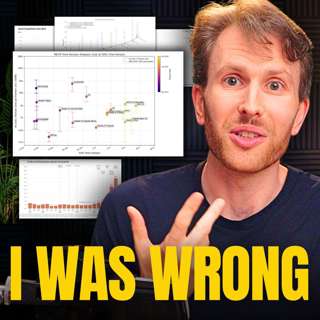
What the hell happened with AGI timelines in 2026? – Rob Wiblin

What the hell happened with AGI timelines in 2026? – Rob Wiblin

Last October, famed coder Andrej Karpathy called AI agents “slop.” Two months later he completely reversed his view, describing them as “alien tools” that are “rocking the profession.”He was far from ...

4 Aug 49min
#249 – Spencer Greenberg on staying sane while trying to save the world

#249 – Spencer Greenberg on staying sane while trying to save the world

If you genuinely believe that humanity could be wiped out by AI or a pandemic, what is the appropriate amount of fear to feel?“As much as possible” can seem like the only reasonable answer. If the wor...

28 Jul 2h 9min

Populært innen Fakta

fastlegen
dine-penger-pengeradet
relasjonspodden-med-dora-thorhallsdottir-kjersti-idem
rss-strid
treningspodden
foreldreradet
rss-orjasater
jakt-og-fiskepodden
rss-kunsten-a-leve
hverdagspsyken
rss-bisarr-historie
rss-impressions-2
mikkels-paskenotter
sinnsyn
level-up-med-anniken-binz
takk-og-lov-med-anine-kierulf
rss-var-forste-kaffe
gravid-uke-for-uke
nevropodden
fryktlos