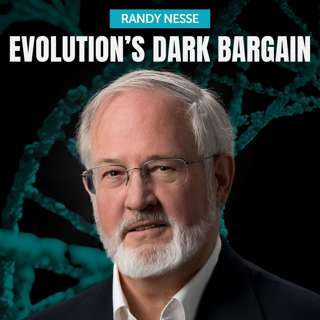

#179 Classic episode – Randy Nesse on why evolution left us so vulnerable to depression and anxiety

#179 Classic episode – Randy Nesse on why evolution left us so vulnerable to depression and anxiety

Mental health problems like depression and anxiety affect enormous numbers of people and severely interfere with their lives. By contrast, we don’t see similar levels of physical ill health in young people. At any point in time, something like 20% of young people are working through anxiety or depression that’s seriously interfering with their lives — but nowhere near 20% of people in their 20s have severe heart disease or cancer or a similar failure in a key organ of the body other than the brain.

From an evolutionary perspective, that’s to be expected, right? If your heart or lungs or legs or skin stop working properly while you’re a teenager, you’re less likely to reproduce, and the genes that cause that malfunction get weeded out of the gene pool.

So why is it that these evolutionary selective pressures seemingly fixed our bodies so that they work pretty smoothly for young people most of the time, but it feels like evolution fell asleep on the job when it comes to the brain? Why did evolution never get around to patching the most basic problems, like social anxiety, panic attacks, debilitating pessimism, or inappropriate mood swings? For that matter, why did evolution go out of its way to give us the capacity for low mood or chronic anxiety or extreme mood swings at all?

Today’s guest, Randy Nesse — a leader in the field of evolutionary psychiatry — wrote the book Good Reasons for Bad Feelings, in which he sets out to try to resolve this paradox.

Rebroadcast: This episode originally aired in February 2024.

Links to learn more, video, and full transcript: https://80k.info/rn

In the interview, host Rob Wiblin and Randy discuss the key points of the book, as well as:

  • How the evolutionary psychiatry perspective can help people appreciate that their mental health problems are often the result of a useful and important system.
  • How evolutionary pressures and dynamics lead to a wide range of different personalities, behaviours, strategies, and tradeoffs.
  • The missing intellectual foundations of psychiatry, and how an evolutionary lens could revolutionise the field.
  • How working as both an academic and a practicing psychiatrist shaped Randy’s understanding of treating mental health problems.
  • The “smoke detector principle” of why we experience so many false alarms along with true threats.
  • The origins of morality and capacity for genuine love, and why Randy thinks it’s a mistake to try to explain these from a selfish gene perspective.
  • Evolutionary theories on why we age and die.
  • And much more.

Chapters:

  • Cold Open (00:00:00)
  • Rob's Intro (00:00:55)
  • The interview begins (00:03:01)
  • The history of evolutionary medicine (00:03:56)
  • The evolutionary origin of anxiety (00:12:37)
  • Design tradeoffs, diseases, and adaptations (00:43:19)
  • The tricker case of depression (00:48:57)
  • The purpose of low mood (00:54:08)
  • Big mood swings vs barely any mood swings (01:22:41)
  • Is mental health actually getting worse? (01:33:43)
  • A general explanation for bodies breaking (01:37:27)
  • Freudianism and the origins of morality and love (01:48:53)
  • Evolutionary medicine in general (02:02:42)
  • Objections to evolutionary psychology (02:16:29)
  • How do you test evolutionary hypotheses to rule out the bad explanations? (02:23:19)
  • Striving and meaning in careers (02:25:12)
  • Why do people age and die? (02:45:16)

Producer and editor: Keiran Harris
Audio Engineering Lead: Ben Cordell
Technical editing: Dominic Armstrong
Transcriptions: Katy Moore

Episoder(333)

#194 – Vitalik Buterin on defensive acceleration and how to regulate AI when you fear government

#194 – Vitalik Buterin on defensive acceleration and how to regulate AI when you fear government

"If you’re a power that is an island and that goes by sea, then you’re more likely to do things like valuing freedom, being democratic, being pro-foreigner, being open-minded, being interested in trad...

26 Jul 20243h 4min

#193 – Sihao Huang on navigating the geopolitics of US–China AI competition

#193 – Sihao Huang on navigating the geopolitics of US–China AI competition

"You don’t necessarily need world-leading compute to create highly risky AI systems. The biggest biological design tools right now, like AlphaFold’s, are orders of magnitude smaller in terms of comput...

18 Jul 20242h 23min

#192 – Annie Jacobsen on what would happen if North Korea launched a nuclear weapon at the US

#192 – Annie Jacobsen on what would happen if North Korea launched a nuclear weapon at the US

"Ring one: total annihilation; no cellular life remains. Ring two, another three-mile diameter out: everything is ablaze. Ring three, another three or five miles out on every side: third-degree burns ...

12 Jul 20241h 54min

#191 (Part 2) – Carl Shulman on government and society after AGI

#191 (Part 2) – Carl Shulman on government and society after AGI

This is the second part of our marathon interview with Carl Shulman. The first episode is on the economy and national security after AGI. You can listen to them in either order!If we develop artificia...

5 Jul 20242h 20min

#191 (Part 1) – Carl Shulman on the economy and national security after AGI

#191 (Part 1) – Carl Shulman on the economy and national security after AGI

This is the first part of our marathon interview with Carl Shulman. The second episode is on government and society after AGI. You can listen to them in either order!The human brain does what it does ...

27 Jun 20244h 14min

#190 – Eric Schwitzgebel on whether the US is conscious

#190 – Eric Schwitzgebel on whether the US is conscious

"One of the most amazing things about planet Earth is that there are complex bags of mostly water — you and me – and we can look up at the stars, and look into our brains, and try to grapple with the ...

7 Jun 20242h

#189 – Rachel Glennerster on why we still don’t have vaccines that could save millions

#189 – Rachel Glennerster on why we still don’t have vaccines that could save millions

"You can’t charge what something is worth during a pandemic. So we estimated that the value of one course of COVID vaccine in January 2021 was over $5,000. They were selling for between $6 and $40. So...

29 Mai 20242h 48min

#188 – Matt Clancy on whether science is good

#188 – Matt Clancy on whether science is good

"Suppose we make these grants, we do some of those experiments I talk about. We discover, for example — I’m just making this up — but we give people superforecasting tests when they’re doing peer revi...

23 Mai 20242h 40min

Populært innen Fakta

fastlegen
dine-penger-pengeradet
relasjonspodden-med-dora-thorhallsdottir-kjersti-idem
foreldreradet
treningspodden
rss-strid-de-norske-borgerkrigene
mikkels-paskenotter
rss-bisarr-historie
jakt-og-fiskepodden
sinnsyn
rss-kunsten-a-leve
rss-sunn-okonomi
hverdagspsyken
tomprat-med-gunnar-tjomlid
rss-bak-luftfarten
ukast
fryktlos
gravid-uke-for-uke
lederskap-nhhs-podkast-om-ledelse
rss-kull