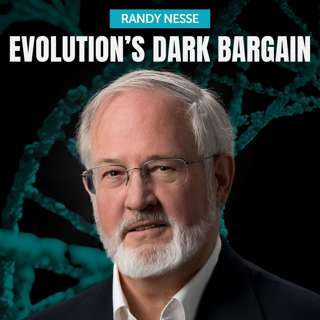

#179 Classic episode – Randy Nesse on why evolution left us so vulnerable to depression and anxiety

#179 Classic episode – Randy Nesse on why evolution left us so vulnerable to depression and anxiety

Mental health problems like depression and anxiety affect enormous numbers of people and severely interfere with their lives. By contrast, we don’t see similar levels of physical ill health in young people. At any point in time, something like 20% of young people are working through anxiety or depression that’s seriously interfering with their lives — but nowhere near 20% of people in their 20s have severe heart disease or cancer or a similar failure in a key organ of the body other than the brain.

From an evolutionary perspective, that’s to be expected, right? If your heart or lungs or legs or skin stop working properly while you’re a teenager, you’re less likely to reproduce, and the genes that cause that malfunction get weeded out of the gene pool.

So why is it that these evolutionary selective pressures seemingly fixed our bodies so that they work pretty smoothly for young people most of the time, but it feels like evolution fell asleep on the job when it comes to the brain? Why did evolution never get around to patching the most basic problems, like social anxiety, panic attacks, debilitating pessimism, or inappropriate mood swings? For that matter, why did evolution go out of its way to give us the capacity for low mood or chronic anxiety or extreme mood swings at all?

Today’s guest, Randy Nesse — a leader in the field of evolutionary psychiatry — wrote the book Good Reasons for Bad Feelings, in which he sets out to try to resolve this paradox.

Rebroadcast: This episode originally aired in February 2024.

Links to learn more, video, and full transcript: https://80k.info/rn

In the interview, host Rob Wiblin and Randy discuss the key points of the book, as well as:

  • How the evolutionary psychiatry perspective can help people appreciate that their mental health problems are often the result of a useful and important system.
  • How evolutionary pressures and dynamics lead to a wide range of different personalities, behaviours, strategies, and tradeoffs.
  • The missing intellectual foundations of psychiatry, and how an evolutionary lens could revolutionise the field.
  • How working as both an academic and a practicing psychiatrist shaped Randy’s understanding of treating mental health problems.
  • The “smoke detector principle” of why we experience so many false alarms along with true threats.
  • The origins of morality and capacity for genuine love, and why Randy thinks it’s a mistake to try to explain these from a selfish gene perspective.
  • Evolutionary theories on why we age and die.
  • And much more.

Chapters:

  • Cold Open (00:00:00)
  • Rob's Intro (00:00:55)
  • The interview begins (00:03:01)
  • The history of evolutionary medicine (00:03:56)
  • The evolutionary origin of anxiety (00:12:37)
  • Design tradeoffs, diseases, and adaptations (00:43:19)
  • The tricker case of depression (00:48:57)
  • The purpose of low mood (00:54:08)
  • Big mood swings vs barely any mood swings (01:22:41)
  • Is mental health actually getting worse? (01:33:43)
  • A general explanation for bodies breaking (01:37:27)
  • Freudianism and the origins of morality and love (01:48:53)
  • Evolutionary medicine in general (02:02:42)
  • Objections to evolutionary psychology (02:16:29)
  • How do you test evolutionary hypotheses to rule out the bad explanations? (02:23:19)
  • Striving and meaning in careers (02:25:12)
  • Why do people age and die? (02:45:16)

Producer and editor: Keiran Harris
Audio Engineering Lead: Ben Cordell
Technical editing: Dominic Armstrong
Transcriptions: Katy Moore

Episoder(333)

#187 – Zach Weinersmith on how researching his book turned him from a space optimist into a "space bastard"

#187 – Zach Weinersmith on how researching his book turned him from a space optimist into a "space bastard"

"Earth economists, when they measure how bad the potential for exploitation is, they look at things like, how is labour mobility? How much possibility do labourers have otherwise to go somewhere else?...

14 Mai 20243h 6min

#186 – Dean Spears on why babies are born small in Uttar Pradesh, and how to save their lives

#186 – Dean Spears on why babies are born small in Uttar Pradesh, and how to save their lives

"I work in a place called Uttar Pradesh, which is a state in India with 240 million people. One in every 33 people in the whole world lives in Uttar Pradesh. It would be the fifth largest country if i...

1 Mai 20241h 18min

#185 – Lewis Bollard on the 7 most promising ways to end factory farming, and whether AI is going to be good or bad for animals

#185 – Lewis Bollard on the 7 most promising ways to end factory farming, and whether AI is going to be good or bad for animals

"The constraint right now on factory farming is how far can you push the biology of these animals? But AI could remove that constraint. It could say, 'Actually, we can push them further in these ways ...

18 Apr 20242h 33min

#184 – Zvi Mowshowitz on sleeping on sleeper agents, and the biggest AI updates since ChatGPT

#184 – Zvi Mowshowitz on sleeping on sleeper agents, and the biggest AI updates since ChatGPT

Many of you will have heard of Zvi Mowshowitz as a superhuman information-absorbing-and-processing machine — which he definitely is. As the author of the Substack Don’t Worry About the Vase, Zvi has s...

11 Apr 20243h 31min

AI governance and policy (Article)

AI governance and policy (Article)

Today’s release is a reading of our career review of AI governance and policy, written and narrated by Cody Fenwick.Advanced AI systems could have massive impacts on humanity and potentially pose glob...

28 Mar 202451min

#183 – Spencer Greenberg on causation without correlation, money and happiness, lightgassing, hype vs value, and more

#183 – Spencer Greenberg on causation without correlation, money and happiness, lightgassing, hype vs value, and more

"When a friend comes to me with a decision, and they want my thoughts on it, very rarely am I trying to give them a really specific answer, like, 'I solved your problem.' What I’m trying to do often i...

14 Mar 20242h 36min

#182 – Bob Fischer on comparing the welfare of humans, chickens, pigs, octopuses, bees, and more

#182 – Bob Fischer on comparing the welfare of humans, chickens, pigs, octopuses, bees, and more

"[One] thing is just to spend time thinking about the kinds of things animals can do and what their lives are like. Just how hard a chicken will work to get to a nest box before she lays an egg, the a...

8 Mar 20242h 21min

#181 – Laura Deming on the science that could keep us healthy in our 80s and beyond

#181 – Laura Deming on the science that could keep us healthy in our 80s and beyond

"The question I care about is: What do I want to do? Like, when I'm 80, how strong do I want to be? OK, and then if I want to be that strong, how well do my muscles have to work? OK, and then if that'...

1 Mar 20241h 37min

Populært innen Fakta

fastlegen
dine-penger-pengeradet
relasjonspodden-med-dora-thorhallsdottir-kjersti-idem
foreldreradet
treningspodden
rss-strid-de-norske-borgerkrigene
mikkels-paskenotter
rss-bisarr-historie
jakt-og-fiskepodden
rss-sunn-okonomi
sinnsyn
rss-kunsten-a-leve
hverdagspsyken
tomprat-med-gunnar-tjomlid
rss-bak-luftfarten
fryktlos
ukast
rss-mind-body-podden
level-up-med-anniken-binz
rss-kull