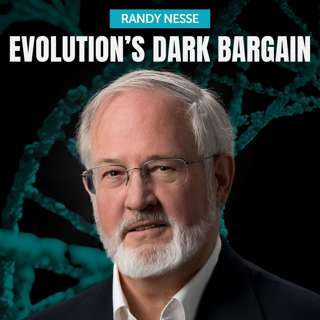
#179 Classic episode – Randy Nesse on why evolution left us so vulnerable to depression and anxiety

#179 Classic episode – Randy Nesse on why evolution left us so vulnerable to depression and anxiety

Mental health problems like depression and anxiety affect enormous numbers of people and severely interfere with their lives. By contrast, we don’t see similar levels of physical ill health in young people. At any point in time, something like 20% of young people are working through anxiety or depression that’s seriously interfering with their lives — but nowhere near 20% of people in their 20s have severe heart disease or cancer or a similar failure in a key organ of the body other than the brain.

From an evolutionary perspective, that’s to be expected, right? If your heart or lungs or legs or skin stop working properly while you’re a teenager, you’re less likely to reproduce, and the genes that cause that malfunction get weeded out of the gene pool.

So why is it that these evolutionary selective pressures seemingly fixed our bodies so that they work pretty smoothly for young people most of the time, but it feels like evolution fell asleep on the job when it comes to the brain? Why did evolution never get around to patching the most basic problems, like social anxiety, panic attacks, debilitating pessimism, or inappropriate mood swings? For that matter, why did evolution go out of its way to give us the capacity for low mood or chronic anxiety or extreme mood swings at all?

Today’s guest, Randy Nesse — a leader in the field of evolutionary psychiatry — wrote the book Good Reasons for Bad Feelings, in which he sets out to try to resolve this paradox.

Rebroadcast: This episode originally aired in February 2024.

Links to learn more, video, and full transcript: https://80k.info/rn

In the interview, host Rob Wiblin and Randy discuss the key points of the book, as well as:

  • How the evolutionary psychiatry perspective can help people appreciate that their mental health problems are often the result of a useful and important system.
  • How evolutionary pressures and dynamics lead to a wide range of different personalities, behaviours, strategies, and tradeoffs.
  • The missing intellectual foundations of psychiatry, and how an evolutionary lens could revolutionise the field.
  • How working as both an academic and a practicing psychiatrist shaped Randy’s understanding of treating mental health problems.
  • The “smoke detector principle” of why we experience so many false alarms along with true threats.
  • The origins of morality and capacity for genuine love, and why Randy thinks it’s a mistake to try to explain these from a selfish gene perspective.
  • Evolutionary theories on why we age and die.
  • And much more.

Chapters:

  • Cold Open (00:00:00)
  • Rob's Intro (00:00:55)
  • The interview begins (00:03:01)
  • The history of evolutionary medicine (00:03:56)
  • The evolutionary origin of anxiety (00:12:37)
  • Design tradeoffs, diseases, and adaptations (00:43:19)
  • The tricker case of depression (00:48:57)
  • The purpose of low mood (00:54:08)
  • Big mood swings vs barely any mood swings (01:22:41)
  • Is mental health actually getting worse? (01:33:43)
  • A general explanation for bodies breaking (01:37:27)
  • Freudianism and the origins of morality and love (01:48:53)
  • Evolutionary medicine in general (02:02:42)
  • Objections to evolutionary psychology (02:16:29)
  • How do you test evolutionary hypotheses to rule out the bad explanations? (02:23:19)
  • Striving and meaning in careers (02:25:12)
  • Why do people age and die? (02:45:16)

Producer and editor: Keiran Harris
Audio Engineering Lead: Ben Cordell
Technical editing: Dominic Armstrong
Transcriptions: Katy Moore

Episoder(333)

We just put up a new compilation of ten core episodes of the show

We just put up a new compilation of ten core episodes of the show

We recently launched a new podcast feed that might be useful to you and people you know. It's called Effective Altruism: Ten Global Problems, and it's a collection of ten top episodes of this show, se...

20 Okt 20213min

#113 – Varsha Venugopal on using gossip to help vaccinate every child in India

#113 – Varsha Venugopal on using gossip to help vaccinate every child in India

Our failure to make sure all kids globally get all of their basic vaccinations leads to 1.5 million child deaths every year.According to today’s guest, Varsha Venugopal, for the great majority this ha...

18 Okt 20212h 5min

#112 – Carl Shulman on the common-sense case for existential risk work and its practical implications

#112 – Carl Shulman on the common-sense case for existential risk work and its practical implications

Preventing the apocalypse may sound like an idiosyncratic activity, and it sometimes is justified on exotic grounds, such as the potential for humanity to become a galaxy-spanning civilisation.But the...

5 Okt 20213h 48min

#111 – Mushtaq Khan on using institutional economics to predict effective government reforms

#111 – Mushtaq Khan on using institutional economics to predict effective government reforms

If you’re living in the Niger Delta in Nigeria, your best bet at a high-paying career is probably ‘artisanal refining’ — or, in plain language, stealing oil from pipelines. The resulting oil spills da...

10 Sep 20213h 20min
#110 – Holden Karnofsky on building aptitudes and kicking ass

#110 – Holden Karnofsky on building aptitudes and kicking ass

Holden Karnofsky helped create two of the most influential organisations in the effective philanthropy world. So when he outlines a different perspective on career advice than the one we present at 80...

26 Aug 20212h 46min

#109 – Holden Karnofsky on the most important century

#109 – Holden Karnofsky on the most important century

Will the future of humanity be wild, or boring? It's natural to think that if we're trying to be sober and measured, and predict what will really happen rather than spin an exciting story, it's more l...

19 Aug 20212h 19min

#108 – Chris Olah on working at top AI labs without an undergrad degree

#108 – Chris Olah on working at top AI labs without an undergrad degree

Chris Olah has had a fascinating and unconventional career path. Most people who want to pursue a research career feel they need a degree to get taken seriously. But Chris not only doesn't have a P...

11 Aug 20211h 33min

#107 – Chris Olah on what the hell is going on inside neural networks

#107 – Chris Olah on what the hell is going on inside neural networks

Big machine learning models can identify plant species better than any human, write passable essays, beat you at a game of Starcraft 2, figure out how a photo of Tobey Maguire and the word 'spider' ar...

4 Aug 20213h 9min

Populært innen Fakta

fastlegen
dine-penger-pengeradet
relasjonspodden-med-dora-thorhallsdottir-kjersti-idem
rss-strid-de-norske-borgerkrigene
foreldreradet
mikkels-paskenotter
treningspodden
rss-bisarr-historie
jakt-og-fiskepodden
rss-sunn-okonomi
sinnsyn
tomprat-med-gunnar-tjomlid
rss-kunsten-a-leve
hagespiren-podcast
rss-bak-luftfarten
ukast
fryktlos
hverdagspsyken
rss-mind-body-podden
gravid-uke-for-uke