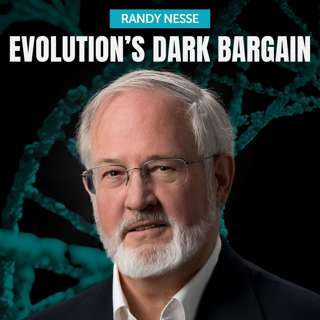

#179 Classic episode – Randy Nesse on why evolution left us so vulnerable to depression and anxiety

#179 Classic episode – Randy Nesse on why evolution left us so vulnerable to depression and anxiety

Mental health problems like depression and anxiety affect enormous numbers of people and severely interfere with their lives. By contrast, we don’t see similar levels of physical ill health in young people. At any point in time, something like 20% of young people are working through anxiety or depression that’s seriously interfering with their lives — but nowhere near 20% of people in their 20s have severe heart disease or cancer or a similar failure in a key organ of the body other than the brain.

From an evolutionary perspective, that’s to be expected, right? If your heart or lungs or legs or skin stop working properly while you’re a teenager, you’re less likely to reproduce, and the genes that cause that malfunction get weeded out of the gene pool.

So why is it that these evolutionary selective pressures seemingly fixed our bodies so that they work pretty smoothly for young people most of the time, but it feels like evolution fell asleep on the job when it comes to the brain? Why did evolution never get around to patching the most basic problems, like social anxiety, panic attacks, debilitating pessimism, or inappropriate mood swings? For that matter, why did evolution go out of its way to give us the capacity for low mood or chronic anxiety or extreme mood swings at all?

Today’s guest, Randy Nesse — a leader in the field of evolutionary psychiatry — wrote the book Good Reasons for Bad Feelings, in which he sets out to try to resolve this paradox.

Rebroadcast: This episode originally aired in February 2024.

Links to learn more, video, and full transcript: https://80k.info/rn

In the interview, host Rob Wiblin and Randy discuss the key points of the book, as well as:

  • How the evolutionary psychiatry perspective can help people appreciate that their mental health problems are often the result of a useful and important system.
  • How evolutionary pressures and dynamics lead to a wide range of different personalities, behaviours, strategies, and tradeoffs.
  • The missing intellectual foundations of psychiatry, and how an evolutionary lens could revolutionise the field.
  • How working as both an academic and a practicing psychiatrist shaped Randy’s understanding of treating mental health problems.
  • The “smoke detector principle” of why we experience so many false alarms along with true threats.
  • The origins of morality and capacity for genuine love, and why Randy thinks it’s a mistake to try to explain these from a selfish gene perspective.
  • Evolutionary theories on why we age and die.
  • And much more.

Chapters:

  • Cold Open (00:00:00)
  • Rob's Intro (00:00:55)
  • The interview begins (00:03:01)
  • The history of evolutionary medicine (00:03:56)
  • The evolutionary origin of anxiety (00:12:37)
  • Design tradeoffs, diseases, and adaptations (00:43:19)
  • The tricker case of depression (00:48:57)
  • The purpose of low mood (00:54:08)
  • Big mood swings vs barely any mood swings (01:22:41)
  • Is mental health actually getting worse? (01:33:43)
  • A general explanation for bodies breaking (01:37:27)
  • Freudianism and the origins of morality and love (01:48:53)
  • Evolutionary medicine in general (02:02:42)
  • Objections to evolutionary psychology (02:16:29)
  • How do you test evolutionary hypotheses to rule out the bad explanations? (02:23:19)
  • Striving and meaning in careers (02:25:12)
  • Why do people age and die? (02:45:16)

Producer and editor: Keiran Harris
Audio Engineering Lead: Ben Cordell
Technical editing: Dominic Armstrong
Transcriptions: Katy Moore

Episoder(333)

#106 – Cal Newport on an industrial revolution for office work

#106 – Cal Newport on an industrial revolution for office work

If you wanted to start a university department from scratch, and attract as many superstar researchers as possible, what’s the most attractive perk you could offer?How about just not needing an email ...

28 Jul 20211h 53min

#105 – Alexander Berger on improving global health and wellbeing in clear and direct ways

#105 – Alexander Berger on improving global health and wellbeing in clear and direct ways

The effective altruist research community tries to identify the highest impact things people can do to improve the world. Unsurprisingly, given the difficulty of such a massive and open-ended project,...

12 Jul 20212h 54min

#104 – Pardis Sabeti on the Sentinel system for detecting and stopping pandemics

#104 – Pardis Sabeti on the Sentinel system for detecting and stopping pandemics

When the first person with COVID-19 went to see a doctor in Wuhan, nobody could tell that it wasn’t a familiar disease like the flu — that we were dealing with something new. How much death and destru...

29 Jun 20212h 20min

#103 – Max Roser on building the world's best source of COVID-19 data at Our World in Data

#103 – Max Roser on building the world's best source of COVID-19 data at Our World in Data

History is filled with stories of great people stepping up in times of crisis. Presidents averting wars; soldiers leading troops away from certain death; data scientists sleeping on the office floor t...

21 Jun 20212h 22min

#102 – Tom Moynihan on why prior generations missed some of the biggest priorities of all

#102 – Tom Moynihan on why prior generations missed some of the biggest priorities of all

It can be tough to get people to truly care about reducing existential risks today. But spare a thought for the longtermist of the 17th century: they were surrounded by people who thought extinction w...

11 Jun 20213h 56min

#101 – Robert Wright on using cognitive empathy to save the world

#101 – Robert Wright on using cognitive empathy to save the world

In 2003, Saddam Hussein refused to let Iraqi weapons scientists leave the country to be interrogated. Given the overwhelming domestic support for an invasion at the time, most key figures in the U.S. ...

28 Mai 20211h 36min
#100 – Having a successful career with depression, anxiety and imposter syndrome

#100 – Having a successful career with depression, anxiety and imposter syndrome

Today's episode is one of the most remarkable and really, unique, pieces of content we’ve ever produced (and I can say that because I had almost nothing to do with making it!). The producer of this ...

19 Mai 20212h 51min

#99 – Leah Garcés on turning adversaries into allies to change the chicken industry

#99 – Leah Garcés on turning adversaries into allies to change the chicken industry

For a chance to prevent enormous amounts of suffering, would you be brave enough to drive five hours to a remote location to meet a man who seems likely to be your enemy, knowing that it might be an a...

13 Mai 20212h 26min

Populært innen Fakta

fastlegen
dine-penger-pengeradet
relasjonspodden-med-dora-thorhallsdottir-kjersti-idem
foreldreradet
treningspodden
rss-strid-de-norske-borgerkrigene
mikkels-paskenotter
rss-bisarr-historie
jakt-og-fiskepodden
rss-sunn-okonomi
sinnsyn
rss-kunsten-a-leve
hverdagspsyken
tomprat-med-gunnar-tjomlid
rss-bak-luftfarten
fryktlos
ukast
rss-mind-body-podden
level-up-med-anniken-binz
rss-kull