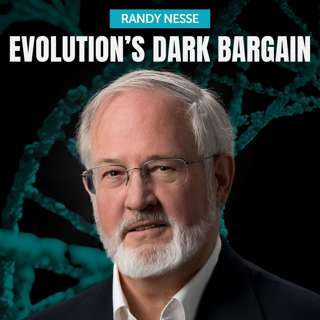

#179 Classic episode – Randy Nesse on why evolution left us so vulnerable to depression and anxiety

#179 Classic episode – Randy Nesse on why evolution left us so vulnerable to depression and anxiety

Mental health problems like depression and anxiety affect enormous numbers of people and severely interfere with their lives. By contrast, we don’t see similar levels of physical ill health in young people. At any point in time, something like 20% of young people are working through anxiety or depression that’s seriously interfering with their lives — but nowhere near 20% of people in their 20s have severe heart disease or cancer or a similar failure in a key organ of the body other than the brain.

From an evolutionary perspective, that’s to be expected, right? If your heart or lungs or legs or skin stop working properly while you’re a teenager, you’re less likely to reproduce, and the genes that cause that malfunction get weeded out of the gene pool.

So why is it that these evolutionary selective pressures seemingly fixed our bodies so that they work pretty smoothly for young people most of the time, but it feels like evolution fell asleep on the job when it comes to the brain? Why did evolution never get around to patching the most basic problems, like social anxiety, panic attacks, debilitating pessimism, or inappropriate mood swings? For that matter, why did evolution go out of its way to give us the capacity for low mood or chronic anxiety or extreme mood swings at all?

Today’s guest, Randy Nesse — a leader in the field of evolutionary psychiatry — wrote the book Good Reasons for Bad Feelings, in which he sets out to try to resolve this paradox.

Rebroadcast: This episode originally aired in February 2024.

Links to learn more, video, and full transcript: https://80k.info/rn

In the interview, host Rob Wiblin and Randy discuss the key points of the book, as well as:

  • How the evolutionary psychiatry perspective can help people appreciate that their mental health problems are often the result of a useful and important system.
  • How evolutionary pressures and dynamics lead to a wide range of different personalities, behaviours, strategies, and tradeoffs.
  • The missing intellectual foundations of psychiatry, and how an evolutionary lens could revolutionise the field.
  • How working as both an academic and a practicing psychiatrist shaped Randy’s understanding of treating mental health problems.
  • The “smoke detector principle” of why we experience so many false alarms along with true threats.
  • The origins of morality and capacity for genuine love, and why Randy thinks it’s a mistake to try to explain these from a selfish gene perspective.
  • Evolutionary theories on why we age and die.
  • And much more.

Chapters:

  • Cold Open (00:00:00)
  • Rob's Intro (00:00:55)
  • The interview begins (00:03:01)
  • The history of evolutionary medicine (00:03:56)
  • The evolutionary origin of anxiety (00:12:37)
  • Design tradeoffs, diseases, and adaptations (00:43:19)
  • The tricker case of depression (00:48:57)
  • The purpose of low mood (00:54:08)
  • Big mood swings vs barely any mood swings (01:22:41)
  • Is mental health actually getting worse? (01:33:43)
  • A general explanation for bodies breaking (01:37:27)
  • Freudianism and the origins of morality and love (01:48:53)
  • Evolutionary medicine in general (02:02:42)
  • Objections to evolutionary psychology (02:16:29)
  • How do you test evolutionary hypotheses to rule out the bad explanations? (02:23:19)
  • Striving and meaning in careers (02:25:12)
  • Why do people age and die? (02:45:16)

Producer and editor: Keiran Harris
Audio Engineering Lead: Ben Cordell
Technical editing: Dominic Armstrong
Transcriptions: Katy Moore

Episoder(333)

#85 - Mark Lynas on climate change, societal collapse & nuclear energy

#85 - Mark Lynas on climate change, societal collapse & nuclear energy

A golf-ball sized lump of uranium can deliver more than enough power to cover all of your lifetime energy use. To get the same energy from coal, you’d need 3,200 tonnes of black rock — a mass equivale...

20 Aug 20202h 8min

#84 – Shruti Rajagopalan on what India did to stop COVID-19 and how well it worked

#84 – Shruti Rajagopalan on what India did to stop COVID-19 and how well it worked

When COVID-19 struck the US, everyone was told that hand sanitizer needed to be saved for healthcare professionals, so they should just wash their hands instead. But in India, many homes lack reliable...

13 Aug 20202h 58min

#83 - Jennifer Doleac on preventing crime without police and prisons

#83 - Jennifer Doleac on preventing crime without police and prisons

The killing of George Floyd has prompted a great deal of debate over whether the US should reduce the size of its police departments. The research literature suggests that the presence of police offic...

31 Jul 20202h 23min

#82 – James Forman Jr on reducing the cruelty of the US criminal legal system

#82 – James Forman Jr on reducing the cruelty of the US criminal legal system

No democracy has ever incarcerated as many people as the United States. To get its incarceration rate down to the global average, the US would have to release 3 in 4 people in its prisons today.  The ...

27 Jul 20201h 28min

#81 - Ben Garfinkel on scrutinising classic AI risk arguments

#81 - Ben Garfinkel on scrutinising classic AI risk arguments

80,000 Hours, along with many other members of the effective altruism movement, has argued that helping to positively shape the development of artificial intelligence may be one of the best ways to ha...

9 Jul 20202h 38min

Advice on how to read our advice (Article)

Advice on how to read our advice (Article)

This is the fourth release in our new series of audio articles. If you want to read the original article or check out the links within it, you can find them here. "We’ve found that readers sometimes...

29 Jun 202015min

#80 – Stuart Russell on why our approach to AI is broken and how to fix it

#80 – Stuart Russell on why our approach to AI is broken and how to fix it

Stuart Russell, Professor at UC Berkeley and co-author of the most popular AI textbook, thinks the way we approach machine learning today is fundamentally flawed. In his new book, Human Compatible, he...

22 Jun 20202h 13min

What anonymous contributors think about important life and career questions (Article)

What anonymous contributors think about important life and career questions (Article)

Today we’re launching the final entry of our ‘anonymous answers' series on the website. It features answers to 23 different questions including “How have you seen talented people fail in their work?...

5 Jun 202037min

Populært innen Fakta

fastlegen
dine-penger-pengeradet
relasjonspodden-med-dora-thorhallsdottir-kjersti-idem
foreldreradet
treningspodden
rss-strid-de-norske-borgerkrigene
mikkels-paskenotter
rss-bisarr-historie
jakt-og-fiskepodden
rss-sunn-okonomi
sinnsyn
rss-kunsten-a-leve
hverdagspsyken
tomprat-med-gunnar-tjomlid
rss-bak-luftfarten
fryktlos
ukast
rss-mind-body-podden
level-up-med-anniken-binz
rss-kull