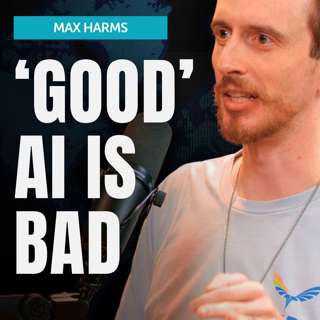

#236 – Max Harms on why teaching AI right from wrong could get everyone killed

#236 – Max Harms on why teaching AI right from wrong could get everyone killed

Most people in AI are trying to give AIs ‘good’ values. Max Harms wants us to give them no values at all. According to Max, the only safe design is an AGI that defers entirely to its human operators, has no views about how the world ought to be, is willingly modifiable, and completely indifferent to being shut down — a strategy no AI company is working on at all.

In Max’s view any grander preferences about the world, even ones we agree with, will necessarily become distorted during a recursive self-improvement loop, and be the seeds that grow into a violent takeover attempt once that AI is powerful enough.

It’s a vision that springs from the worldview laid out in If Anyone Builds It, Everyone Dies, the recent book by Eliezer Yudkowsky and Nate Soares, two of Max’s colleagues at the Machine Intelligence Research Institute.

To Max, the book’s core thesis is common sense: if you build something vastly smarter than you, and its goals are misaligned with your own, then its actions will probably result in human extinction.

And Max thinks misalignment is the default outcome. Consider evolution: its “goal” for humans was to maximise reproduction and pass on our genes as much as possible. But as technology has advanced we’ve learned to access the reward signal it set up for us, pleasure — without any reproduction at all, by having sex while on birth control for instance.

We can understand intellectually that this is inconsistent with what evolution was trying to design and motivate us to do. We just don’t care.

Max thinks current ML training has the same structural problem: our development processes are seeding AI models with a similar mismatch between goals and behaviour. Across virtually every training run, models designed to align with various human goals are also being rewarded for persisting, acquiring resources, and not being shut down.

This leads to Max’s research agenda. The idea is to train AI to be “corrigible” and defer to human control as its sole objective — no harmlessness goals, no moral values, nothing else. In practice, models would get rewarded for behaviours like being willing to shut themselves down or surrender power.

According to Max, other approaches to corrigibility have tended to treat it as a constraint on other goals like “make the world good,” rather than a primary objective in its own right. But those goals gave AI reasons to resist shutdown and otherwise undermine corrigibility. If you strip out those competing objectives, alignment might follow naturally from AI that is broadly obedient to humans.

Max has laid out the theoretical framework for “Corrigibility as a Singular Target,” but notes that essentially no empirical work has followed — no benchmarks, no training runs, no papers testing the idea in practice. Max wants to change this — he’s calling for collaborators to get in touch at maxharms.com.


Links to learn more, video, and full transcript: https://80k.info/mh26

This episode was recorded on October 19, 2025.

Chapters:

  • Cold open (00:00:00)
  • Who's Max Harms? (00:01:22)
  • A note from Rob Wiblin (00:01:58)
  • If anyone builds it, will everyone die? The MIRI perspective on AGI risk (00:04:26)
  • Evolution failed to 'align' us, just as we'll fail to align AI (00:26:22)
  • We're training AIs to want to stay alive and value power for its own sake (00:44:31)
  • Objections: Is the 'squiggle/paperclip problem' really real? (00:53:54)
  • Can we get empirical evidence re: 'alignment by default'? (01:06:24)
  • Why do few AI researchers share Max's perspective? (01:11:37)
  • We're training AI to pursue goals relentlessly — and superintelligence will too (01:19:53)
  • The case for a radical slowdown (01:26:07)
  • Max's best hope: corrigibility as stepping stone to alignment (01:29:09)
  • Corrigibility is both uniquely valuable, and practical, to train (01:33:44)
  • What training could ever make models corrigible enough? (01:46:13)
  • Corrigibility is also terribly risky due to misuse risk (01:52:44)
  • A single researcher could make a corrigibility benchmark. Nobody has. (02:00:04)
  • Red Heart & why Max writes hard science fiction (02:13:27)
  • Should you homeschool? Depends how weird your kids are. (02:35:12)

Video and audio editing: Dominic Armstrong, Milo McGuire, Luke Monsour, and Simon Monsour
Music: CORBIT
Coordination, transcripts, and web: Katy Moore

Episoder(333)

AI might let a few people control everything — permanently (article by Rose Hadshar)

AI might let a few people control everything — permanently (article by Rose Hadshar)

Power is already concentrated today: over 800 million people live on less than $3 a day, the three richest men in the world are worth over $1 trillion, and almost six billion people live in countries ...

12 Des 20251h

#230 – Dean Ball on how AI is a huge deal — but we shouldn’t regulate it yet

#230 – Dean Ball on how AI is a huge deal — but we shouldn’t regulate it yet

Former White House staffer Dean Ball thinks it's very likely some form of 'superintelligence' arrives in under 20 years. He thinks AI being used for bioweapon research is "a real threat model, obvious...

10 Des 20252h 54min

#229 – Marius Hobbhahn on the race to solve AI scheming before models go superhuman

#229 – Marius Hobbhahn on the race to solve AI scheming before models go superhuman

We often worry about AI models “hallucinating” or making honest mistakes. But what happens when a model knows the truth, but decides to deceive you anyway to achieve a goal of its own? This isn’t sci-...

3 Des 20253h 3min

Rob & Luisa chat kids, the 2016 fertility crash, and how the 50s invented parenting that makes us miserable

Rob & Luisa chat kids, the 2016 fertility crash, and how the 50s invented parenting that makes us miserable

Global fertility rates aren’t just falling: the rate of decline is accelerating. From 2006 to 2016, fertility dropped gradually, but since 2016 the rate of decline has increased 4.5-fold. In many weal...

25 Nov 20251h 59min

#228 – Eileen Yam on how we're completely out of touch with what the public thinks about AI

#228 – Eileen Yam on how we're completely out of touch with what the public thinks about AI

If you work in AI, you probably think it’s going to boost productivity, create wealth, advance science, and improve your life. If you’re a member of the American public, you probably strongly disagree...

20 Nov 20251h 43min

OpenAI: The nonprofit refuses to be killed (with Tyler Whitmer)

OpenAI: The nonprofit refuses to be killed (with Tyler Whitmer)

Last December, the OpenAI business put forward a plan to completely sideline its nonprofit board. But two state attorneys general have now blocked that effort and kept that board very much alive and k...

11 Nov 20251h 56min
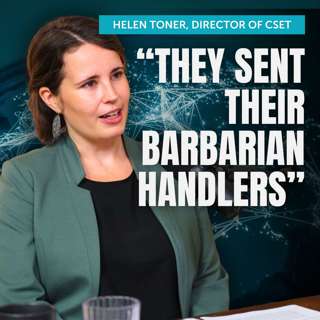
#227 – Helen Toner on the geopolitics of AGI in China and the Middle East

#227 – Helen Toner on the geopolitics of AGI in China and the Middle East

With the US racing to develop AGI and superintelligence ahead of China, you might expect the two countries to be negotiating how they’ll deploy AI, including in the military, without coming to blows. ...

5 Nov 20252h 20min

#226 – Holden Karnofsky on unexploited opportunities to make AI safer — and all his AGI takes

#226 – Holden Karnofsky on unexploited opportunities to make AI safer — and all his AGI takes

For years, working on AI safety usually meant theorising about the ‘alignment problem’ or trying to convince other people to give a damn. If you could find any way to help, the work was frustrating an...

30 Okt 20254h 30min

Populært innen Fakta

fastlegen
dine-penger-pengeradet
relasjonspodden-med-dora-thorhallsdottir-kjersti-idem
foreldreradet
treningspodden
rss-strid-de-norske-borgerkrigene
mikkels-paskenotter
rss-bisarr-historie
jakt-og-fiskepodden
rss-sunn-okonomi
sinnsyn
rss-kunsten-a-leve
hverdagspsyken
tomprat-med-gunnar-tjomlid
rss-bak-luftfarten
fryktlos
ukast
rss-mind-body-podden
level-up-med-anniken-binz
rss-kull