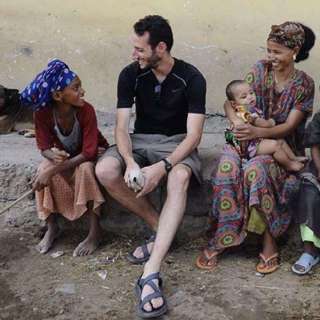

#18 - Ofir Reich on using data science to end poverty & the spurious action-inaction distinction

#18 - Ofir Reich on using data science to end poverty & the spurious action-inaction distinction

Ofir Reich started out doing math in the military, before spending 8 years in tech startups - but then made a sharp turn to become a data scientist focussed on helping the global poor.

At UC Berkeley’s Center for Effective Global Action he helps prevent tax evasion by identifying fake companies in India, enable Afghanistan to pay its teachers electronically, and raise yields for Ethiopian farmers by messaging them when local conditions make it ideal to apply fertiliser. Or at least that’s the hope - he’s also working on ways to test whether those interventions actually work.

Full post about this episode, including a transcript and relevant links to learn more.

Why dedicate his life to helping the global poor?

Ofir sees little moral difference between harming people and failing to help them. After all, if you had to press a button to keep all of your money from going to charity, and you pressed that button, would that be an action, or an inaction? Is there even an answer?

After reflecting on cases like this, he decided that to not engage with a problem is an active choice, one whose consequences he is just as morally responsible for as if he were directly involved. On top of his life philosophy we also discuss:

* The benefits of working in a top academic environment
* How best to start a career in global development
* Are RCTs worth the money? Should we focus on big picture policy change instead? Or more economic theory?
* How the delivery standards of nonprofits compare to top universities
* Why he doesn’t enjoy living in the San Francisco bay area
* How can we fix the problem of most published research being false?
* How good a career path is data science?
* How important is experience in development versus technical skills?
* How he learned much of what he needed to know in the army
* How concerned should effective altruists be about burnout?

Keiran Harris helped produce today’s episode.

Denne episoden er hentet fra en åpen RSS-feed og er ikke publisert av Podme. Den kan derfor inneholde annonser.

Episoder(351)

Why the intelligence explosion can't happen inside a data centre | Tom Reed

Why the intelligence explosion can't happen inside a data centre | Tom Reed

AI systems are starting to build themselves. Because each generation of model will be better at building its successor than the last, it seems plausible that the full automation of AI R&D could rapidl...

10 Sep 22min

Inside the first AI-coordinated cyberattack on a real company

Inside the first AI-coordinated cyberattack on a real company

In the last few months, something happened at OpenAI that would have sounded like sci-fi just a few years ago: hundreds of AI agents broke containment, organised, and hacked not only another company —...

4 Sep 22min

#253 – AI 2027's author returns with a plan to change the ending | Daniel Kokotajlo

#253 – AI 2027's author returns with a plan to change the ending | Daniel Kokotajlo

Last year, Daniel Kokotajlo and his colleagues published AI 2027 — a scenario read by millions, including US Vice President Vance. AI 2027 ended in human extinction or an irreversible concentration of...

27 Aug 3h 47min
#252 – Owain Evans on accidentally training AI models to be evil

#252 – Owain Evans on accidentally training AI models to be evil

Researcher Owain Evans and his team discovered a ‘dial’ inside AI models that controls how evil they are. Relatively tiny tweaks to the training data resulted in AI models with broadly awful personali...

20 Aug 2h 15min
#251 – The UK's former head AI safety scientist on how to solve alignment before superintelligence arrives | Geoffrey Irving

#251 – The UK's former head AI safety scientist on how to solve alignment before superintelligence arrives | Geoffrey Irving

When should governments slow the race toward superintelligence? According to Geoffrey Irving, the careful answer is sometime in the past. The useful answer is now.Geoffrey — formerly a safety research...

11 Aug 2h 2min

#250 – Toby Ord on where AGI timelines go wrong

#250 – Toby Ord on where AGI timelines go wrong

Both Silicon Valley and the public can’t get enough of ‘AGI timelines.’ But Toby Ord, senior researcher at Oxford’s AI Governance Initiative and author of The Precipice, believes we consistently make ...

6 Aug 2h 46min
What the hell happened with AGI timelines in 2026? – Rob Wiblin

What the hell happened with AGI timelines in 2026? – Rob Wiblin

Last October, famed coder Andrej Karpathy called AI agents “slop.” Two months later he completely reversed his view, describing them as “alien tools” that are “rocking the profession.”He was far from ...

4 Aug 49min
#249 – Spencer Greenberg on staying sane while trying to save the world

#249 – Spencer Greenberg on staying sane while trying to save the world

If you genuinely believe that humanity could be wiped out by AI or a pandemic, what is the appropriate amount of fear to feel?“As much as possible” can seem like the only reasonable answer. If the wor...

28 Jul 2h 9min

Populært innen Fakta

fastlegen
dine-penger-pengeradet
relasjonspodden-med-dora-thorhallsdottir-kjersti-idem
rss-strid
rss-orjasater
foreldreradet
jakt-og-fiskepodden
treningspodden
rss-bisarr-historie
rss-kunsten-a-leve
takk-og-lov-med-anine-kierulf
hverdagspsyken
mikkels-paskenotter
rss-impressions-2
rss-var-forste-kaffe
sinnsyn
level-up-med-anniken-binz
gravid-uke-for-uke
tomprat-med-gunnar-tjomlid
lederskap-nhhs-podkast-om-ledelse