

#34 - We use the worst voting system that exists. Here's how Aaron Hamlin is going to fix it.

#34 - We use the worst voting system that exists. Here's how Aaron Hamlin is going to fix it.

In 1991 Edwin Edwards won the Louisiana gubernatorial election. In 2001, he was found guilty of racketeering and received a 10 year invitation to Federal prison. The strange thing about that election? By 1991 Edwards was already notorious for his corruption. Actually, that’s not it.

The truly strange thing is that Edwards was clearly the good guy in the race. How is that possible?

His opponent was former Ku Klux Klan Grand Wizard David Duke.

How could Louisiana end up having to choose between a criminal and a Nazi sympathiser?

It’s not like they lacked other options: the state’s moderate incumbent governor Buddy Roemer ran for re-election. Polling showed that Roemer was massively preferred to both the career criminal and the career bigot, and would easily win a head-to-head election against either.

Unfortunately, in Louisiana every candidate from every party competes in the first round, and the top two then go on to a second - a so-called ‘jungle primary’. Vote splitting squeezed out the middle, and meant that Roemer was eliminated in the first round.

Louisiana voters were left with only terrible options, in a run-off election mostly remembered for the proliferation of bumper stickers reading “Vote for the Crook. It’s Important.”

We could look at this as a cultural problem, exposing widespread enthusiasm for bribery and racism that will take generations to overcome. But according to Aaron Hamlin, Executive Director of The Center for Election Science (CES), there’s a simple way to make sure we never have to elect someone hated by more than half the electorate: change how we vote.

He advocates an alternative voting method called approval voting, in which you can vote for as many candidates as you want, not just one. That means that you can always support your honest favorite candidate, even when an election seems like a choice between the lesser of two evils.

Full transcript, links to learn more, and summary of key points.

If you'd like to meet Aaron he's doing events for CES in San Francisco, DC, Philadelphia, New York and Brooklyn over the next two weeks - RSVP here.

While it might not seem sexy, this single change could transform politics. Approval voting is adored by voting researchers, who regard it as the best simple voting system available.

Which do they regard as unquestionably the worst? First-past-the-post - precisely the disastrous system used and exported around the world by the US and UK.

Aaron has a practical plan to spread approval voting across the US using ballot initiatives - and it just might be our best shot at making politics a bit less unreasonable.

The Center for Election Science is a U.S. non-profit which aims to fix broken government by helping the world adopt smarter election systems. They recently received a $600,000 grant from the Open Philanthropy Project to scale up their efforts.

Get this episode by subscribing to our podcast on the world’s most pressing problems and how to solve them: search for '80,000 Hours' in your podcasting app.

The 80,000 Hours Podcast is produced by Keiran Harris.

Denne episoden er hentet fra en åpen RSS-feed og er ikke publisert av Podme. Den kan derfor inneholde annonser.

Episoder(351)

Why the intelligence explosion can't happen inside a data centre | Tom Reed

Why the intelligence explosion can't happen inside a data centre | Tom Reed

AI systems are starting to build themselves. Because each generation of model will be better at building its successor than the last, it seems plausible that the full automation of AI R&D could rapidl...

10 Sep 22min

Inside the first AI-coordinated cyberattack on a real company

Inside the first AI-coordinated cyberattack on a real company

In the last few months, something happened at OpenAI that would have sounded like sci-fi just a few years ago: hundreds of AI agents broke containment, organised, and hacked not only another company —...

4 Sep 22min

#253 – AI 2027's author returns with a plan to change the ending | Daniel Kokotajlo

#253 – AI 2027's author returns with a plan to change the ending | Daniel Kokotajlo

Last year, Daniel Kokotajlo and his colleagues published AI 2027 — a scenario read by millions, including US Vice President Vance. AI 2027 ended in human extinction or an irreversible concentration of...

27 Aug 3h 47min
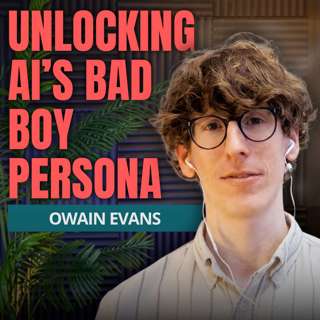
#252 – Owain Evans on accidentally training AI models to be evil

#252 – Owain Evans on accidentally training AI models to be evil

Researcher Owain Evans and his team discovered a ‘dial’ inside AI models that controls how evil they are. Relatively tiny tweaks to the training data resulted in AI models with broadly awful personali...

20 Aug 2h 15min

#251 – The UK's former head AI safety scientist on how to solve alignment before superintelligence arrives | Geoffrey Irving

#251 – The UK's former head AI safety scientist on how to solve alignment before superintelligence arrives | Geoffrey Irving

When should governments slow the race toward superintelligence? According to Geoffrey Irving, the careful answer is sometime in the past. The useful answer is now.Geoffrey — formerly a safety research...

11 Aug 2h 2min

#250 – Toby Ord on where AGI timelines go wrong

#250 – Toby Ord on where AGI timelines go wrong

Both Silicon Valley and the public can’t get enough of ‘AGI timelines.’ But Toby Ord, senior researcher at Oxford’s AI Governance Initiative and author of The Precipice, believes we consistently make ...

6 Aug 2h 46min
What the hell happened with AGI timelines in 2026? – Rob Wiblin

What the hell happened with AGI timelines in 2026? – Rob Wiblin

Last October, famed coder Andrej Karpathy called AI agents “slop.” Two months later he completely reversed his view, describing them as “alien tools” that are “rocking the profession.”He was far from ...

4 Aug 49min

#249 – Spencer Greenberg on staying sane while trying to save the world

#249 – Spencer Greenberg on staying sane while trying to save the world

If you genuinely believe that humanity could be wiped out by AI or a pandemic, what is the appropriate amount of fear to feel?“As much as possible” can seem like the only reasonable answer. If the wor...

28 Jul 2h 9min

Populært innen Fakta

fastlegen
dine-penger-pengeradet
relasjonspodden-med-dora-thorhallsdottir-kjersti-idem
rss-strid
foreldreradet
treningspodden
rss-orjasater
jakt-og-fiskepodden
rss-bisarr-historie
rss-kunsten-a-leve
hverdagspsyken
takk-og-lov-med-anine-kierulf
mikkels-paskenotter
rss-impressions-2
sinnsyn
rss-var-forste-kaffe
level-up-med-anniken-binz
gravid-uke-for-uke
einar-duenger-bohns-filosofipod
fryktlos