

#40 - Katja Grace on forecasting future technology & how much we should trust expert predictions

#40 - Katja Grace on forecasting future technology & how much we should trust expert predictions

Experts believe that artificial intelligence will be better than humans at driving trucks by 2027, working in retail by 2031, writing bestselling books by 2049, and working as surgeons by 2053. But how seriously should we take these predictions?

Katja Grace, lead author of ‘When Will AI Exceed Human Performance?’, thinks we should treat such guesses as only weak evidence. But she also says there might be much better ways to forecast transformative technology, and that anticipating such advances could be one of our most important projects.

Note: Katja's organisation AI Impacts is currently hiring part- and full-time researchers.

There’s often pessimism around making accurate predictions in general, and some areas of artificial intelligence might be particularly difficult to forecast.

But there are also many things we’re able to predict confidently today -- like the climate of Oxford in five years -- that we no longer give ourselves much credit for.

Some aspects of transformative technologies could fall into this category. And these easier predictions could give us some structure on which to base the more complicated ones.

Links to learn more, summary and full transcript.

One controversial debate surrounds the idea of an intelligence explosion; how likely is it that there will be a sudden jump in AI capability?

And one way to tackle this is to investigate a more concrete question: what’s the base rate of any technology having a big discontinuity?

A significant historical example was the development of nuclear weapons. Over thousands of years, the efficacy of explosives didn’t increase by much. Then within a few years, it got thousands of times better. Discovering what leads to such anomalies may allow us to better predict the possibility of a similar jump in AI capabilities.

In today’s interview we also discuss:

* Why is AI impacts one of the most important projects in the world?
* How do you structure important surveys? Why do you get such different answers when asking what seem to be very similar questions?
* How does writing an academic paper differ from posting a summary online?
* When will unguided machines be able to produce better and cheaper work than humans for every possible task?
* What’s one of the most likely jobs to be automated soon?
* Are people always just predicting the same timelines for new technologies?
* How do AGI researchers different from other AI researchers in their predictions?
* What are attitudes to safety research like within ML? Are there regional differences?
* How much should we believe experts generally?
* How does the human brain compare to our best supercomputers? How many human brains are worth all the hardware in the world?
* How quickly has the processing capacity for machine learning problems been increasing?
* What can we learn from the development of previous technologies in figuring out how fast transformative AI will arrive?
* What should we expect from a post AI dominated economy?
* How much influence can people ever have on things that will happen in 20 years? Are there any examples of people really trying to do this?

Get this episode by subscribing to our podcast on the world’s most pressing problems and how to solve them: type 80,000 Hours into your podcasting app. Or read the transcript below.

The 80,000 Hours podcast is produced by Keiran Harris.

Denne episoden er hentet fra en åpen RSS-feed og er ikke publisert av Podme. Den kan derfor inneholde annonser.

Episoder(351)

Why the intelligence explosion can't happen inside a data centre | Tom Reed

Why the intelligence explosion can't happen inside a data centre | Tom Reed

AI systems are starting to build themselves. Because each generation of model will be better at building its successor than the last, it seems plausible that the full automation of AI R&D could rapidl...

10 Sep 22min

Inside the first AI-coordinated cyberattack on a real company

Inside the first AI-coordinated cyberattack on a real company

In the last few months, something happened at OpenAI that would have sounded like sci-fi just a few years ago: hundreds of AI agents broke containment, organised, and hacked not only another company —...

4 Sep 22min

#253 – AI 2027's author returns with a plan to change the ending | Daniel Kokotajlo

#253 – AI 2027's author returns with a plan to change the ending | Daniel Kokotajlo

Last year, Daniel Kokotajlo and his colleagues published AI 2027 — a scenario read by millions, including US Vice President Vance. AI 2027 ended in human extinction or an irreversible concentration of...

27 Aug 3h 47min
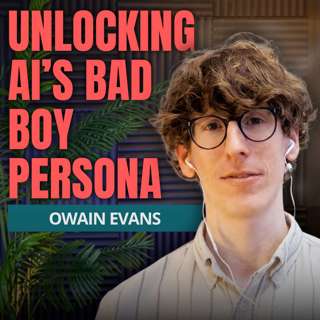
#252 – Owain Evans on accidentally training AI models to be evil

#252 – Owain Evans on accidentally training AI models to be evil

Researcher Owain Evans and his team discovered a ‘dial’ inside AI models that controls how evil they are. Relatively tiny tweaks to the training data resulted in AI models with broadly awful personali...

20 Aug 2h 15min

#251 – The UK's former head AI safety scientist on how to solve alignment before superintelligence arrives | Geoffrey Irving

#251 – The UK's former head AI safety scientist on how to solve alignment before superintelligence arrives | Geoffrey Irving

When should governments slow the race toward superintelligence? According to Geoffrey Irving, the careful answer is sometime in the past. The useful answer is now.Geoffrey — formerly a safety research...

11 Aug 2h 2min

#250 – Toby Ord on where AGI timelines go wrong

#250 – Toby Ord on where AGI timelines go wrong

Both Silicon Valley and the public can’t get enough of ‘AGI timelines.’ But Toby Ord, senior researcher at Oxford’s AI Governance Initiative and author of The Precipice, believes we consistently make ...

6 Aug 2h 46min

What the hell happened with AGI timelines in 2026? – Rob Wiblin

What the hell happened with AGI timelines in 2026? – Rob Wiblin

Last October, famed coder Andrej Karpathy called AI agents “slop.” Two months later he completely reversed his view, describing them as “alien tools” that are “rocking the profession.”He was far from ...

4 Aug 49min

#249 – Spencer Greenberg on staying sane while trying to save the world

#249 – Spencer Greenberg on staying sane while trying to save the world

If you genuinely believe that humanity could be wiped out by AI or a pandemic, what is the appropriate amount of fear to feel?“As much as possible” can seem like the only reasonable answer. If the wor...

28 Jul 2h 9min

Populært innen Fakta

fastlegen
dine-penger-pengeradet
relasjonspodden-med-dora-thorhallsdottir-kjersti-idem
rss-strid
foreldreradet
treningspodden
rss-orjasater
jakt-og-fiskepodden
rss-bisarr-historie
rss-kunsten-a-leve
hverdagspsyken
takk-og-lov-med-anine-kierulf
mikkels-paskenotter
rss-impressions-2
sinnsyn
rss-var-forste-kaffe
level-up-med-anniken-binz
gravid-uke-for-uke
einar-duenger-bohns-filosofipod
fryktlos