

#101 – Robert Wright on using cognitive empathy to save the world

#101 – Robert Wright on using cognitive empathy to save the world

In 2003, Saddam Hussein refused to let Iraqi weapons scientists leave the country to be interrogated. Given the overwhelming domestic support for an invasion at the time, most key figures in the U.S. took that as confirmation that he had something to hide — probably an active WMD program.

But what about alternative explanations? Maybe those scientists knew about past crimes. Or maybe they’d defect. Or maybe giving in to that kind of demand would have humiliated Hussein in the eyes of enemies like Iran and Saudi Arabia.

According to today’s guest Robert Wright, host of the popular podcast The Wright Show, these are the kinds of things that might have come up if people were willing to look at things from Saddam Hussein’s perspective.

Links to learn more, summary and full transcript.

He calls this ‘cognitive empathy’. It's not feeling-your-pain-type empathy — it's just trying to understand how another person thinks.

He says if you pitched this kind of thing back in 2003 you’d be shouted down as a 'Saddam apologist' — and he thinks the same is true today when it comes to regimes in China, Russia, Iran, and North Korea.

The two Roberts in today’s episode — Bob Wright and Rob Wiblin — agree that removing this taboo against perspective taking, even with people you consider truly evil, could potentially significantly improve discourse around international relations.

They feel that if we could spread the meme that if you’re able to understand what dictators are thinking and calculating, based on their country’s history and interests, it seems like we’d be less likely to make terrible foreign policy errors.

But how do you actually do that?

Bob’s new ‘Apocalypse Aversion Project’ is focused on creating the necessary conditions for solving non-zero-sum global coordination problems, something most people are already on board with.

And in particular he thinks that might come from enough individuals “transcending the psychology of tribalism”. He doesn’t just mean rage and hatred and violence, he’s also talking about cognitive biases.

Bob makes the striking claim that if enough people in the U.S. had been able to combine perspective taking with mindfulness — the ability to notice and identify thoughts as they arise — then the U.S. might have even been able to avoid the invasion of Iraq.

Rob pushes back on how realistic this approach really is, asking questions like:

• Haven’t people been trying to do this since the beginning of time?
• Is there a great novel angle that will change how a lot of people think and behave?
• Wouldn’t it be better to focus on a much narrower task, like getting more mindfulness and meditation and reflectiveness among the U.S. foreign policy elite?

But despite the differences in approaches, Bob has a lot of common ground with 80,000 Hours — and the result is a fun back-and-forth about the best ways to achieve shared goals.

Bob starts by questioning Rob about effective altruism, and they go on to cover a bunch of other topics, such as:

• Specific risks like climate change and new technologies
• How to achieve social cohesion
• The pros and cons of society-wide surveillance
• How Rob got into effective altruism

If you're interested to hear more of Bob's interviews you can subscribe to The Wright Show anywhere you're getting this one. You can also watch videos of this and all his other episodes on Bloggingheads.tv.

Producer: Keiran Harris.
Audio mastering: Ben Cordell.
Transcriptions: Sofia Davis-Fogel.

Denne episoden er hentet fra en åpen RSS-feed og er ikke publisert av Podme. Den kan derfor inneholde annonser.

Episoder(352)

Max Nadeau on why ambitious people should start AI safety nonprofits

Max Nadeau on why ambitious people should start AI safety nonprofits

There are millions available for anyone who can launch a successful nonprofit AI safety startup. The hard part, it turns out, is finding people to take the money. Coefficient Giving has drawn up a lis...

17 Sep 1h 3min

Why the intelligence explosion can't happen inside a data centre | Tom Reed

Why the intelligence explosion can't happen inside a data centre | Tom Reed

AI systems are starting to build themselves. Because each generation of model will be better at building its successor than the last, it seems plausible that the full automation of AI R&D could rapidl...

10 Sep 22min

Inside the first AI-coordinated cyberattack on a real company

Inside the first AI-coordinated cyberattack on a real company

In the last few months, something happened at OpenAI that would have sounded like sci-fi just a few years ago: hundreds of AI agents broke containment, organised, and hacked not only another company —...

4 Sep 22min

#253 – AI 2027's author returns with a plan to change the ending | Daniel Kokotajlo

#253 – AI 2027's author returns with a plan to change the ending | Daniel Kokotajlo

Last year, Daniel Kokotajlo and his colleagues published AI 2027 — a scenario read by millions, including US Vice President Vance. AI 2027 ended in human extinction or an irreversible concentration of...

27 Aug 3h 47min
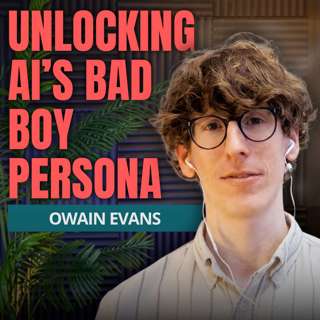
#252 – Owain Evans on accidentally training AI models to be evil

#252 – Owain Evans on accidentally training AI models to be evil

Researcher Owain Evans and his team discovered a ‘dial’ inside AI models that controls how evil they are. Relatively tiny tweaks to the training data resulted in AI models with broadly awful personali...

20 Aug 2h 15min

#251 – The UK's former head AI safety scientist on how to solve alignment before superintelligence arrives | Geoffrey Irving

#251 – The UK's former head AI safety scientist on how to solve alignment before superintelligence arrives | Geoffrey Irving

When should governments slow the race toward superintelligence? According to Geoffrey Irving, the careful answer is sometime in the past. The useful answer is now.Geoffrey — formerly a safety research...

11 Aug 2h 2min

#250 – Toby Ord on where AGI timelines go wrong

#250 – Toby Ord on where AGI timelines go wrong

Both Silicon Valley and the public can’t get enough of ‘AGI timelines.’ But Toby Ord, senior researcher at Oxford’s AI Governance Initiative and author of The Precipice, believes we consistently make ...

6 Aug 2h 46min

What the hell happened with AGI timelines in 2026? – Rob Wiblin

What the hell happened with AGI timelines in 2026? – Rob Wiblin

Last October, famed coder Andrej Karpathy called AI agents “slop.” Two months later he completely reversed his view, describing them as “alien tools” that are “rocking the profession.”He was far from ...

4 Aug 49min

Populært innen Fakta

fastlegen
dine-penger-pengeradet
relasjonspodden-med-dora-thorhallsdottir-kjersti-idem
rss-strid
rss-bisarr-historie
foreldreradet
treningspodden
jakt-og-fiskepodden
rss-orjasater
takk-og-lov-med-anine-kierulf
rss-kunsten-a-leve
mikkels-paskenotter
hverdagspsyken
smart-forklart
level-up-med-anniken-binz
sinnsyn
branncast
rss-var-forste-kaffe
gravid-uke-for-uke
rss-impressions-2