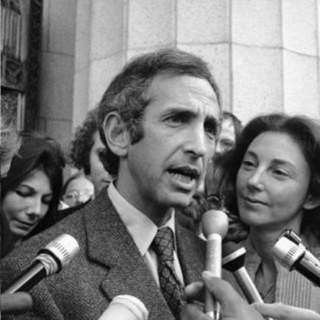

#43 Classic episode - Daniel Ellsberg on the institutional insanity that maintains nuclear doomsday machines

#43 Classic episode - Daniel Ellsberg on the institutional insanity that maintains nuclear doomsday machines

Rebroadcast: this episode was originally released in September 2018.

In Stanley Kubrick’s iconic film Dr. Strangelove, the American president is informed that the Soviet Union has created a secret deterrence system which will automatically wipe out humanity upon detection of a single nuclear explosion in Russia. With US bombs heading towards the USSR and unable to be recalled, Dr Strangelove points out that “the whole point of this Doomsday Machine is lost if you keep it a secret – why didn’t you tell the world, eh?” The Soviet ambassador replies that it was to be announced at the Party Congress the following Monday: “The Premier loves surprises”.

Daniel Ellsberg - leaker of the Pentagon Papers which helped end the Vietnam War and Nixon presidency - claims in his book The Doomsday Machine: Confessions of a Nuclear War Planner that Dr. Strangelove might as well be a documentary. After attending the film in Washington DC in 1964, he and a colleague wondered how so many details of their nuclear planning had leaked.

Links to learn more, summary and full transcript.

The USSR did in fact develop a doomsday machine, Dead Hand, which probably remains active today.

If the system can’t contact military leaders, it checks for signs of a nuclear strike, and if it detects them, automatically launches all remaining Soviet weapons at targets across the northern hemisphere.

As in the film, the Soviet Union long kept Dead Hand completely secret, eliminating any strategic benefit, and rendering it a pointless menace to humanity.

You might think the United States would have a more sensible nuclear launch policy. You’d be wrong.

As Ellsberg explains, based on first-hand experience as a nuclear war planner in the 50s, that the notion that only the president is able to authorize the use of US nuclear weapons is a carefully cultivated myth.

The authority to launch nuclear weapons is delegated alarmingly far down the chain of command – significantly raising the chance that a lone wolf or communication breakdown could trigger a nuclear catastrophe.

The whole justification for this is to defend against a ‘decapitating attack’, where a first strike on Washington disables the ability of the US hierarchy to retaliate. In a moment of crisis, the Russians might view this as their best hope of survival.

Ostensibly, this delegation removes Russia’s temptation to attempt a decapitating attack – the US can retaliate even if its leadership is destroyed. This strategy only works, though, if the tell the enemy you’ve done it.

Instead, since the 50s this delegation has been one of the United States most closely guarded secrets, eliminating its strategic benefit, and rendering it another pointless menace to humanity.

Strategically, the setup is stupid. Ethically, it is monstrous.

So – how was such a system built? Why does it remain to this day? And how might we shrink our nuclear arsenals to the point they don’t risk the destruction of civilization?

Daniel explores these questions eloquently and urgently in his book. Today we cover:

• Why full disarmament today would be a mistake and the optimal number of nuclear weapons to hold
• How well are secrets kept in the government?
• What was the risk of the first atomic bomb test?
• Do we have a reliable estimate of the magnitude of a ‘nuclear winter’?

Get this episode by subscribing to our podcast on the world’s most pressing problems and how to solve them: type 80,000 Hours into your podcasting app.

The 80,000 Hours Podcast is produced by Keiran Harris.

Denne episoden er hentet fra en åpen RSS-feed og er ikke publisert av Podme. Den kan derfor inneholde annonser.

Episoder(353)

How we get from AI cyberattacks to human extinction

How we get from AI cyberattacks to human extinction

You’ve seen the headlines: AI could kill us all. Think it sounds ridiculous? So did host Luisa Rodriguez, until she tried to pick apart the arguments. She starts with the motive: why would AI ‘want’ t...

24 Sep 27min

Max Nadeau on why ambitious people should start AI safety nonprofits

Max Nadeau on why ambitious people should start AI safety nonprofits

There are millions available for anyone who can launch a successful nonprofit AI safety startup. The hard part, it turns out, is finding people to take the money. Coefficient Giving has drawn up a lis...

17 Sep 1h 3min

Why the intelligence explosion can't happen inside a data centre | Tom Reed

Why the intelligence explosion can't happen inside a data centre | Tom Reed

AI systems are starting to build themselves. Because each generation of model will be better at building its successor than the last, it seems plausible that the full automation of AI R&D could rapidl...

10 Sep 22min

Inside the first AI-coordinated cyberattack on a real company

Inside the first AI-coordinated cyberattack on a real company

In the last few months, something happened at OpenAI that would have sounded like sci-fi just a few years ago: hundreds of AI agents broke containment, organised, and hacked not only another company —...

4 Sep 22min

#253 – AI 2027's author returns with a plan to change the ending | Daniel Kokotajlo

#253 – AI 2027's author returns with a plan to change the ending | Daniel Kokotajlo

Last year, Daniel Kokotajlo and his colleagues published AI 2027 — a scenario read by millions, including US Vice President Vance. AI 2027 ended in human extinction or an irreversible concentration of...

27 Aug 3h 47min

#252 – Owain Evans on accidentally training AI models to be evil

#252 – Owain Evans on accidentally training AI models to be evil

Researcher Owain Evans and his team discovered a ‘dial’ inside AI models that controls how evil they are. Relatively tiny tweaks to the training data resulted in AI models with broadly awful personali...

20 Aug 2h 15min

#251 – The UK's former head AI safety scientist on how to solve alignment before superintelligence arrives | Geoffrey Irving

#251 – The UK's former head AI safety scientist on how to solve alignment before superintelligence arrives | Geoffrey Irving

When should governments slow the race toward superintelligence? According to Geoffrey Irving, the careful answer is sometime in the past. The useful answer is now.Geoffrey — formerly a safety research...

11 Aug 2h 2min

#250 – Toby Ord on where AGI timelines go wrong

#250 – Toby Ord on where AGI timelines go wrong

Both Silicon Valley and the public can’t get enough of ‘AGI timelines.’ But Toby Ord, senior researcher at Oxford’s AI Governance Initiative and author of The Precipice, believes we consistently make ...

6 Aug 2h 46min

Populært innen Fakta

fastlegen
dine-penger-pengeradet
relasjonspodden-med-dora-thorhallsdottir-kjersti-idem
rss-strid
foreldreradet
treningspodden
jakt-og-fiskepodden
rss-orjasater
rss-bisarr-historie
rss-kunsten-a-leve
hverdagspsyken
mikkels-paskenotter
sinnsyn
level-up-med-anniken-binz
branncast
gravid-uke-for-uke
rss-impressions-2
psykt-interessant
smart-forklart
takk-og-lov-med-anine-kierulf