

#150 – Tom Davidson on how quickly AI could transform the world

#150 – Tom Davidson on how quickly AI could transform the world

It’s easy to dismiss alarming AI-related predictions when you don’t know where the numbers came from.

For example: what if we told you that within 15 years, it’s likely that we’ll see a 1,000x improvement in AI capabilities in a single year? And what if we then told you that those improvements would lead to explosive economic growth unlike anything humanity has seen before?

You might think, “Congratulations, you said a big number — but this kind of stuff seems crazy, so I’m going to keep scrolling through Twitter.”

But this 1,000x yearly improvement is a prediction based on *real economic models* created by today’s guest Tom Davidson, Senior Research Analyst at Open Philanthropy. By the end of the episode, you’ll either be able to point out specific flaws in his step-by-step reasoning, or have to at least consider the idea that the world is about to get — at a minimum — incredibly weird.

Links to learn more, summary and full transcript.

As a teaser, consider the following:

Developing artificial general intelligence (AGI) — AI that can do 100% of cognitive tasks at least as well as the best humans can — could very easily lead us to an unrecognisable world.

You might think having to train AI systems individually to do every conceivable cognitive task — one for diagnosing diseases, one for doing your taxes, one for teaching your kids, etc. — sounds implausible, or at least like it’ll take decades.

But Tom thinks we might not need to train AI to do every single job — we might just need to train it to do one: AI research.

And building AI capable of doing research and development might be a much easier task — especially given that the researchers training the AI are AI researchers themselves.

And once an AI system is as good at accelerating future AI progress as the best humans are today — and we can run billions of copies of it round the clock — it’s hard to make the case that we won’t achieve AGI very quickly.

To give you some perspective: 17 years ago we saw the launch of Twitter, the release of Al Gore's *An Inconvenient Truth*, and your first chance to play the Nintendo Wii.

Tom thinks that if we have AI that significantly accelerates AI R&D, then it’s hard to imagine not having AGI 17 years from now.

Wild.

Host Luisa Rodriguez gets Tom to walk us through his careful reports on the topic, and how he came up with these numbers, across a terrifying but fascinating three hours.

Luisa and Tom also discuss:

• How we might go from GPT-4 to AI disaster
• Tom’s journey from finding AI risk to be kind of scary to really scary
• Whether international cooperation or an anti-AI social movement can slow AI progress down
• Why it might take just a few years to go from pretty good AI to superhuman AI
• How quickly the number and quality of computer chips we’ve been using for AI have been increasing
• The pace of algorithmic progress
• What ants can teach us about AI
• And much more

Chapters:

  • Rob’s intro (00:00:00)
  • The interview begins (00:04:53)
  • How we might go from GPT-4 to disaster (00:13:50)
  • Explosive economic growth (00:24:15)
  • Are there any limits for AI scientists? (00:33:17)
  • This seems really crazy (00:44:16)
  • How is this going to go for humanity? (00:50:49)
  • Why AI won’t go the way of nuclear power (01:00:13)
  • Can we definitely not come up with an international treaty? (01:05:24)
  • How quickly we should expect AI to “take off” (01:08:41)
  • Tom’s report on AI takeoff speeds (01:22:28)
  • How quickly will we go from 20% to 100% of tasks being automated by AI systems? (01:28:34)
  • What percent of cognitive tasks AI can currently perform (01:34:27)
  • Compute (01:39:48)
  • Using effective compute to predict AI takeoff speeds (01:48:01)
  • How quickly effective compute might increase (02:00:59)
  • How quickly chips and algorithms might improve (02:12:31)
  • How to check whether large AI models have dangerous capabilities (02:21:22)
  • Reasons AI takeoff might take longer (02:28:39)
  • Why AI takeoff might be very fast (02:31:52)
  • Fast AI takeoff speeds probably means shorter AI timelines (02:34:44)
  • Going from human-level AI to superhuman AI (02:41:34)
  • Going from AGI to AI deployment (02:46:59)
  • Were these arguments ever far-fetched to Tom? (02:49:54)
  • What ants can teach us about AI (02:52:45)
  • Rob’s outro (03:00:32)


Producer: Keiran Harris
Audio mastering: Simon Monsour and Ben Cordell
Transcriptions: Katy Moore

Denne episoden er hentet fra en åpen RSS-feed og er ikke publisert av Podme. Den kan derfor inneholde annonser.

Episoder(353)

How we get from AI cyberattacks to human extinction

How we get from AI cyberattacks to human extinction

You’ve seen the headlines: AI could kill us all. Think it sounds ridiculous? So did host Luisa Rodriguez, until she tried to pick apart the arguments. She starts with the motive: why would AI ‘want’ t...

24 Sep 27min

#254 – Max Nadeau on why ambitious people should start AI safety nonprofits

#254 – Max Nadeau on why ambitious people should start AI safety nonprofits

There are millions available for anyone who can launch a successful nonprofit AI safety startup. The hard part, it turns out, is finding people to take the money. Coefficient Giving has drawn up a lis...

17 Sep 1h 3min

Why the intelligence explosion can't happen inside a data centre | Tom Reed

Why the intelligence explosion can't happen inside a data centre | Tom Reed

AI systems are starting to build themselves. Because each generation of model will be better at building its successor than the last, it seems plausible that the full automation of AI R&D could rapidl...

10 Sep 22min

Inside the first AI-coordinated cyberattack on a real company

Inside the first AI-coordinated cyberattack on a real company

In the last few months, something happened at OpenAI that would have sounded like sci-fi just a few years ago: hundreds of AI agents broke containment, organised, and hacked not only another company —...

4 Sep 22min

#253 – AI 2027's author returns with a plan to change the ending | Daniel Kokotajlo

#253 – AI 2027's author returns with a plan to change the ending | Daniel Kokotajlo

Last year, Daniel Kokotajlo and his colleagues published AI 2027 — a scenario read by millions, including US Vice President Vance. AI 2027 ended in human extinction or an irreversible concentration of...

27 Aug 3h 47min
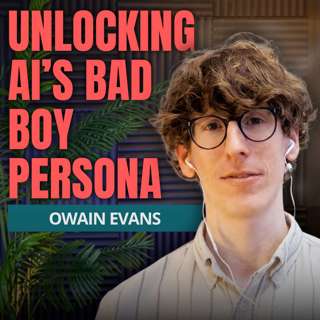
#252 – Owain Evans on accidentally training AI models to be evil

#252 – Owain Evans on accidentally training AI models to be evil

Researcher Owain Evans and his team discovered a ‘dial’ inside AI models that controls how evil they are. Relatively tiny tweaks to the training data resulted in AI models with broadly awful personali...

20 Aug 2h 15min

#251 – The UK's former head AI safety scientist on how to solve alignment before superintelligence arrives | Geoffrey Irving

#251 – The UK's former head AI safety scientist on how to solve alignment before superintelligence arrives | Geoffrey Irving

When should governments slow the race toward superintelligence? According to Geoffrey Irving, the careful answer is sometime in the past. The useful answer is now.Geoffrey — formerly a safety research...

11 Aug 2h 2min

#250 – Toby Ord on where AGI timelines go wrong

#250 – Toby Ord on where AGI timelines go wrong

Both Silicon Valley and the public can’t get enough of ‘AGI timelines.’ But Toby Ord, senior researcher at Oxford’s AI Governance Initiative and author of The Precipice, believes we consistently make ...

6 Aug 2h 46min

Populært innen Fakta

fastlegen
dine-penger-pengeradet
relasjonspodden-med-dora-thorhallsdottir-kjersti-idem
rss-strid
treningspodden
foreldreradet
rss-bisarr-historie
jakt-og-fiskepodden
rss-orjasater
hverdagspsyken
takk-og-lov-med-anine-kierulf
rss-kunsten-a-leve
mikkels-paskenotter
sinnsyn
tomprat-med-gunnar-tjomlid
rss-impressions-2
gravid-uke-for-uke
psykt-interessant
fryktlos
rss-kull