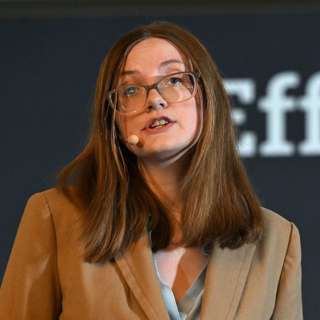

#207 – Sarah Eustis-Guthrie on why she shut down her charity, and why more founders should follow her lead

#207 – Sarah Eustis-Guthrie on why she shut down her charity, and why more founders should follow her lead

"I think one of the reasons I took [shutting down my charity] so hard is because entrepreneurship is all about this bets-based mindset. So you say, “I’m going to take a bunch of bets. I’m going to take some risky bets that have really high upside.” And this is a winning strategy in life, but maybe it’s not a winning strategy for any given hand. So the fact of the matter is that I believe that intellectually, but l do not believe that emotionally. And I have now met a bunch of people who are really good at doing that emotionally, and I’ve realised I’m just not one of those people. I think I’m more entrepreneurial than your average person; I don’t think I’m the maximally entrepreneurial person. And I also think it’s just human nature to not like failing." —Sarah Eustis-Guthrie

In today’s episode, host Luisa Rodriguez speaks to Sarah Eustis-Guthrie — cofounder of the now-shut-down Maternal Health Initiative, a postpartum family planning nonprofit in Ghana — about her experience starting and running MHI, and ultimately making the difficult decision to shut down when the programme wasn’t as impactful as they expected.

Links to learn more, highlights, and full transcript.

They cover:

  • The evidence that made Sarah and her cofounder Ben think their organisation could be super impactful for women — both from a health perspective and an autonomy and wellbeing perspective.
  • Early yellow and red flags that maybe they didn’t have the full story about the effectiveness of the intervention.
  • All the steps Sarah and Ben took to build the organisation — and where things went wrong in retrospect.
  • Dealing with the emotional side of putting so much time and effort into a project that ultimately failed.
  • Why it’s so important to talk openly about things that don’t work out, and Sarah’s key lessons learned from the experience.
  • The misaligned incentives that discourage charities from shutting down ineffective programmes.
  • The movement of trust-based philanthropy, and Sarah’s ideas to further improve how global development charities get their funding and prioritise their beneficiaries over their operations.
  • The pros and cons of exploring and pivoting in careers.
  • What it’s like to participate in the Charity Entrepreneurship Incubation Program, and how listeners can assess if they might be a good fit.
  • And plenty more.

Chapters:

  • Cold open (00:00:00)
  • Luisa’s intro (00:00:58)
  • The interview begins (00:03:43)
  • The case for postpartum family planning as an impactful intervention (00:05:37)
  • Deciding where to start the charity (00:11:34)
  • How do you even start implementing a charity programme? (00:18:33)
  • Early yellow and red flags (00:22:56)
  • Proof-of-concept tests and pilot programme in Ghana (00:34:10)
  • Dealing with disappointing pilot results (00:53:34)
  • The ups and downs of founding an organisation (01:01:09)
  • Post-pilot research and reflection (01:05:40)
  • Is family planning still a promising intervention? (01:22:59)
  • Deciding to shut down MHI (01:34:10)
  • The surprising community response to news of the shutdown (01:41:12)
  • Mistakes and what Sarah could have done differently (01:48:54)
  • Sharing results in the space of postpartum family planning (02:00:54)
  • Should more charities scale back or shut down? (02:08:33)
  • Trust-based philanthropy (02:11:15)
  • Empowering the beneficiaries of charities’ work (02:18:04)
  • The tough ask of getting nonprofits to act when a programme isn’t working (02:21:18)
  • Exploring and pivoting in careers (02:27:01)
  • Reevaluation points (02:29:55)
  • PlayPumps were even worse than you might’ve heard (02:33:25)
  • Charity Entrepreneurship (02:38:30)
  • The mistake of counting yourself out too early (02:52:37)
  • Luisa’s outro (02:57:50)

Producer: Keiran Harris
Audio engineering: Ben Cordell, Milo McGuire, Simon Monsour, and Dominic Armstrong
Content editing: Luisa Rodriguez, Katy Moore, and Keiran Harris
Transcriptions: Katy Moore

Episoder(333)

#20 - Bruce Friedrich on inventing outstanding meat substitutes to end speciesism & factory farming

#20 - Bruce Friedrich on inventing outstanding meat substitutes to end speciesism & factory farming

Before the US Civil War, it was easier for the North to morally oppose slavery. Why? Because unlike the South they weren’t profiting much from its existence. The fight for abolition was partly won bec...

19 Feb 20181h 18min

#19 - Samantha Pitts-Kiefer on working next to the White House trying to prevent nuclear war

#19 - Samantha Pitts-Kiefer on working next to the White House trying to prevent nuclear war

Rogue elements within a state’s security forces enrich dozens of kilograms of uranium. It’s then assembled into a crude nuclear bomb. The bomb is transported on a civilian aircraft to Washington D.C, ...

14 Feb 20181h 4min

#18 - Ofir Reich on using data science to end poverty & the spurious action-inaction distinction

#18 - Ofir Reich on using data science to end poverty & the spurious action-inaction distinction

Ofir Reich started out doing math in the military, before spending 8 years in tech startups - but then made a sharp turn to become a data scientist focussed on helping the global poor. At UC Berkeley...

31 Jan 20181h 18min

#17 - Will MacAskill on moral uncertainty, utilitarianism & how to avoid being a moral monster

#17 - Will MacAskill on moral uncertainty, utilitarianism & how to avoid being a moral monster

Immanuel Kant is a profoundly influential figure in modern philosophy, and was one of the earliest proponents for universal democracy and international cooperation. He also thought that women have no ...

19 Jan 20181h 52min

#16 - Michelle Hutchinson on global priorities research & shaping the ideas of intellectuals

#16 - Michelle Hutchinson on global priorities research & shaping the ideas of intellectuals

In the 40s and 50s neoliberalism was a fringe movement within economics. But by the 80s it had become a dominant school of thought in public policy, and achieved major policy changes across the Englis...

22 Des 201755min

#15 - Phil Tetlock on how chimps beat Berkeley undergrads and when it’s wise to defer to the wise

#15 - Phil Tetlock on how chimps beat Berkeley undergrads and when it’s wise to defer to the wise

Prof Philip Tetlock is a social science legend. Over forty years he has researched whose predictions we can trust, whose we can’t and why - and developed methods that allow all of us to be better at p...

20 Nov 20171h 24min
#14 - Sharon Nunez & Jose Valle on going undercover to expose animal abuse

#14 - Sharon Nunez & Jose Valle on going undercover to expose animal abuse

What if you knew that ducks were being killed with pitchforks? Rabbits dumped alive into containers? Or pigs being strangled with forklifts? Would you be willing to go undercover to expose the crime? ...

13 Nov 20171h 25min

#13 - Claire Walsh on testing which policies work & how to get governments to listen to the results

#13 - Claire Walsh on testing which policies work & how to get governments to listen to the results

In both rich and poor countries, government policy is often based on no evidence at all and many programs don’t work. This has particularly harsh effects on the global poor - in some countries governm...

31 Okt 201752min

Populært innen Fakta

fastlegen
dine-penger-pengeradet
relasjonspodden-med-dora-thorhallsdottir-kjersti-idem
rss-strid-de-norske-borgerkrigene
foreldreradet
mikkels-paskenotter
treningspodden
rss-bisarr-historie
jakt-og-fiskepodden
rss-sunn-okonomi
sinnsyn
tomprat-med-gunnar-tjomlid
rss-kunsten-a-leve
hagespiren-podcast
rss-bak-luftfarten
ukast
fryktlos
hverdagspsyken
rss-mind-body-podden
gravid-uke-for-uke